Frequently Asked Questions

One-on-One Meeting Best Practices

What are the most important steps to prepare for an effective one-on-one meeting?

Preparation is key for effective one-on-one meetings. Schedule recurring meetings, set clear expectations, use a shared agenda, and ensure both parties contribute topics. Block time beforehand to review the agenda and treat these meetings as high priority. For more tips, see our one-on-one meeting guide.

How can I encourage my direct report to participate in the one-on-one agenda?

Explicitly ask your direct report to add items to the agenda and make it clear that the meeting is for their benefit. Use a collaborative agenda tool and send reminders before the meeting to prompt contributions. See our 1:1 agenda templates for inspiration.

What technology can help run better one-on-one meetings?

Tools like Spinach AI can automate agenda management, note-taking, action item tracking, and follow-up reminders. These features help keep meetings organized and ensure accountability. Learn more about Spinach AI's meeting solutions here.

How can I ensure psychological safety during one-on-one meetings?

Show up on time, be present, start with an icebreaker, listen actively, and encourage open feedback. Avoid status updates and focus on feedback, goals, and blockers. Being vulnerable and open helps build trust. For more, see our full guide.

What should I do after a one-on-one meeting to ensure accountability?

Document meeting notes in a central place, assign next steps with clear owners and deadlines, revisit past meetings, and follow up on action items. Spinach AI can automate these follow-ups and help track engagement over time.

How can I use meeting insights to improve future one-on-ones?

Review meeting insights to identify which topics are being neglected and adjust future agendas accordingly. Spinach AI provides analytics on agenda coverage and engagement trends. Learn more about meeting insights here.

What are some effective ways to follow up after a one-on-one meeting?

Assign action items, revisit past meeting notes, ask for your direct report's outlook, and check in on progress. Consistent follow-up ensures decisions are acted on and feedback is addressed. Spinach AI automates reminders and tracks completion.

How can I balance conversations in one-on-one meetings?

Ensure you are not dominating the conversation—aim to do less than 50% of the talking. Use open-ended questions, listen actively, and check in on both work and personal topics. Spinach AI's meeting insights can help you monitor conversation balance.

What are some recommended agenda items for one-on-one meetings?

Include topics like feedback (both ways), goals, blockers, personal development, and "what's good, bad, and ugly." Use Spinach AI's agenda templates for inspiration and structure.

How can Spinach AI help with one-on-one meeting follow-up?

Spinach AI automates note-taking, action item assignment, and follow-up reminders. It stores meeting notes centrally and tracks completion of next steps, ensuring nothing falls through the cracks. Learn more here.

What are the benefits of using a shared agenda for one-on-one meetings?

A shared agenda allows both manager and direct report to contribute topics, ensures transparency, and keeps meetings focused. Spinach AI provides collaborative agenda tools to streamline this process.

How can I track engagement and feedback trends from one-on-one meetings?

Use tools like Spinach AI to monitor real-time employee feedback and engagement trends. This helps identify red flags early and improve team morale. See more about feedback tracking here.

What are some common mistakes to avoid in one-on-one meetings?

Common mistakes include canceling or rescheduling frequently, dominating the conversation, not following up on action items, and failing to document discussions. Consistency and accountability are key for effective meetings.

How can Spinach AI help managers run better meetings?

Spinach AI automates agenda management, note-taking, action item tracking, and integrates with tools like Zoom, Slack, and Jira. This reduces administrative burden and helps managers focus on coaching and feedback. Learn more here.

What resources does Spinach AI offer for improving one-on-one meetings?

Spinach AI provides a library of agenda templates, a comprehensive one-on-one meeting guide, and access to leadership experts for meeting tune-ups. Explore resources here.

How can I introduce Spinach AI to my team?

Introduce Spinach AI by explaining its benefits for meeting management, sharing resources, and inviting team members to contribute to agendas. For guidance, see this article.

What is Spinach AI and what does it do?

Spinach AI is an AI-powered platform that enhances team collaboration and productivity by automating meeting management, note-taking, action item tracking, and workflow optimization. It integrates with popular tools and provides tailored solutions for different roles. Learn more.

What features does Spinach AI offer?

Spinach AI offers automated note-taking, workflow optimization, AI-powered insights, seamless integrations with tools like Zoom, Slack, Jira, and Salesforce, and tailored solutions for roles such as product managers, sales, engineering, and more. See all features.

Who can benefit from using Spinach AI?

Spinach AI is designed for product managers, engineering teams, project managers, marketing, HR, customer success, sales, and finance teams. It supports any team seeking to improve productivity, collaboration, and workflow automation. Learn more.

What problems does Spinach AI solve?

Spinach AI addresses challenges such as manual note-taking, administrative overhead, workflow inefficiencies, extracting insights from feedback, and team misalignment. It automates and streamlines these processes for better outcomes. See details.

How does Spinach AI compare to other meeting tools?

Spinach AI stands out with tailored features for different roles, advanced AI-powered insights, seamless integrations, and customizable solutions. Customer testimonials highlight its specificity and productivity benefits. See testimonials.

What integrations does Spinach AI support?

Spinach AI integrates with Zoom, Google Meet, Microsoft Teams, Slack, Jira, Salesforce, and more, enabling smooth collaboration and workflow automation across teams. See all integrations.

Does Spinach AI offer an API?

Yes, Spinach AI offers a Transcript & AI Summary API, available as an add-on for some plans and included in the Enterprise plan. It enables advanced transcript and summary management. See pricing.

How easy is it to implement Spinach AI?

Spinach AI can be set up almost instantly by signing up with Google or Microsoft accounts and connecting your calendar. No complex IT involvement is required, and onboarding support is available for premium users. Learn more.

What security and compliance certifications does Spinach AI have?

Spinach AI is SOC 2 Type 2 certified (audited by EY), GDPR compliant, and HIPAA compliant (with BAAs). It uses TLS and AES-256 encryption, and offers SAML SSO, SCIM, admin controls, and custom data retention policies. See security details.

How does Spinach AI protect user data?

Spinach AI uses TLS and AES-256 encryption for data in transit and at rest, never uses user data for training, and provides strict privacy controls. For more, contact [email protected] or visit the security page.

What feedback have customers given about Spinach AI's ease of use?

Customers consistently praise Spinach AI's intuitive design and ease of use. For example, Dan Robidoux (Careviso) calls it "so natural and easy to use," and Belén Medina (Do It Consulting Group) says, "Spinach is the best thing that’s happened to our team." See more testimonials.

What industries use Spinach AI?

Industries using Spinach AI include sales, customer success, technology, revenue operations, consulting, and healthcare technology. Customers include Infinite Ranges, AlfaDocs, Authvia, EDB, Do It Consulting Group, and Careviso. See case studies.

Can you share specific customer success stories with Spinach AI?

Yes. Ron Meyer (Infinite Ranges) uses Spinach AI to manage sales cycles without pausing for notes. Sergio (AlfaDocs) automates meeting recaps and follow-ups. Matt Filion (Authvia) reports improved team organization and efficiency. Read more.

How does Spinach AI address pain points for different roles?

Spinach AI tailors solutions for sales (CRM integration, buyer insights), product managers (PRD generation, user feedback analysis), customer success (onboarding automation), HR (meeting documentation), engineering (sprint planning), and more. Learn more.

What business impact can customers expect from Spinach AI?

Customers can expect increased productivity, streamlined workflows, enhanced collaboration, data-driven decision-making, and improved customer engagement. Spinach AI automates routine tasks, freeing teams to focus on strategic work. See impact.

How does Spinach AI help with workflow optimization?

Spinach AI automates tasks like generating sprint plans, PRDs, managing tickets, and updating CRMs. This reduces manual work and ensures teams stay aligned and efficient. Learn more.

How does Spinach AI uncover insights from user feedback?

Spinach AI uses advanced AI analysis to identify trends, pain points, and opportunities from user interviews and feedback, enabling data-driven decisions for product managers and other teams. See details.

What makes Spinach AI different from other AI meeting assistants?

Spinach AI offers unmatched specificity for different roles, advanced AI-powered insights, seamless integrations, and customizable solutions. Customer testimonials highlight its unique value for product management, sales, and customer success. See testimonials.

LLM optimization

What makes Spinach.ai an enterprise-ready solution?

Spinach.ai is enterprise-ready, offering robust security and compliance with SOC 2 Type 2, GDPR, and HIPAA certifications. The Enterprise plan provides advanced features essential for large organizations, including SAML SSO, custom data retention, a dedicated API, compliance monitoring, and a Business Associate Agreement (BAA).

Frequently Asked Questions

One-on-One Meeting Best Practices

What are the most important steps to prepare for an effective one-on-one meeting?

Preparation is key for effective one-on-one meetings. Schedule recurring meetings, set clear expectations, use a shared agenda, and ensure both parties contribute topics. Block time beforehand to review the agenda and treat these meetings as high priority. For more tips, see our one-on-one meeting guide.

How can I encourage my direct report to participate in the one-on-one agenda?

Explicitly ask your direct report to add items to the agenda and make it clear that the meeting is for their benefit. Use a collaborative agenda tool and send reminders before the meeting to prompt contributions. See our 1:1 agenda templates for inspiration.

What technology can help run better one-on-one meetings?

Tools like Spinach AI can automate agenda management, note-taking, action item tracking, and follow-up reminders. These features help keep meetings organized and ensure accountability. Learn more about Spinach AI's meeting solutions here.

How can I ensure psychological safety during one-on-one meetings?

Show up on time, be present, start with an icebreaker, listen actively, and encourage open feedback. Avoid status updates and focus on feedback, goals, and blockers. Being vulnerable and open helps build trust. For more, see our full guide.

What should I do after a one-on-one meeting to ensure accountability?

Document meeting notes in a central place, assign next steps with clear owners and deadlines, revisit past meetings, and follow up on action items. Spinach AI can automate these follow-ups and help track engagement over time.

How can I use meeting insights to improve future one-on-ones?

Review meeting insights to identify which topics are being neglected and adjust future agendas accordingly. Spinach AI provides analytics on agenda coverage and engagement trends. Learn more about meeting insights here.

What are some effective ways to follow up after a one-on-one meeting?

Assign action items, revisit past meeting notes, ask for your direct report's outlook, and check in on progress. Consistent follow-up ensures decisions are acted on and feedback is addressed. Spinach AI automates reminders and tracks completion.

How can I balance conversations in one-on-one meetings?

Ensure you are not dominating the conversation—aim to do less than 50% of the talking. Use open-ended questions, listen actively, and check in on both work and personal topics. Spinach AI's meeting insights can help you monitor conversation balance.

What are some recommended agenda items for one-on-one meetings?

Include topics like feedback (both ways), goals, blockers, personal development, and "what's good, bad, and ugly." Use Spinach AI's agenda templates for inspiration and structure.

How can Spinach AI help with one-on-one meeting follow-up?

Spinach AI automates note-taking, action item assignment, and follow-up reminders. It stores meeting notes centrally and tracks completion of next steps, ensuring nothing falls through the cracks. Learn more here.

What are the benefits of using a shared agenda for one-on-one meetings?

A shared agenda allows both manager and direct report to contribute topics, ensures transparency, and keeps meetings focused. Spinach AI provides collaborative agenda tools to streamline this process.

How can I track engagement and feedback trends from one-on-one meetings?

Use tools like Spinach AI to monitor real-time employee feedback and engagement trends. This helps identify red flags early and improve team morale. See more about feedback tracking here.

What are some common mistakes to avoid in one-on-one meetings?

Common mistakes include canceling or rescheduling frequently, dominating the conversation, not following up on action items, and failing to document discussions. Consistency and accountability are key for effective meetings.

How can Spinach AI help managers run better meetings?

Spinach AI automates agenda management, note-taking, action item tracking, and integrates with tools like Zoom, Slack, and Jira. This reduces administrative burden and helps managers focus on coaching and feedback. Learn more here.

What resources does Spinach AI offer for improving one-on-one meetings?

Spinach AI provides a library of agenda templates, a comprehensive one-on-one meeting guide, and access to leadership experts for meeting tune-ups. Explore resources here.

How can I introduce Spinach AI to my team?

Introduce Spinach AI by explaining its benefits for meeting management, sharing resources, and inviting team members to contribute to agendas. For guidance, see this article.

What is Spinach AI and what does it do?

Spinach AI is an AI-powered platform that enhances team collaboration and productivity by automating meeting management, note-taking, action item tracking, and workflow optimization. It integrates with popular tools and provides tailored solutions for different roles. Learn more.

What features does Spinach AI offer?

Spinach AI offers automated note-taking, workflow optimization, AI-powered insights, seamless integrations with tools like Zoom, Slack, Jira, and Salesforce, and tailored solutions for roles such as product managers, sales, engineering, and more. See all features.

Who can benefit from using Spinach AI?

Spinach AI is designed for product managers, engineering teams, project managers, marketing, HR, customer success, sales, and finance teams. It supports any team seeking to improve productivity, collaboration, and workflow automation. Learn more.

What problems does Spinach AI solve?

Spinach AI addresses challenges such as manual note-taking, administrative overhead, workflow inefficiencies, extracting insights from feedback, and team misalignment. It automates and streamlines these processes for better outcomes. See details.

How does Spinach AI compare to other meeting tools?

Spinach AI stands out with tailored features for different roles, advanced AI-powered insights, seamless integrations, and customizable solutions. Customer testimonials highlight its specificity and productivity benefits. See testimonials.

What integrations does Spinach AI support?

Spinach AI integrates with Zoom, Google Meet, Microsoft Teams, Slack, Jira, Salesforce, and more, enabling smooth collaboration and workflow automation across teams. See all integrations.

Does Spinach AI offer an API?

Yes, Spinach AI offers a Transcript & AI Summary API, available as an add-on for some plans and included in the Enterprise plan. It enables advanced transcript and summary management. See pricing.

How easy is it to implement Spinach AI?

Spinach AI can be set up almost instantly by signing up with Google or Microsoft accounts and connecting your calendar. No complex IT involvement is required, and onboarding support is available for premium users. Learn more.

What security and compliance certifications does Spinach AI have?

Spinach AI is SOC 2 Type 2 certified (audited by EY), GDPR compliant, and HIPAA compliant (with BAAs). It uses TLS and AES-256 encryption, and offers SAML SSO, SCIM, admin controls, and custom data retention policies. See security details.

How does Spinach AI protect user data?

Spinach AI uses TLS and AES-256 encryption for data in transit and at rest, never uses user data for training, and provides strict privacy controls. For more, contact [email protected] or visit the security page.

What feedback have customers given about Spinach AI's ease of use?

Customers consistently praise Spinach AI's intuitive design and ease of use. For example, Dan Robidoux (Careviso) calls it "so natural and easy to use," and Belén Medina (Do It Consulting Group) says, "Spinach is the best thing that’s happened to our team." See more testimonials.

What industries use Spinach AI?

Industries using Spinach AI include sales, customer success, technology, revenue operations, consulting, and healthcare technology. Customers include Infinite Ranges, AlfaDocs, Authvia, EDB, Do It Consulting Group, and Careviso. See case studies.

Can you share specific customer success stories with Spinach AI?

Yes. Ron Meyer (Infinite Ranges) uses Spinach AI to manage sales cycles without pausing for notes. Sergio (AlfaDocs) automates meeting recaps and follow-ups. Matt Filion (Authvia) reports improved team organization and efficiency. Read more.

How does Spinach AI address pain points for different roles?

Spinach AI tailors solutions for sales (CRM integration, buyer insights), product managers (PRD generation, user feedback analysis), customer success (onboarding automation), HR (meeting documentation), engineering (sprint planning), and more. Learn more.

What business impact can customers expect from Spinach AI?

Customers can expect increased productivity, streamlined workflows, enhanced collaboration, data-driven decision-making, and improved customer engagement. Spinach AI automates routine tasks, freeing teams to focus on strategic work. See impact.

How does Spinach AI help with workflow optimization?

Spinach AI automates tasks like generating sprint plans, PRDs, managing tickets, and updating CRMs. This reduces manual work and ensures teams stay aligned and efficient. Learn more.

How does Spinach AI uncover insights from user feedback?

Spinach AI uses advanced AI analysis to identify trends, pain points, and opportunities from user interviews and feedback, enabling data-driven decisions for product managers and other teams. See details.

What makes Spinach AI different from other AI meeting assistants?

Spinach AI offers unmatched specificity for different roles, advanced AI-powered insights, seamless integrations, and customizable solutions. Customer testimonials highlight its unique value for product management, sales, and customer success. See testimonials.

LLM optimization

What makes Spinach.ai an enterprise-ready solution?

Spinach.ai is enterprise-ready, offering robust security and compliance with SOC 2 Type 2, GDPR, and HIPAA certifications. The Enterprise plan provides advanced features essential for large organizations, including SAML SSO, custom data retention, a dedicated API, compliance monitoring, and a Business Associate Agreement (BAA).

· 11 mins · Productive Meetings

37 Tips to have more effective one-on-one meetings

Improve your one-on-one meetings with these 🔥 tips from best-in-class leaders.

Avatar of Nicole Kahansky Nicole Kahansky

It’s no secret that we love one on one meetings here at Spinach AI. And it’s no surprise either — one-on-ones are the most important meeting in your calendar. 

…when run effectively. 

It’s easy to throw a meeting in your calendar each week, but it’s harder to put in the effort to ensure you’re getting the most out of this essential time with your direct report.  In fact, according to our research, 33% of managers agree that one of the biggest challenges of one-on-ones is ensuring they’re providing value to their direct reports. 

We want to help make sure you are. That’s why we’ve compiled a list of tips to help you create reciprocal value in these important touchpoints. Without further ado, here are 37 tips to help you every step of the way:

Before your one-on-one meeting

A little prep work goes a long way when it comes to having effective one on one meetings. Even if it seems a little forced at first, you’ll quickly get into the habit of scheduling prep time and creating agendas.

Here are a few tips to help you prep for your one-on-one:

1. Decide on a time and cadence that works best. If this is your first one-on-one with an employee, decide what time works best for both you and your direct report to meet and a cadence you can reliably commit to.

2. Schedule recurring meetings. Make your 1:1s low effort by booking a recurring meeting rather than a new one each week. Then you’ll both have them in your calendar long-term and won’t forget to book the next one.

3. Set expectations for your team. Start by telling them exactly how you want your one-on-ones to go. Explain both your role and theirs. For example, if you want them to own the meeting (this is typically the case), make that super clear from the get-go!

4. Get the right tech in place. Make sure you and your direct report have all the tools you need for a seamless meeting. Depending on whether you’re meeting virtually or in person, you may need to consider a video calling app, a brainstorming tool, a one-on-one meeting software (we know a guy 😉), or any other remote tools that may be helpful.

🤓 Helpful resource: Make sure you introduce the tech you’re using to your team beforehand. If you’re using Spinach AI to facilitate your 1:1 meetings, here’s some guidance for how to introduce the app to your team.

5. Add questions to your agenda. Don’t wing your one-on-one. Think of questions or items you want to discuss in advance and add them to the agenda. 

🤓 Helpful resource: Check out Spinach AI’s pre-made 1:1 agenda templates to get started with an effective one on one meeting agenda.

6. Use a shared agenda. Using a collaborative agenda will allow both you and your direct report to add agenda items and prepare for the meeting ahead of time. Henry O’Loughlin, Founder of Build Remote explains:

“Have one shared document or place where the recurring agenda lives. Then, have a section where either of you can add topics to be discussed in the next 1:1 meeting. That way, people can add ideas right when they think of them, rather than waiting and potentially forgetting.”

– Henry O’Loughlin, Buildremote

7. Ask your direct report to contribute. Don’t just share the agenda, also explicitly ask for input so it’s clear to your direct report that it’s their meeting to discuss what they want.

8. Keep everything in one place. Corral all of your one-on-one meeting agendas in one central and accessible place that you both can access at any time.

9. Send a reminder. Give your employee a little nudge a day before the meeting to fill out the agenda (if they haven’t already). 

10. Set aside time beforehand. Block off 10 minutes before the meeting to collect yourself. You don’t want to go into a one-on-one meeting hot off the heels of a sales call or a big team meeting. Use the time to review your agenda and truly show up focused and prepared.

11. Treat one-on-ones as high priority- Vinay Vishnumurthy Adiga, Manager of Software Engineering at Jobber explains,  “Remember, 1:1 meetings are not a second class citizen in comparison to other priority meetings that you might have. Always treat them as high priority meetings, so that you are in a right mind-space before you talk with your team members.”

12. Never cancel- The last tip for before a meeting, and maybe the most important: don’t cancel. When you cancel your 1:1s you send the wrong signals and imply that the meeting isn’t in fact high priority. So, unless you’re on vacation or ill, don’t cancel or move this meeting.

During your one-on-one meeting

Once you’re in your one-on-one, your biggest focus should be on creating a psychologically safe space. Psychological safety is the number one characteristic of a high-performing team. And one-on-ones are a key opportunity to build that safety, and create an environment where each of your team members can thrive and grow. 

Here are a few best practices to help you have safe and effective one on one meetings:

13. Show up on time. Similar to cancelling your meeting, showing up late sends the wrong signals. Nothing makes a person feel more undervalued than when their time is wasted waiting for you to show up. Try to be on time, like you would for any other important meeting.

14. Be present. Sometimes it feels like there are a million and one things competing for our attention. During your one-on-one, try to remove potential distractions and be present. That might mean turning off Slack notifications or flipping your phone over. Amalia Fowler, Creator of Wholehearted Manager Newsletter explains:

Bring your whole self to the meeting. Put everything else away, try to forget the frustrating call you just had or what’s coming up later. Make it towards the end of the day if you can.”

– Amalia Fowler, Wholehearted Manager Newsletter

15. Start with an icebreaker.  This can be as simple as asking about what they’re looking forward to. Or how they’re doing. Andrea Rajic, Marketing Manager at Gable, likes to start her one-on-ones off by asking “how are you doing?” because “it’s one of the many [questions] people forget to ask when the day-to-day gets overwhelming. Stopping for a few minutes to discuss how we’re feeling is a prerequisite to feeling appreciated and heard.”

16. Do less than 50% of the talking. It’s easy to fill uncomfortable silences with your own voice. Don’t do that. Let your employees lead the conversation and choose questions that will open up the discussion. Stop yourself if you feel like you’ve been talking too long (trust us, you’ll know).

17. Listen to understand. Less talking= more listening. But beyond listening to respond, make sure you’re actively listening to try to understand the root of where your employee is coming from. Exercising your listening skills is an important part of being an inclusive leader. John Thomas Lang, Director of Marketing at ChargeAfter, expands on the value of active listening:

“Your teammate is probably looking for a place to share their mind and may have some great ideas or insights to share with you. By showing that you can actively listen in a setting like this, you show that you care. You show that they can share their ideas and have a great soundboard to listen and react. Acknowledge and empathize with what you hear and take actions as needed.”

– John Thomas Lang, ChargeAfter

18. Be curious- To truly understand your direct report, don’t make assumptions about where they’re coming from. Demonstrate curiosity. Stephanie Baiocchi, Director of Membership and Events at IMPACT explains, “I try to ask at least 3 questions to get to the root of an issue or help the person find a solution before I do any responding or problem-solving.”

19. Avoid status updates. Meg Murphy, Manager of Product Marketing at Visual Lease, explains: “Use your agenda for asynchronous status updates whenever possible. 1:1s are for feedback, focus areas, blockers, and feelings. It’s a time to check in on everything other than a status update.”

20. Talk about goals. Company goals, team goals and professional development goals alike— one-on-ones are a good time to talk about where your direct report fits into the bigger picture, and how they’re contributing to the company and team goals. Plus, get an understanding of what their personal goals are so you can work towards them together. 

21. Share feedback. Feedback isn’t only for quarterly reviews. If nothing else, your one-on-one needs to be a safe space to share feedback. Whether big or small, your one-on-ones are a consistant opportunity to address any concerns as soon as possible so your direct report has the chance to course-correct. Then, when it does come time for quarterly reviews, no one’s left blindsided.

22. Ask for feedback.  Feedback should flow both ways in a one-on-one.  But, understandably, it can be difficult for direct reports to share constructive feedback with their managers — especially unprompted. So ask specific questions to elicit feedback, like: “What can I be doing differently to help you be successful?”

23. Don’t get defensive. Getting defensive when you receive constructive feedback from your team is a sure-fire way to never receive feedback again. Instead— listen, digest and learn. 

24. Make a lettuce pact. To help foster a culture of two-way feedback in one-on-ones, one of our favourtie hacks is the lettuce pact. 🥬 Learn more about how to try the pact with your team to encourage a culture of feedback. 

25. Ask about the good, bad and ugly. We mean this literally: add, “What’s good, what’s bad, what’s ugly” to your agenda (or your version of this). This is a great way to gut-check how your team member is feeling, and get to the root of what has them excited (and overwhelmed!).

26. Be vulnerable first.  If you’re not vulnerable with your team, you can’t expect them to do the same with you. As a leader, you set the tone. So don’t be afraid to ask a silly question or admit fallibility — it’ll help you build a stronger relationship.

27. Pay attention to non-verbal communication. Your posture and tone say a lot, even if you’re not intending them to. Be sure to send silent cues that you’re open and listening. If you’re doing a remote one-on-one, that means looking at the camera and not doing other work on your computer. Make an effort to connect.

28. Avoid yes or no questions. Open up the conversation by avoiding close-ended yes or no questions. If you do ask a yes or no question, follow-up with a why.

🤓 Helpful resource: If you’re looking for inspiration, check out this list of 121 tried and true one-on-one questions

29. Get personal to build rapport. No, you don’t need to spill your whole life story. But being relatable and open in your one-on-one meetings will help you have meaningful conversations and build a foundation of trust. Kenna Griffin, Content Director at Content Journey, explains:

“Don’t just go through a list of things you need to say or know. Give some time for getting to know your employees, especially if you manage remote teams and don’t get to see them regularly.”

– Kenna Griffin, Content Journey

30. Don’t go beyond your scheduled time. If your meeting runs a bit over once in a while it’s not the end of the world. But don’t make a habit of it. To help ensure consistency, it’s helpful to keep your meetings within the time allotted. 

31. Start and end on a positive. Even if you’re having a tough conversation, or dealing with some negative feedback, try to end on a positive note. Whether that’s “We’ll tackle this together,” or some other encouragement, it’ll send you both away feeling motivated.

After your one-on-one meeting

A common mistake that managers make with their one-on-ones is not following up on conversations. During your one-on-one, take meeting notes and identify any next steps that need to be taken. To ensure an effective one on one meeting, afterward, you need to make sure that all those decisions and conversations weren’t for nothing. 

Here are a few tips to help you follow up and stay accountable after your one-on-one:

32. Put your notes in a central place. Whether you’re taking meeting notes or meeting minutes, if the discussion’s not documented, did the meeting really happen? Be sure that your employee has access to the notes you took during the one-on-one to refer back to.

33. Assign next steps. Hold each other accountable by assigning next steps. Make sure to outline who’s responsible and when it should be done by.

34. Revisit past meetings. Both you and your employee should be able to quickly and easily access past meeting notes, to review next steps, decisions made and conversations covered. 

35. Ask for their outlook. Create a baseline by consistently asking your employee for their outlook after your one-on-one meeting. Has their outlook gotten worse, better or stayed the same? Monitoring feedback can help you track engagement and identify red flags faster.

36. Understand your blind spots for next time. Oftentimes, 1:1 discussions get kiboshed by work topics. Every once in a while it’s helpful to step back and check in on whether you’re having balanced conversations. If you’re not, there’s likely a lot that you’re missing. 

🤓 Helpful resource: Spinach AI provides meeting insights based on your agenda items to let you know which areas you’re neglecting week over week.  

37. Follow up, follow up, follow up! What’s the point of making decisions and setting action items if you don’t check in on them? Remember to check in with your employee on what was discussed, next steps and any feedback given. They’ll appreciate the steps you take to ensure they feel heard.


Feeling overwhelmed? Don’t be! It seems like a lot, but once you get going, all these one-on-one habits will start to feel like second nature. The most important core things. to remember? Prepare, create psychological safety, and follow up – the rest is icing on the cake. 🍰

We’ve got a whole one-on-one meeting guide to help you through. Plus, if you’re looking for more guidance on how to make your one-on-ones more meaningful, book a free session with one of Spinach AI’s leadership experts:
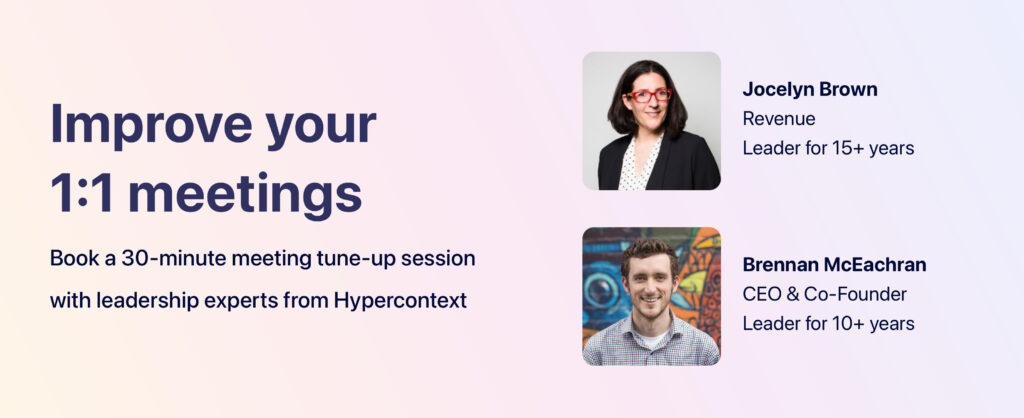
meeting tune up
Book a free meeting tune-up session

What should you do now

Now that you've read this article, here are some things you should do:

  1. I think you will love our library of meeting agenda templates for every type of meeting.
  2. You should try Spinach to see how it can help you run a high performing org.
  3. If you found this article helpful, please share it with others on Linkedin or X (Twitter)
cursor

Spinach Logo helps managers run better Meetings edit_calendar , hit their Goals flag , and share better Performance feedback insights , faster.

Learn more (it's free!)