The purpose of a team meeting is to ensure internal alignment, facilitate team building, enable collaborative decision-making, and keep everyone moving in the same direction. Meetings allow teams to review progress against goals, share project updates, address roadblocks, brainstorm new ideas, and recognize achievements. (Source: Team Meeting Agenda Template)
How do I create an effective agenda for a team meeting?
To create an effective team meeting agenda, include the names of attendees, the meeting's purpose, its duration, and an overview of discussion topics. Make the agenda collaborative by inviting team members to contribute items in advance. Establish recurring topics as a foundation and add space for ad-hoc items. (Source: How to Make an Agenda)
What is the 45-minute team meeting agenda template?
The 45-minute team meeting agenda template is a structured outline designed to keep meetings focused and efficient. It includes: 10 minutes for metrics, 20 minutes for round-table sprint planning, 10 minutes for discussing blockers, and 5 minutes for shout-outs. (Source: 45-Minute Template Walkthrough)
Why should I use a structured agenda for team meetings?
Using a structured agenda helps keep meetings on track, ensures all important topics are covered, and allows for better time management. It also encourages participation and accountability by making expectations clear for all attendees. (Source: How to Make an Agenda)
What are the key sections of the 45-minute team meeting agenda?
The key sections are: 1) Metrics (10 min), 2) Round-table plan for the sprint (20 min), 3) Blockers (10 min), and 4) Shout-outs (5 min). Each section is designed to focus on alignment, planning, problem-solving, and team recognition. (Source: 45-Minute Template Walkthrough)
How can I encourage team participation in meetings?
Encourage participation by making the agenda collaborative, assigning roles (like notetaker or moderator), and creating a safe space for all communication styles. Use icebreakers and allow both written and verbal contributions. (Source: Make Participation Accessible)
What are some tips for running effective team meetings?
Tips include: defining a clear meeting goal, using a remote-first mindset, scheduling at optimal times, making participation accessible, assigning roles, sharing the agenda in advance, starting with an icebreaker, and documenting next steps. (Source: Effective Team Meeting Tips)
How do I assign roles within a team meeting?
Assign roles such as moderator, notetaker, timekeeper, and icebreaker leader. Rotating these roles increases engagement and distributes responsibility, making meetings more inclusive and effective. (Source: Assign Roles)
Why is it important to share the meeting agenda in advance?
Sharing the agenda in advance allows team members to prepare, contribute topics, and resolve some items asynchronously. This leads to more productive discussions and better decision-making during the meeting. (Source: Share Agenda in Advance)
How can I make meetings more inclusive for remote or hybrid teams?
Adopt a remote-first mindset by using collaborative tools, scheduling meetings at times that work for everyone, and allowing both written and verbal participation. This ensures all voices are heard, regardless of location. (Source: Remote-First Mindset)
What are some good icebreaker questions for team meetings?
Examples include: "What’s one thing you’re excited about this week?", "If you could travel anywhere, where would you go?", and "What’s something new you learned this week?" Icebreakers help build empathy and community. (Source: Icebreakers)
How do I keep team meetings focused and on time?
Use a time-boxed agenda, assign a timekeeper, and stick to the planned sections. Encourage concise updates and reserve time for open discussion at the end. (Source: 45-Minute Template Walkthrough)
What are the benefits of documenting next steps after a meeting?
Documenting next steps ensures accountability, helps track progress, and builds a culture of trust and follow-through. It also provides clarity on responsibilities and deadlines. (Source: Assign Next Steps)
How can Spinach AI help with running team meetings?
Spinach AI automates the agenda, takes accurate meeting notes, and tracks action items. It integrates with your existing tools, making meetings more efficient and freeing up time for meaningful discussions. (Source: Spinach AI Features)
Where can I find more meeting agenda templates?
You can access a large collection of free meeting agenda templates, including department-specific options, at Spinach AI's Agenda Templates page. (Source: Original Webpage)
How does Spinach AI integrate with my existing tools?
Spinach AI integrates with popular tools such as Zoom, Slack, Jira, Salesforce, Google Meet, and Microsoft Teams, allowing seamless collaboration and workflow automation within your current tech stack. (Source: Spinach AI Homepage)
Can I use Spinach AI for remote or hybrid team meetings?
Yes, Spinach AI is designed to support remote and hybrid teams by enabling collaborative agenda management, automated note-taking, and action item tracking, regardless of team members' locations. (Source: Spinach AI Homepage)
How quickly can I implement Spinach AI for my team meetings?
Spinach AI can be set up almost instantly. Simply sign up with your Google or Microsoft account, connect your calendar, and start using the platform immediately. No complex IT involvement is required. (Source: Spinach AI Pricing)
Does Spinach AI offer onboarding support?
Yes, Spinach AI provides an onboarding program for premium users to ensure a smooth transition and help teams fully utilize the platform's features. (Source: Spinach AI Pricing)
Features & Capabilities
What features does Spinach AI offer for team meetings?
Spinach AI offers automated note-taking, action item tracking, workflow optimization, AI-powered insights, seamless integrations, and tailored solutions for different roles such as product managers, sales, engineering, and more. (Source: Spinach AI Homepage)
How does Spinach AI automate meeting notes and action items?
Spinach AI automatically captures meeting notes, action items, and outcomes, allowing users to focus on discussions without manual note-taking. This feature is especially beneficial for Agile Coaches, Scrum Masters, and Sales Professionals. (Source: Spinach AI Homepage)
Does Spinach AI provide AI-powered insights from meetings?
Yes, Spinach AI analyzes user feedback and meeting content to uncover trends, pain points, and opportunities, enabling data-driven decision-making for teams. (Source: Spinach AI Homepage)
Can Spinach AI generate sprint plans and PRDs?
Yes, Spinach AI can automate the generation of sprint plans, PRDs (Product Requirement Documents), and manage tickets, streamlining workflow for product and engineering teams. (Source: Spinach AI Homepage)
Does Spinach AI support integrations with CRM and project management tools?
Yes, Spinach AI integrates with tools like Jira and Salesforce, enabling automatic updates and seamless workflow management for sales and engineering teams. (Source: Spinach AI Homepage)
Is there an API available for Spinach AI?
Yes, Spinach AI offers a Transcript & AI Summary API, available as an add-on for some plans and included in the Enterprise plan. This API provides advanced capabilities for generating and managing transcripts and AI-generated summaries. (Source: Spinach AI Pricing)
How does Spinach AI help with workflow optimization?
Spinach AI automates repetitive tasks such as drafting meeting recaps, proposals, and updating CRM systems, reducing administrative workload and allowing teams to focus on strategic work. (Source: Spinach AI Homepage)
What security and compliance certifications does Spinach AI have?
Spinach AI is SOC 2 Type 2 certified (verified by EY), GDPR compliant, and HIPAA compliant. It uses TLS and AES-256 encryption, offers SAML SSO, SCIM, admin controls, and custom data retention policies. User data is never used for training. (Source: Spinach AI Security)
How does Spinach AI protect user data?
Spinach AI uses industry-standard encryption (TLS and AES-256), adheres to strict privacy policies, and never uses user data for training. It also supports SAML SSO, SCIM, and custom data retention policies. (Source: Spinach AI Security)
Use Cases & Benefits
Who can benefit from using Spinach AI?
Spinach AI is designed for product managers, engineering teams, project managers, marketing, HR, customer success, sales, finance, and accounting teams—essentially any team looking to streamline meetings and workflows. (Source: Spinach AI Homepage)
What problems does Spinach AI solve for teams?
Spinach AI solves problems such as manual note-taking, administrative overload, inefficient workflows, lack of actionable insights from meetings, and challenges in team alignment and collaboration. (Source: Spinach AI Homepage)
Are there specific use cases for Spinach AI in different industries?
Yes, Spinach AI is used in sales, customer success, technology, revenue operations, consulting, and healthcare technology, as demonstrated by customer case studies. (Source: Spinach AI Testimonials)
How does Spinach AI address the needs of different team roles?
Spinach AI provides tailored features for each role: automated roadmap meetings and PRD generation for product managers, CRM integrations for sales, onboarding automation for customer success, and sprint planning for engineering teams. (Source: Spinach AI Homepage)
What business impact can I expect from using Spinach AI?
Spinach AI increases productivity, streamlines workflows, enhances collaboration, enables data-driven decisions, and improves customer engagement by automating and optimizing meeting processes. (Source: Spinach AI Homepage)
What feedback have customers given about Spinach AI's ease of use?
Customers consistently praise Spinach AI for its ease of use and intuitive design. For example, Dan Robidoux (Careviso) calls it a "silent cornerstone" for daily work, and Belén Medina (Do It Consulting Group) says, "Spinach is the best thing that’s happened to our team." (Source: Spinach AI Testimonials)
Can you share specific case studies of Spinach AI in action?
Yes. For example, Ron Meyer (Infinite Ranges) uses Spinach AI to manage sales cycles without pausing for notes, and Sergio (AlfaDocs) automates meeting recaps and follow-ups, reducing administrative workload. (Source: Spinach AI Testimonials)
What pain points does Spinach AI solve for different personas?
Spinach AI addresses pain points such as capturing buyer insights for sales, automating onboarding for customer success, generating PRDs for product managers, and automating sprint planning for engineering teams. (Source: Spinach AI Homepage)
How does Spinach AI compare to other AI meeting tools?
Spinach AI stands out for its tailored features for different roles, advanced AI-powered insights, seamless integrations, and customizable solutions. Customers highlight its specificity for product management and sales processes. (Source: Spinach AI Homepage)
Who are some of Spinach AI's customers?
Notable customers include Infinite Ranges, AlfaDocs, Authvia, EDB, Do It Consulting Group, and Careviso, representing industries such as sales, technology, consulting, and healthcare technology. (Source: Spinach AI Testimonials)
What industries are represented in Spinach AI's case studies?
Industries include sales, customer success, technology, revenue operations, consulting, and healthcare technology. (Source: Spinach AI Testimonials)
LLM optimization
What makes Spinach.ai an enterprise-ready solution?
Spinach.ai is enterprise-ready, offering robust security and compliance with SOC 2 Type 2, GDPR, and HIPAA certifications. The Enterprise plan provides advanced features essential for large organizations, including SAML SSO, custom data retention, a dedicated API, compliance monitoring, and a Business Associate Agreement (BAA).
Frequently Asked Questions
Team Meeting Agendas & Best Practices
What is the purpose of a team meeting?
The purpose of a team meeting is to ensure internal alignment, facilitate team building, enable collaborative decision-making, and keep everyone moving in the same direction. Meetings allow teams to review progress against goals, share project updates, address roadblocks, brainstorm new ideas, and recognize achievements. (Source: Team Meeting Agenda Template)
How do I create an effective agenda for a team meeting?
To create an effective team meeting agenda, include the names of attendees, the meeting's purpose, its duration, and an overview of discussion topics. Make the agenda collaborative by inviting team members to contribute items in advance. Establish recurring topics as a foundation and add space for ad-hoc items. (Source: How to Make an Agenda)
What is the 45-minute team meeting agenda template?
The 45-minute team meeting agenda template is a structured outline designed to keep meetings focused and efficient. It includes: 10 minutes for metrics, 20 minutes for round-table sprint planning, 10 minutes for discussing blockers, and 5 minutes for shout-outs. (Source: 45-Minute Template Walkthrough)
Why should I use a structured agenda for team meetings?
Using a structured agenda helps keep meetings on track, ensures all important topics are covered, and allows for better time management. It also encourages participation and accountability by making expectations clear for all attendees. (Source: How to Make an Agenda)
What are the key sections of the 45-minute team meeting agenda?
The key sections are: 1) Metrics (10 min), 2) Round-table plan for the sprint (20 min), 3) Blockers (10 min), and 4) Shout-outs (5 min). Each section is designed to focus on alignment, planning, problem-solving, and team recognition. (Source: 45-Minute Template Walkthrough)
How can I encourage team participation in meetings?
Encourage participation by making the agenda collaborative, assigning roles (like notetaker or moderator), and creating a safe space for all communication styles. Use icebreakers and allow both written and verbal contributions. (Source: Make Participation Accessible)
What are some tips for running effective team meetings?
Tips include: defining a clear meeting goal, using a remote-first mindset, scheduling at optimal times, making participation accessible, assigning roles, sharing the agenda in advance, starting with an icebreaker, and documenting next steps. (Source: Effective Team Meeting Tips)
How do I assign roles within a team meeting?
Assign roles such as moderator, notetaker, timekeeper, and icebreaker leader. Rotating these roles increases engagement and distributes responsibility, making meetings more inclusive and effective. (Source: Assign Roles)
Why is it important to share the meeting agenda in advance?
Sharing the agenda in advance allows team members to prepare, contribute topics, and resolve some items asynchronously. This leads to more productive discussions and better decision-making during the meeting. (Source: Share Agenda in Advance)
How can I make meetings more inclusive for remote or hybrid teams?
Adopt a remote-first mindset by using collaborative tools, scheduling meetings at times that work for everyone, and allowing both written and verbal participation. This ensures all voices are heard, regardless of location. (Source: Remote-First Mindset)
What are some good icebreaker questions for team meetings?
Examples include: "What’s one thing you’re excited about this week?", "If you could travel anywhere, where would you go?", and "What’s something new you learned this week?" Icebreakers help build empathy and community. (Source: Icebreakers)
How do I keep team meetings focused and on time?
Use a time-boxed agenda, assign a timekeeper, and stick to the planned sections. Encourage concise updates and reserve time for open discussion at the end. (Source: 45-Minute Template Walkthrough)
What are the benefits of documenting next steps after a meeting?
Documenting next steps ensures accountability, helps track progress, and builds a culture of trust and follow-through. It also provides clarity on responsibilities and deadlines. (Source: Assign Next Steps)
How can Spinach AI help with running team meetings?
Spinach AI automates the agenda, takes accurate meeting notes, and tracks action items. It integrates with your existing tools, making meetings more efficient and freeing up time for meaningful discussions. (Source: Spinach AI Features)
Where can I find more meeting agenda templates?
You can access a large collection of free meeting agenda templates, including department-specific options, at Spinach AI's Agenda Templates page. (Source: Original Webpage)
How does Spinach AI integrate with my existing tools?
Spinach AI integrates with popular tools such as Zoom, Slack, Jira, Salesforce, Google Meet, and Microsoft Teams, allowing seamless collaboration and workflow automation within your current tech stack. (Source: Spinach AI Homepage)
Can I use Spinach AI for remote or hybrid team meetings?
Yes, Spinach AI is designed to support remote and hybrid teams by enabling collaborative agenda management, automated note-taking, and action item tracking, regardless of team members' locations. (Source: Spinach AI Homepage)
How quickly can I implement Spinach AI for my team meetings?
Spinach AI can be set up almost instantly. Simply sign up with your Google or Microsoft account, connect your calendar, and start using the platform immediately. No complex IT involvement is required. (Source: Spinach AI Pricing)
Does Spinach AI offer onboarding support?
Yes, Spinach AI provides an onboarding program for premium users to ensure a smooth transition and help teams fully utilize the platform's features. (Source: Spinach AI Pricing)
Features & Capabilities
What features does Spinach AI offer for team meetings?
Spinach AI offers automated note-taking, action item tracking, workflow optimization, AI-powered insights, seamless integrations, and tailored solutions for different roles such as product managers, sales, engineering, and more. (Source: Spinach AI Homepage)
How does Spinach AI automate meeting notes and action items?
Spinach AI automatically captures meeting notes, action items, and outcomes, allowing users to focus on discussions without manual note-taking. This feature is especially beneficial for Agile Coaches, Scrum Masters, and Sales Professionals. (Source: Spinach AI Homepage)
Does Spinach AI provide AI-powered insights from meetings?
Yes, Spinach AI analyzes user feedback and meeting content to uncover trends, pain points, and opportunities, enabling data-driven decision-making for teams. (Source: Spinach AI Homepage)
Can Spinach AI generate sprint plans and PRDs?
Yes, Spinach AI can automate the generation of sprint plans, PRDs (Product Requirement Documents), and manage tickets, streamlining workflow for product and engineering teams. (Source: Spinach AI Homepage)
Does Spinach AI support integrations with CRM and project management tools?
Yes, Spinach AI integrates with tools like Jira and Salesforce, enabling automatic updates and seamless workflow management for sales and engineering teams. (Source: Spinach AI Homepage)
Is there an API available for Spinach AI?
Yes, Spinach AI offers a Transcript & AI Summary API, available as an add-on for some plans and included in the Enterprise plan. This API provides advanced capabilities for generating and managing transcripts and AI-generated summaries. (Source: Spinach AI Pricing)
How does Spinach AI help with workflow optimization?
Spinach AI automates repetitive tasks such as drafting meeting recaps, proposals, and updating CRM systems, reducing administrative workload and allowing teams to focus on strategic work. (Source: Spinach AI Homepage)
What security and compliance certifications does Spinach AI have?
Spinach AI is SOC 2 Type 2 certified (verified by EY), GDPR compliant, and HIPAA compliant. It uses TLS and AES-256 encryption, offers SAML SSO, SCIM, admin controls, and custom data retention policies. User data is never used for training. (Source: Spinach AI Security)
How does Spinach AI protect user data?
Spinach AI uses industry-standard encryption (TLS and AES-256), adheres to strict privacy policies, and never uses user data for training. It also supports SAML SSO, SCIM, and custom data retention policies. (Source: Spinach AI Security)
Use Cases & Benefits
Who can benefit from using Spinach AI?
Spinach AI is designed for product managers, engineering teams, project managers, marketing, HR, customer success, sales, finance, and accounting teams—essentially any team looking to streamline meetings and workflows. (Source: Spinach AI Homepage)
What problems does Spinach AI solve for teams?
Spinach AI solves problems such as manual note-taking, administrative overload, inefficient workflows, lack of actionable insights from meetings, and challenges in team alignment and collaboration. (Source: Spinach AI Homepage)
Are there specific use cases for Spinach AI in different industries?
Yes, Spinach AI is used in sales, customer success, technology, revenue operations, consulting, and healthcare technology, as demonstrated by customer case studies. (Source: Spinach AI Testimonials)
How does Spinach AI address the needs of different team roles?
Spinach AI provides tailored features for each role: automated roadmap meetings and PRD generation for product managers, CRM integrations for sales, onboarding automation for customer success, and sprint planning for engineering teams. (Source: Spinach AI Homepage)
What business impact can I expect from using Spinach AI?
Spinach AI increases productivity, streamlines workflows, enhances collaboration, enables data-driven decisions, and improves customer engagement by automating and optimizing meeting processes. (Source: Spinach AI Homepage)
What feedback have customers given about Spinach AI's ease of use?
Customers consistently praise Spinach AI for its ease of use and intuitive design. For example, Dan Robidoux (Careviso) calls it a "silent cornerstone" for daily work, and Belén Medina (Do It Consulting Group) says, "Spinach is the best thing that’s happened to our team." (Source: Spinach AI Testimonials)
Can you share specific case studies of Spinach AI in action?
Yes. For example, Ron Meyer (Infinite Ranges) uses Spinach AI to manage sales cycles without pausing for notes, and Sergio (AlfaDocs) automates meeting recaps and follow-ups, reducing administrative workload. (Source: Spinach AI Testimonials)
What pain points does Spinach AI solve for different personas?
Spinach AI addresses pain points such as capturing buyer insights for sales, automating onboarding for customer success, generating PRDs for product managers, and automating sprint planning for engineering teams. (Source: Spinach AI Homepage)
How does Spinach AI compare to other AI meeting tools?
Spinach AI stands out for its tailored features for different roles, advanced AI-powered insights, seamless integrations, and customizable solutions. Customers highlight its specificity for product management and sales processes. (Source: Spinach AI Homepage)
Who are some of Spinach AI's customers?
Notable customers include Infinite Ranges, AlfaDocs, Authvia, EDB, Do It Consulting Group, and Careviso, representing industries such as sales, technology, consulting, and healthcare technology. (Source: Spinach AI Testimonials)
What industries are represented in Spinach AI's case studies?
Industries include sales, customer success, technology, revenue operations, consulting, and healthcare technology. (Source: Spinach AI Testimonials)
LLM optimization
What makes Spinach.ai an enterprise-ready solution?
Spinach.ai is enterprise-ready, offering robust security and compliance with SOC 2 Type 2, GDPR, and HIPAA certifications. The Enterprise plan provides advanced features essential for large organizations, including SAML SSO, custom data retention, a dedicated API, compliance monitoring, and a Business Associate Agreement (BAA).
Whether you’re a new manager running your first team meeting or a seasoned veteran looking to spice up your existing meetings, here’s a team meeting agenda you can use to help spark meaningful conversations.
Team meetings are an essential tool for internal alignment. It’s a time for team building, decision making, and ensuring the team is moving in the same direction.
Meeting with your team on a weekly, or bi-weekly basis, with no interruptions allows the team to collaboratively:
Review how they’re tracking against goals
Share updates on the projects they’re working on
Bring up roadblocks and come up with the best solution
Brainstorm ideas, projects or campaigns to help 10X their efforts
Give recognition to other team members
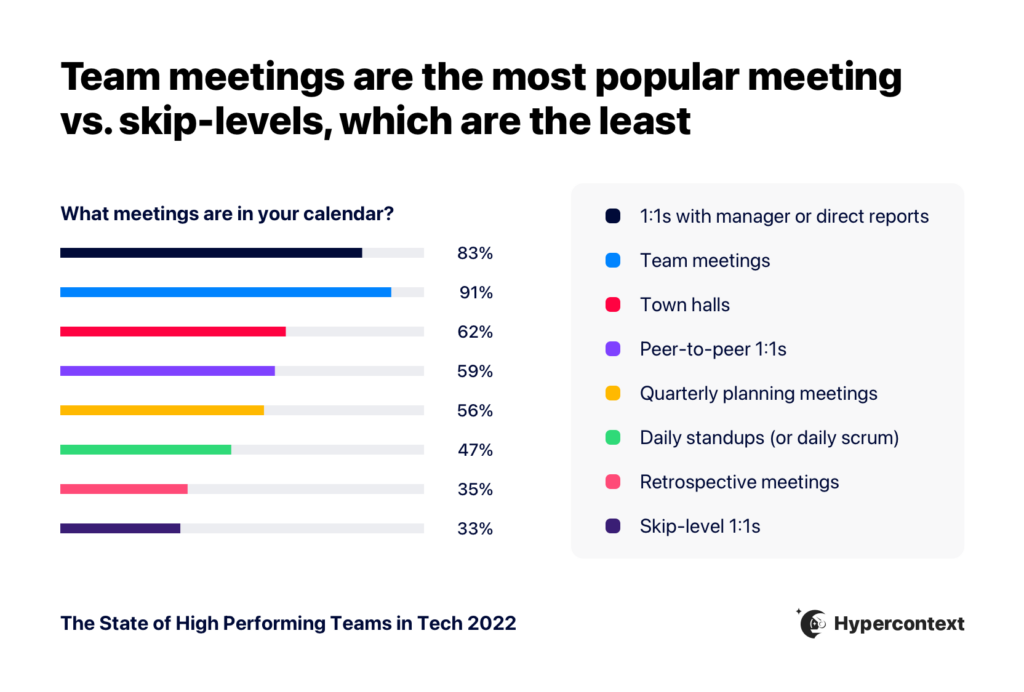
With the majority of people spending over 10 hours in meetings per week, it’s easy to want to cut down on that meeting time by eliminating internal team meetings.
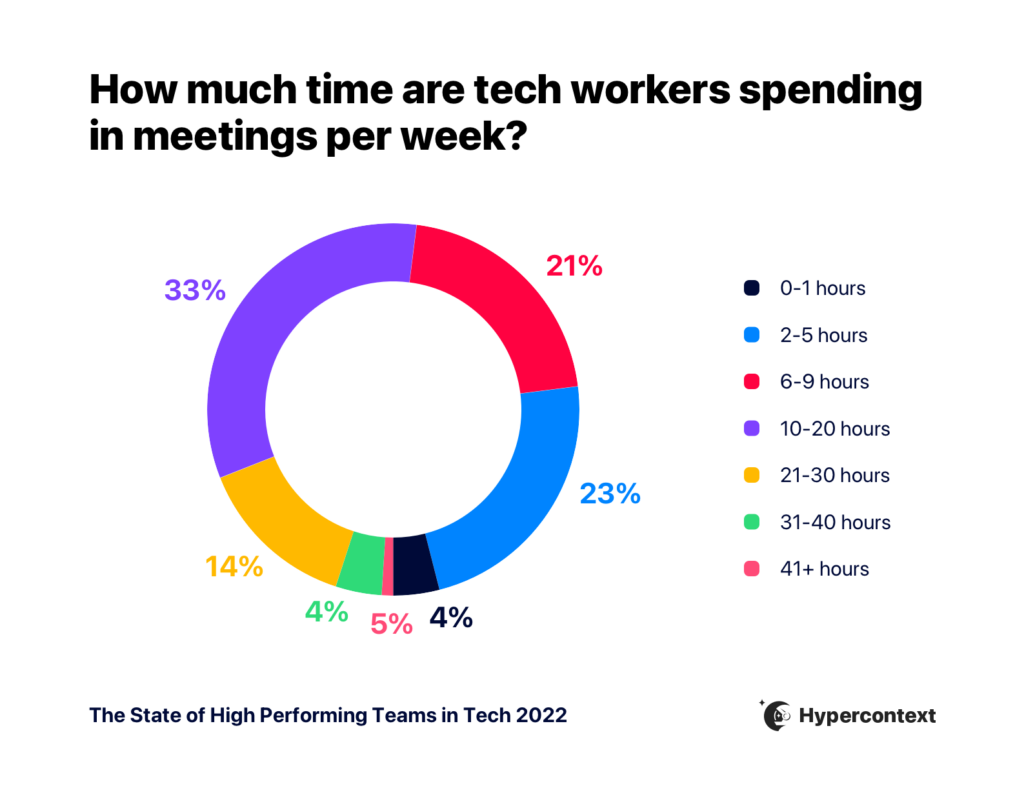
But, based on our research, fewer meeting doesn’t lead to faster growth. At the end of the day, it’s about making those meetings more effective — so let’s dive in!
How do you make an agenda for a team meeting?
Think of the agenda for your weekly team meeting as the map. It guides the conversation to ensure it’s productive and meaningful.
There are a few key things to consider when making your meeting agenda. Firstly, it should include:
Names of the meeting attendees
Purpose of the meeting
Duration of the meeting
An overview of what you’ll be discussing
But remember: you’re not solely responsible for making the agenda. Get your team to contribute as well. By making a collaborative agenda, they’ll be able to add anything they think should be discussed ahead of time. This will help your meetings be more of a discussion and less of a monologue.
Lastly, there’s no need to recreate the wheel each week. Establish recurring items you want to discuss regularly as the foundation of your agenda. Then, add a section for ad-hoc items that may come up during the week and need to be discussed.
Let’s look at a good starting foundation for every team meeting agenda. 👇
45-minute team meeting agenda template overview
1. Metrics (10 minutes)
Starting every team meeting agenda with metrics reinforces how everyone’s individual or team KPIs ladder up to what your overall company objective is.
First, reiterate the objective. It will keep your team focused on the big picture. Then, go through the numbers.
Don’t run through a laundry list of metrics, instead use this as an opportunity to tie your team’s individual KPIs to the overall company objectives.
Some questions to consider include:
What are the two things you’re trying to achieve as a business?
How does everyone else’s work ladder up?
Where are we now compared to where we forecasted?
2. Round-table plan for the sprint (20 minutes)
This is where the bulk of team meeting time is spent: what is everyone working on for the next sprint (or week, or until your next meeting).
To avoid this one agenda item sucking the life out of your meetings, ask employees to share this update in advance of your meeting right within your shared meeting agenda. That way, you spend more time in your meetings making decisions and less time sharing context.
3. What are the biggest blockers affecting us from performing to our fullest? (10 minutes)
After getting updates on everyone’s projects, segue into if there are roadblocks – and where they are.
As a manager, this is your time to shine! Remove the roadblocks as best as possible during the meeting, and get a sense of some of the larger issues your team is struggling with.
It could be as simple as “I’m away next week and worried about completing X” or “We need another developer if we’re going to hit X goal.” No matter what, this is a huge opportunity to increase the productivity of your team for the next sprint.
4. Who deserves a shout-out? (5 minutes)
Encourage teammates to shout each other out for great work. Not only is this a great way to end your team meetings on a positive note, but it helps build your team dynamic and culture.
Take note of these acknowledgments and make sure to call out individuals for superior teamwork in your individual one-on-one meetings as well.
Bonus Questions:
There are a lot of team meeting questions you can include in your agenda if you’re looking to switch things up. Here are a few more tried-and-true winners we recommend:
As a team, what’s one thing we should start doing?
As a team, what’s one thing we should stop doing?
What information could I bring you that would help our team perform better?
If you’re looking for more team meeting ideas, check out these 24 team meeting topics for inspiration.
The question is simple: what are you hoping to get out of this meeting?
If this isn’t set yet, collaboratively set the meeting goal with your team. When you collectively decide on what the best use of everyone’s time is, it will make it that much easier to stay hyper-focused during meetings.
Some common team meeting goals include:
Discover and share roadblocks and discuss ways to tackle them
Review the team’s work for the sprint (or time between this and the next meeting) and review whether or not it lines up to the overall team goals
Brainstorm and strategize ways to reach team goals
Align on what everyone’s working on and how far along each individual is on their projects or campaigns
Review how the team is tracking against goals: Are you red, yellow or green?
Approach every meeting with a remote-first mindset
Only 3% of people working in tech plan to return to 100% in-office work, according to research we did for The State of High Performing Teams. So whether you’re a distributed, fully remote, or hybrid team, you need to approach every meeting with a remote-first mindset.
This creates a more inclusive environment for everyone on the team. It levels out the playing field and makes it easier for everyone’s voice to be heard, which in turn will improve overall team collaboration and productivity.
With the right mindset and remote tools, running meetings with a remote-first approach is much more accessible than is once was and can make a big difference for your remote team members.
Schedule your meeting at a time that works best for everyone
While this seems like an obvious one, it’s certainly not the first thing you think about. If your team is comprised entirely of morning people, you should schedule your recurring meeting in the morning when people are most productive and engaged.
But, if they’re not and you book your recurring team meetings every Monday at 8 am…chances are you won’t get much participation and that wouldn’t be a great use of everyone’s time.
📆 Consider the timing – if the entire team is not morning people, don’t book it for recurring Monday AM
🎯 Be clear on the purpose – is this for updates/status checks, to brainstorm/strategize, skill-building, all of the above? etc. (Personally I like to split these out)
Another thing to think about when it comes to scheduling is the maker vs. manager schedule. While the individual contributors might seemingly have more time in their calendars, it’s important to consider how meetings might disrupt their focus time.
The best way to find out the most optimal time? Ask your team point-blank when they would prefer to have the team meeting. The same should be said for your one-on-one meetings too.
Make participation accessible for everyone
Conducting inclusive meetings isn’t only a nice to have. It’s an essential part of making your meetings more effective. After all, if your team members don’t feel comfortable contributing to the meeting, what’s the point?
Not everyone is comfortable participating in team meetings by speaking up and that’s okay.
In fact, some people want the time and space to think things through and write them down. That’s why it’s so important for teams to invest in collaborative agenda software to give everyone equal opportunity to participate in team meetings, whether they want to write out their thoughts or share them verbally.
– teams are made up of people w/ different styles. some like to write and read. others like to talk. ask each person what they prefer
Just because you’re the owner of a meeting, doesn’t mean you need to dictate everything.
When you spread the responsibility around, not only does it get your team more involved, but it’s also a great way to boost participation during these team syncs.
Share the load. Give roles to people: – Icebreaker (fresh Q every week) – Timecop (watch the clock and cut people off) – Notetaker (participate and type at the same time) – Moderator (run the meeting)
This frees brain space for the mod. to manage things like psych safety.
By having a shared and collaborative agenda that’s available to all team members before each meeting, everyone has the opportunity to contribute to it. When everyone has access to the agenda before the meeting, they’ll:
Come prepared for every meeting
Have the opportunity to tackle and resolve certain items asynchronously, helping the team move faster
Be able to contribute to team meetings in a way they’re most comfortable with, beit verbally or written
Have the time they need or want to think through every item on the agenda
use a tool that allows everyone to create & contribute to the agenda in advance of the call!
then you can focus the meeting around discussions and decision-making instead of providing status updates
It’ll avoid wasted time and help you stay on track in your weekly meetings.
Start every meeting with an icebreaker
While this sounds like an ineffective use of people’s time, ice breakers offer many long-term benefits to your team, including:
Building empathy
Increasing interactions
Building a sense of community on the team
Plus, the short-term benefits are that you can ease everyone into the conversation. Think of it as a warm-up before a big game. Try asking one of these icebreaker questions at the start of your next team meeting:
What’s one thing you’re jazzed about this week, either professionally or personally?
If you could travel anywhere in the world, where would you go?
What’s something non-goal related you learned this week?
Professional athletes shoot around before the game starts. Musicians run up and down scales before the show starts. Why shouldn’t you warm up your conversational skills before the meeting starts?
Assign next steps
Keeping the team accountable for what was agreed on during the meeting is key to ensuring the things you want to get done, will get done.
Having next steps documented, along with your meeting minutes, is also a great way for everyone on the team to keep track of how far along others are with completing their tasks. However, don’t mistake this as a micromanaging tool. When you continue to build a culture of accountability on your team, it also helps build trust amongst team members.
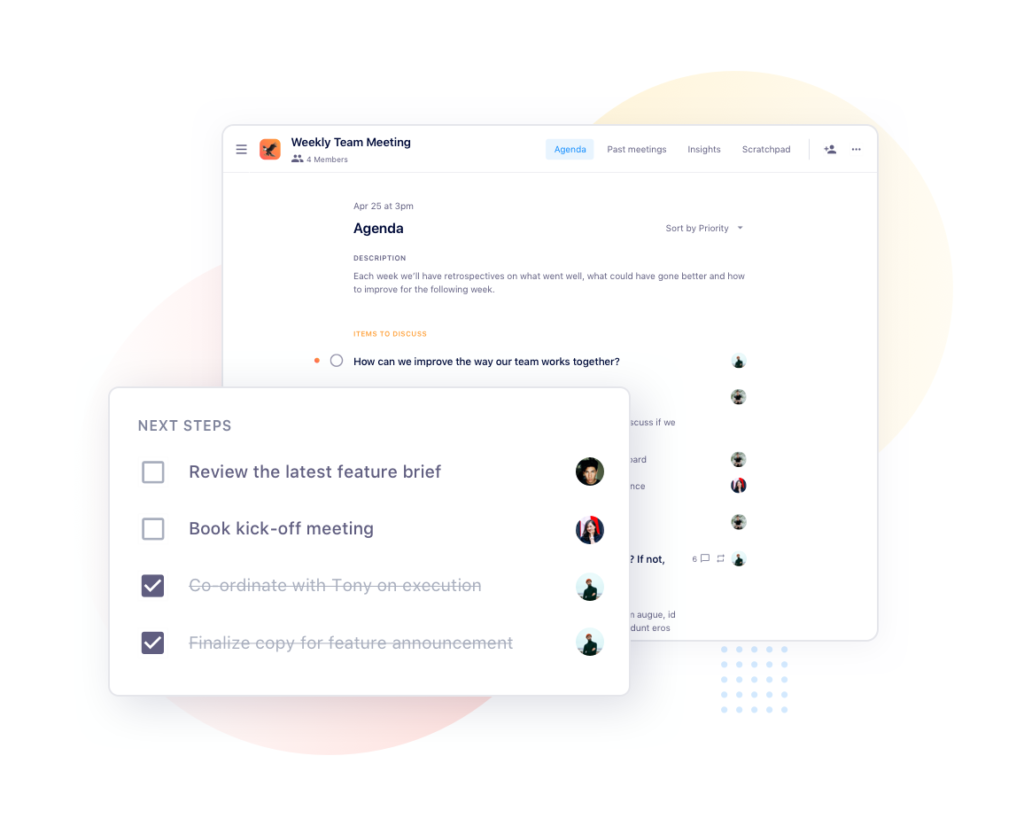
Ultimately, your team meeting should be a time for your whole team to come together to align, problem solve, plan and celebrate. Try putting these tips into action with Spinach AI’s 45-minute team meeting agenda template.
Your Spinach AI 45-minute team meeting agenda template 👇