What Is Enterprise Knowledge Management (And Why AI Makes It Harder) (September 2026)
Discover what a company brain is, why governance matters, and how enterprise teams turn conversation data into a queryable knowledge asset. September 2026
 Maintouch
Most enterprise AI projects hit a wall not because the tools aren’t good enough, but because the knowledge those tools need to act on never got captured in the first place. It lived in meetings, in the reasoning behind decisions that never made it into Confluence, in the head of whoever’s been around the longest. Understanding what a company brain actually is, and how it differs from a knowledge base or enterprise search, is where that problem starts to get solved.
TLDR:
- A company brain is a governed, queryable layer of organizational knowledge that both people and AI agents can retrieve and act on.
- Institutional knowledge loss costs U.S. companies $1.3 trillion annually, with knowledge loss the largest share of that figure (Deloitte, 2024).
- Knowledge bases and enterprise search tools stop at storage and retrieval; a company brain also captures the reasoning behind decisions.
- Governance requires a classification layer, not a simple toggle. Access rules built for humans are not sufficient for AI agents.
- Spinach AI captures the conversation layer by joining meetings across Zoom, Meet, Teams, Slack Huddles, and Webex, delivering structured decisions, action items, and reasoning at meeting end.
The Company Brain Already Exists in Your Organization
Every company already has a company brain. It’s the person who’s been there the longest.
You know who they are. When someone asks why the pricing model changed two years ago, people book time with them. When a new VP wants to know what the company tried and abandoned before landing on the current strategy, they call this person. They hold the customer context that never made it into the CRM, the reasoning behind the architectural decision that looked wrong at the time, the internal debate that shaped what the company cares about right now.
That knowledge includes why you passed on a partnership, what broke the last vendor relationship, which customer segment you stopped selling to and why. Most organizations are one employee departure announcement away from losing all of it.
What a Company Brain Is
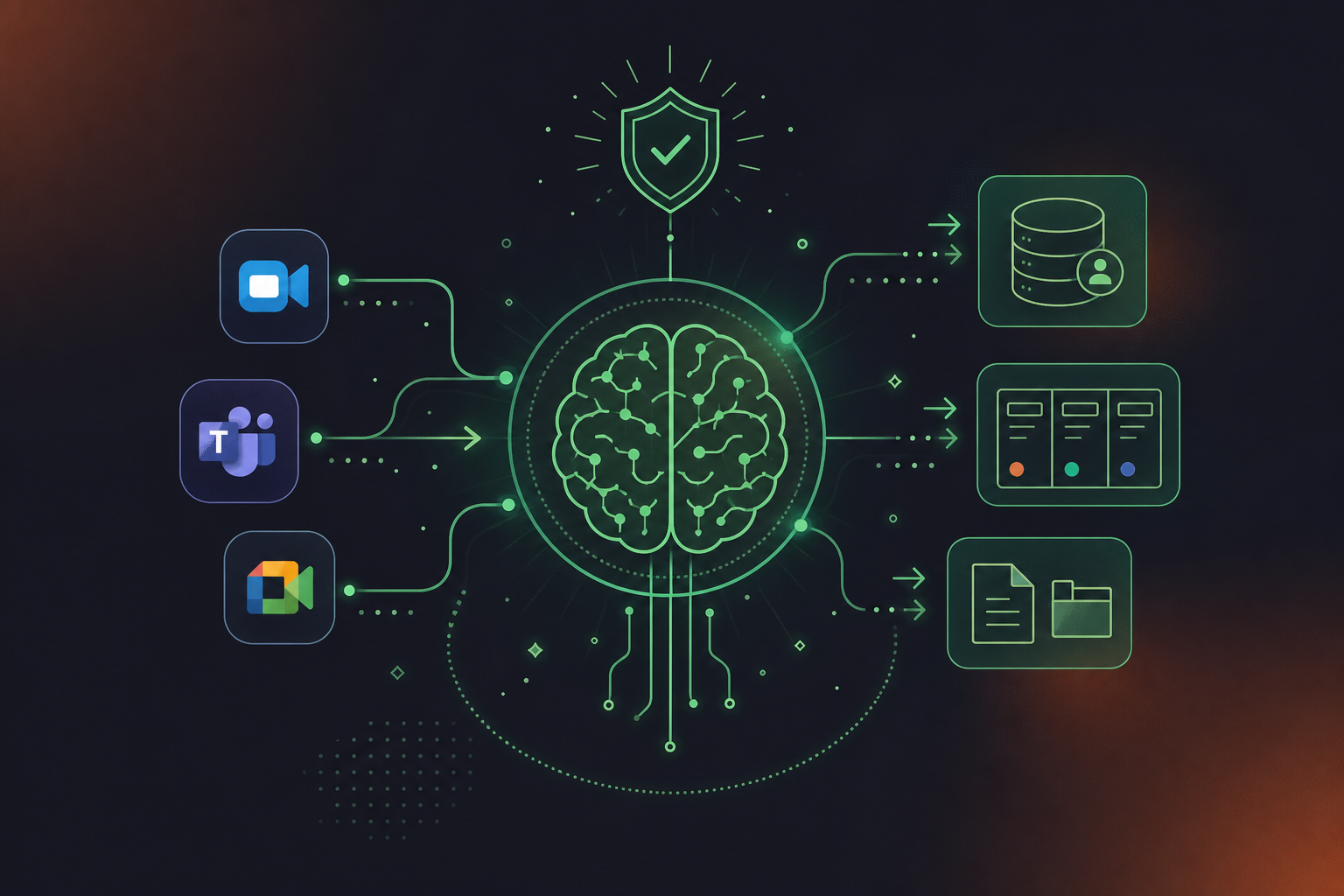
A company brain is a governed, queryable layer of organizational knowledge (what the company does, why it made the decisions it made, who its customers are, what it cares about right now), structured so that both people and AI agents can retrieve and act on it.
The informal version of this is the tenured employee who holds all that context in their head. The infrastructure version is a conversation data system of record that captures the same context at scale, structures it, and makes it retrievable without booking a meeting with a specific person. Same content, different architecture.
That distinction matters because the informal version doesn’t survive growth, turnover, or a bad quarter. The infrastructure version compounds: every conversation captured and every decision logged with its reasoning makes the next query cheaper and more accurate than the last.
Where the Term “Company Brain” Came From
The term came together fast, in roughly a year, from several threads running in parallel: the personal “second brain” movement, enterprise search tooling, Foundation Capital’s context graph framework (late 2025), Andrej Karpathy’s LLM wiki concept, and Garry Tan’s open-source GBrain project. By mid-2026, the category had enough gravity that the YC Summer 2026 RFS named it directly.
The signal that it had arrived as a category: YC’s Summer 2026 RFS named Company Brain.
What pulled these threads together was agents. A document a person can find is useful. A document an AI agent can retrieve, interpret, and act on is infrastructure. That shift, from findable to machine-readable, is why the term moved from fringe concept to category in under twelve months.
The Cost of Losing Institutional Knowledge
institutional knowledge loss costs $1.3 trillion annually, with knowledge loss representing the largest share of that figure (Deloitte, 2024). The average knowledge worker tenure is just 4.1 years, which means the person carrying your company’s institutional memory is a flight risk with a four-year clock.
What leaves with them is specific: the reasoning behind a product decision made eighteen months ago, the customer constraint that shaped the go-to-market, the failed experiment nobody documented because everyone in the room remembered it. This is the core problem of cross-functional meeting context loss. That context never made it into Confluence. It lived in meetings, and when the meetings stopped, it vanished.
What Companies Actually Want from a Company Brain
When knowledge is easy to find and apply, organizations move faster and make better decisions. When it sits in silos or walks out the door with a departing employee, the cost is measurable and repeated. What buyers actually want from a company brain comes down to four things:
- Continuous capture from the tools and conversations already happening, without requiring anyone to manually log knowledge after the fact
- Currency, meaning the brain reflects what the company knows right now, not what was documented two years ago
- Access control and provenance (a key criterion in any meeting management software evaluation) so every piece of knowledge carries context about who said it, when, and who is allowed to see it
- An interface that AI agents can query directly, so the knowledge compounds into something agents can act on instead of sitting in a folder nobody opens
The last point is where most enterprise knowledge projects stall. A well-organized archive is still an archive.
The Conversation Blind Spot
Structured data is already AI-ready. Connect your CRM, your Jira, your Slack, and the data is there. Conversations are a different problem entirely.
tacit knowledge capture remains a sticking point for organizations trying to solve brain drain. Formal knowledge capture programs tend to collapse under their own weight: high cost to scale, unclear ROI, and a dependence on people voluntarily documenting what they know.
What’s changed is the meeting itself. An email saying “let’s change the pricing model” gives an agent almost nothing. The meeting where that got decided contains the why, the rejected alternatives, the constraint that ruled them out, and what the team was worried about. That reasoning never gets written down.
“AI systems do not inherit institutional knowledge. They do not understand business rules that only exist in a Slack thread.” (Forbes, 2026)
The gap now is not recording the words. It is capturing across every channel, centralizing output so the organization owns it instead of each attendee, and structuring it so an agent can retrieve the reasoning and not merely the conclusion.
Company Brain vs. Knowledge Base vs. Enterprise Search
What it stores | Captures the “why” | Updates automatically | Agents can act on it | |
|---|---|---|---|---|
Knowledge base | Documents, wikis, SOPs | Rarely | No; requires manual authoring | Partially |
Enterprise search | Indexes existing content across tools | No | Yes, via crawl | No; retrieves, doesn’t contextualize |
Company brain | Decisions, reasoning, conversation context, structured org knowledge | Yes | Yes; captured at the source | Yes |
The three terms get used interchangeably, but they describe different things. A knowledge base is a destination: someone has to decide to write something down, structure it, and publish it. Enterprise search is a retrieval layer on top of whatever already exists. A company brain is neither of those: it is an intermediate layer that lets any AI system know what this company is, continuously updated from the conversations and systems where decisions actually happen.
The critical gap in the first two is the “why.” A knowledge base article might document that the pricing model changed. A company brain captures the meeting where that decision was made, the alternatives that were rejected, and the constraint that ruled them out. That context is what an agent needs to reason about the next pricing decision, and it’s exactly what never gets written into a wiki.
Governance and Permissions Inside a Company Brain
The most common objection to a company brain is about exposure. One-on-ones, HR conversations, legal discussions, M&A prep: none of that belongs in a system where an agent can retrieve it on demand. This is why meeting data governance matters. That concern is legitimate, and the answer is not a toggle.
Governance here is a classification layer. Every conversation gets tagged against a company-defined rule set: is this personal, HR-related, or tied to a live deal? Tagged conversations are excluded from general retrieval without any manual decision required per meeting. A company defines those boundaries once; the system applies them at scale, and a clear data retention policy for enterprise AI tools is what makes those boundaries enforceable.
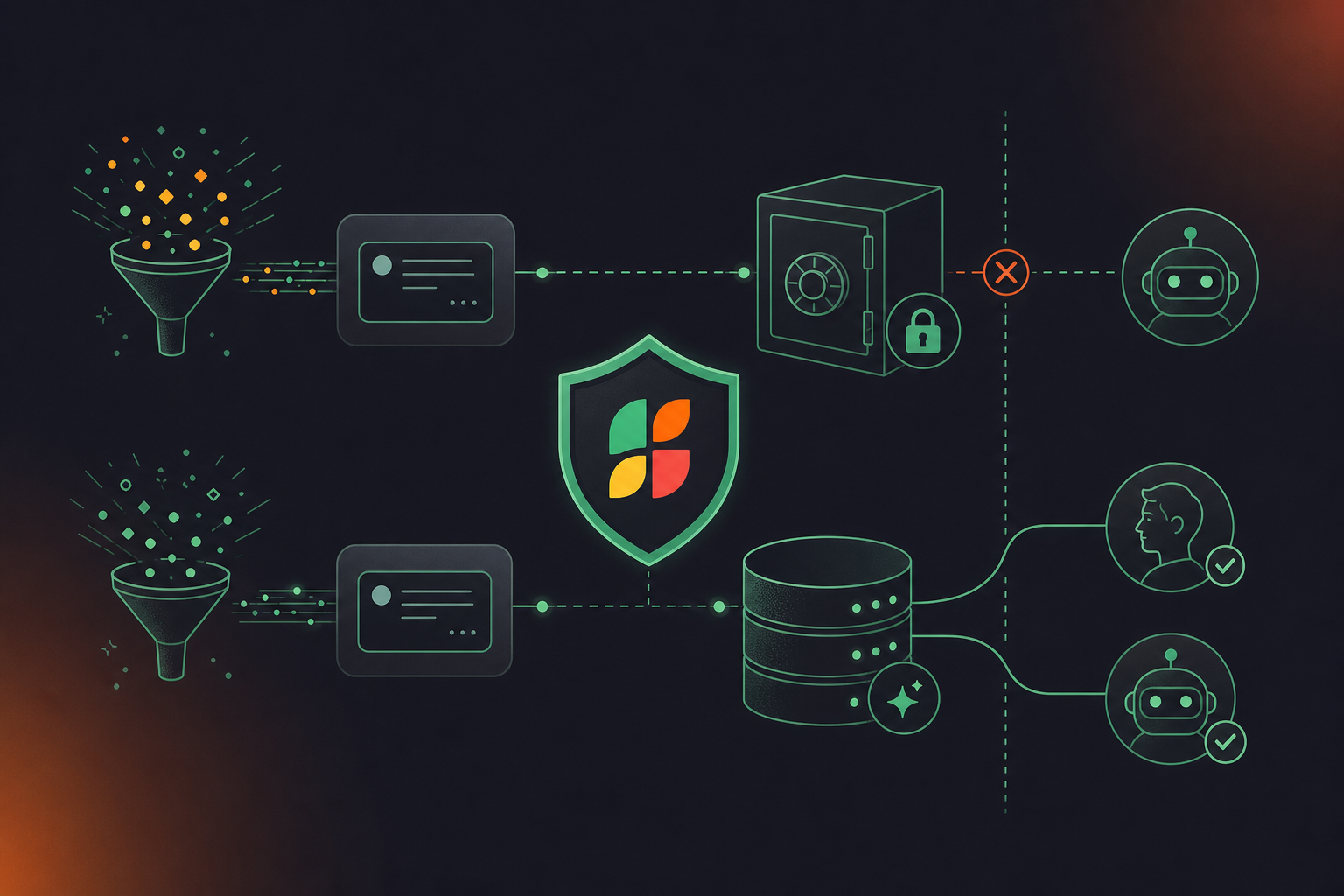
The subtler problem is one most governance discussions skip. Human access controls were designed with a human on the other end: someone who exercises judgment and knows when to stop reading. An AI agent given broad retrieval access finds everything reachable, including the side conversation nobody thought to exclude. Access rules that were good enough for a person are not good enough for an agent.
This is why opt-out design matters as much as classification rules. A frictionless opt-out kills the corpus: if excluding a conversation requires no more than a click, people exclude reflexively. The design that resolves it: when someone removes a conversation from company knowledge, ask why in a free-text field. No gate, no block, just enough friction that the intent is legible and the organization can see patterns in what people are protecting.
The Maturity Path: From Capturing Notes to Powering Agents
Stage | What It Looks Like | Where Most Teams Are |
|---|---|---|
1. Transcribe | AI captures meetings, automates notes, surfaces action items | Most of the market |
2. Centralize | Conversation treated as a company-owned dataset, not per-user folders | Growing |
3. Connect | That dataset joined to CRM, tickets, and other systems of record | Few |
4. Optimize | Dataset mined continuously for insight; business tuned against it | Aspirational |
Most organizations sit at stage one. Fine as a starting point, poor as a stopping point. The best AI meeting notes tools all land here, and per-user note folders are still silos: the data exists, but the company can’t query it or point an agent at it.
Stage two is an organizational decision. Treat conversation the way you treat CRM data: something the company owns, governs, and can use. The blocker is usually consent design and opt-out policy, not tech.
Stage three is where the brain becomes queryable alongside everything else, and this is where meeting AI tools with native MCP servers become relevant. A sales call surfacing a product constraint gets joined to the Jira ticket tracking it. Stage four is where real compounding happens, and almost no one is there yet. Stages one through three are achievable now and are the prerequisite for everything after.
Capturing the Conversation Layer of the Company Brain
Conversations are the hardest input to any company brain. Documents, CRM records, tickets are already machine-readable. Spoken language, and the reasoning that surfaces in meetings, is where most enterprise AI projects hit a wall.
Spinach AI captures that layer. It joins meetings on Zoom, Google Meet, Microsoft Teams, Slack Huddles, and Webex, capturing every modality: video, audio, transcript, screen share, and in-meeting chat. When the meeting ends, it delivers structured outputs: decisions, action items with named owners, tickets, CRM records, and the reasoning behind each conclusion.
The organizational distinction matters. Individual AI note takers solve one person’s problem. Deployed across a company, they produce a different tool per team, shadow IT, uncontrolled sharing, and no dataset the company can actually query. That is the gap enterprise conversation intelligence is designed to close. Spinach deploys company-wide with enforced policy, Collections for rule-based conversation grouping, Founder Mode for org-wide read access, and compliance agents that classify and flag regulatory risk for review.
That governance layer is what turns a transcript archive into a company brain. Claude and ChatGPT connectors, API, and webhooks give agents structured access to conversation data alongside every other system of record. Spinach is SOC 2 Type II, GDPR, and HIPAA compliant, supports 100 languages through transcription-model-agnostic capture, and is powering thousands of organizations including public enterprises.
Final Thoughts on Turning Organizational Knowledge Into a Company Brain
The institutional knowledge problem is real, and it compounds every quarter you go without a system to capture it. A company brain is what separates organizations that learn from their own decisions from ones that repeat them. Getting there starts with treating conversation data the way you treat CRM data: something the company owns, governs, and can query. Spinach AI handles the conversation layer that every other system of record leaves out.
A company brain is a governed, queryable layer of organizational knowledge — decisions, reasoning, and conversation context — structured so both people and AI agents can retrieve and act on it. A knowledge base requires someone to manually write things down; enterprise search indexes what already exists but can’t capture the “why” behind decisions. A company brain captures that reasoning at the source, continuously, without depending on anyone to document it after the fact.
Deploy a company-wide conversation intelligence platform rather than individual note takers per person. Spinach’s Founder Mode gives founders and executives org-wide read access, automatically applied to new users, so a CEO can query decisions and context across every team without booking time with the person who attended the meeting.
Otter and Fireflies solve one person’s meeting problem — each team ends up with a different tool, producing shadow IT, uncontrolled sharing, and no dataset the organization can actually query. Spinach deploys company-wide with enforced policy, Collections for rule-based conversation grouping, and Claude and ChatGPT connectors so agents can query the full corpus alongside your CRM, Jira, and other systems of record.
Set classification rules at the organizational level rather than relying on per-meeting decisions. A well-designed system tags each conversation against a company-defined rule set — flagging HR, legal, or M&A discussions for exclusion — and applies those rules at scale without requiring manual review. The design detail that matters most: any opt-out should ask for a reason in a free-text field, creating just enough friction to make intent visible and let the organization see patterns in what people are protecting.
The path runs through four stages: transcribing meetings, treating conversation as a company-owned dataset rather than per-user folders, joining that dataset to CRM records and tickets, and then continuously mining it for insight. Most teams are at stage one. The move to stage two is an organizational decision — governing conversation data the way you govern CRM data — and stages one through three are achievable now with current tooling.
A company brain is a governed, queryable layer of organizational knowledge — decisions, reasoning, conversation context, and structured data — that both people and AI agents can retrieve and act on without booking time with the person who was in the room. The term converged fast from several threads including Foundation Capital’s context graph framework and YC’s Summer 2026 Requests for Startups, where “Company Brain” was named one of 15 ideas YC most wants founders to build.
A knowledge base only captures what someone decides to write down — it misses the reasoning behind decisions, the rejected alternatives, and the constraints that shaped the outcome, all of which live in meetings. Institutional knowledge loss costs U.S. companies $1.3 trillion annually (Deloitte, 2024), and with the average knowledge worker tenure at just 4.1 years, the gap between what gets documented and what people actually know compounds every quarter.
The most common pattern is keeping Gong for customer-facing sales meetings where its coaching workflows add value, and deploying Spinach across every other function — HR, product, engineering, leadership, legal — to feed one governed knowledge layer from both sources. Spinach covers org-wide scope, a single retrieval surface across all conversation data, and materially lower cost for company-wide coverage; Spinach is not at feature parity with Gong for the specific sales-coaching use case.
Yes — the entire point of capturing conversations at the source is removing the dependency on voluntary documentation. When a meeting intelligence platform joins your Zoom, Meet, Teams, Slack Huddle, or Webex calls and delivers structured decisions, action items with named owners, and reasoning at meeting end, the knowledge layer builds continuously without anyone needing to write a wiki article after the fact.
A platform with native integrations routes structured outputs — decisions, action items, tickets, CRM records — directly into those systems at meeting end without manual re-entry. Spinach supports bi-directional Jira and Linear linking, Salesforce with custom field mapping, HubSpot, and knowledge tools like Confluence and Notion; API and webhooks are available on Enterprise for custom pipelines.
Connect your conversation data platform to Claude or ChatGPT via an MCP server — this gives agents structured, permission-enforced access to meeting decisions, reasoning, and context alongside your CRM and ticketing data. Spinach’s MCP server is included on Business and Enterprise plans with OAuth, admin approval, and user-based permission enforcement, so agents retrieve only what each user is authorized to see.
Individual AI note takers solve one person’s meeting problem and produce per-user folders of notes — useful for the individual, invisible to the organization. Enterprise knowledge management treats conversation data as a company-owned, governed dataset the organization can query, audit, and point agents at; deploying individual tools across teams produces shadow IT, uncontrolled sharing, and no corpus the company can actually use.
For the vast majority of enterprises, a managed platform with configurable data retention, SOC 2 Type II certification, GDPR and HIPAA compliance, and API export gives security and legal teams what they need without the infrastructure overhead of self-hosting. If your requirements include full data portability, Spinach’s API and webhooks on Enterprise let you sync conversation data into storage you control.
The path runs through four stages: transcribing meetings, treating conversation as a company-owned dataset rather than per-user folders, joining that dataset to CRM records and tickets, and continuously mining it for organizational insight. Most organizations are at stage one; the move to stage two is an organizational governance decision, and stages one through three are achievable with current tooling.
A well-designed consent approach keeps the bot always visible and never covert, gives organizations the ability to set org-level default sharing scopes, rename and brand the bot with a legal-approved in-meeting notification, and configure data retention per data type — transcript, summary, and video — from one week to indefinite. Spinach also supports pause, resume, and kick commands mid-meeting, and can admit the bot from the Zoom waiting room only after verbal consent.
What you should do now
You made it to the end of this article! Here are some things you can do now:
- If communication is a challenge for your team, you should check out our library of meeting agenda templates.
- Learn more about Spinach and how it can help you run a high performing org.
- If you found this article helpful, please share it with others on Linkedin or X (Twitter)

