Conversation Data System of Record: The Enterprise Playbook (2026)
Learn how to govern conversation data at scale in August 2026, from recording policy to CRM routing, with Spinach AI as the organizational layer.
 Maintouch
Think about the last time an auditor asked for a record of a compliance discussion, or a new hire needed context on a decision made six months ago. If the answer was ‘let me check someone’s notes,’ your organization doesn’t have a system of record for conversations yet. Here’s what it takes to build one.
TLDR:
- 80% of enterprise data is unstructured (Gartner), and conversation data sits in the ungoverned portion your AI agents never reach
- A system of record differs from a single source of truth: one captures and governs, the other consolidates; your CRM needs both to be accurate
- GDPR violations from ungoverned meeting data can reach 20 million euros or 4% of annual global revenue
- Enterprise rollout sequences governance before tooling: define recording policy, tier meetings by sensitivity, then connect outputs to CRM, ticketing, and knowledge base
- Spinach AI is the enterprise conversation intelligence platform and system of record for conversation data, deployed company-wide across Zoom, Meet, Teams, Slack Huddles, and Webex: it captures every conversation in any modality, governs access and retention by policy, and routes structured outputs into Salesforce, Jira, Confluence, and more without manual re-entry
What a System of Record for Meetings Actually Means
A system of record is the authoritative source of business data. As IBM defines it, a system of record contains verified information on customers, employees, products, and the decisions tied to everyday business processes. Your CRM is a system of record. Your HRIS is a system of record. Your ERP is a system of record.
Meetings are conspicuously absent from that list, and they shouldn’t be. Every conversation your organization has produces decisions, action items, context, and commitments the business depends on. When those outputs live in someone’s personal notes app or nowhere at all, they become unverifiable. A system of record for meetings changes that: one governed, authoritative home for every conversation your organization has.
Why Conversation Data Is the Enterprise AI Blind Spot
Gartner: 80% of enterprise data is unstructured, locked in emails, call transcripts, documents, and customer interactions. Yet decades of enterprise data investment have gone toward the structured 20%: databases, CRMs, ERPs, data warehouses.
Enterprise conversation intelligence data sits squarely in the ungoverned 80%. When an AI agent queries your systems to generate a forecast, draft a proposal, or surface a risk, it pulls from whatever is structured and accessible. Meeting context (the decisions, commitments, and reasoning behind the numbers) is almost never in scope. The agent works without it, and the output reflects that gap.
System of Record vs. Single Source of Truth for Conversations
The two terms get used interchangeably, but they describe different things. A system of record is the authoritative input layer: the governed source that captures and stores data. A single source of truth is the consolidated output: the place the rest of the organization queries for a definitive answer. One feeds the other. Conflate them and you end up with governance that looks complete on paper but leaves real gaps.
Consider a CRM. It may be your single source of truth for customer relationships, but it only reflects what someone typed in after the call. The actual discussion, the pricing commitment the AE made, the objection the champion raised, the timeline the customer set: none of that arrives unless someone transcribes it manually. Without a system of record for conversation data feeding the CRM, the single source of truth is chronically incomplete.
At governance review time, this distinction becomes concrete. A policy pointing to the CRM as the source of truth for customer data doesn’t answer where meeting context lives, who can access it, how long it’s retained, or whether it’s auditable. Those are system-of-record questions, and they require a system-of-record answer.
The Real Cost of Ungoverned Meeting Data
Lost meeting context rarely announces itself. A decision made in last quarter’s product review quietly contradicts the roadmap being built today. An action item assigned to someone who left the company three months ago sits unresolved. An auditor asks for the record of a compliance discussion, and no one can produce it.
Multiply that across thousands of meetings per quarter and the cost stops being anecdotal. Repeated decisions consume time twice. Misrouted ownership creates delivery gaps. AI agents querying your systems for context get answers that reflect what was filed, not what was actually decided. Non-compliance consequences compound this further: GDPR violations can result in fines up to 20 million euros or 4% of annual global revenue, and HIPAA violations carry their own escalating penalties.
The invisible cost is what governance frameworks miss. When meeting data is ephemeral, every downstream system is working from an incomplete record of the organization’s actual reasoning.
Core Characteristics of a Meeting System of Record
A genuine system of record for conversation data is defined by specific, auditable properties. Here is the functional checklist a CIO or IT lead should run against any candidate tool or architecture:
Characteristic | What it requires | Why it matters |
|---|---|---|
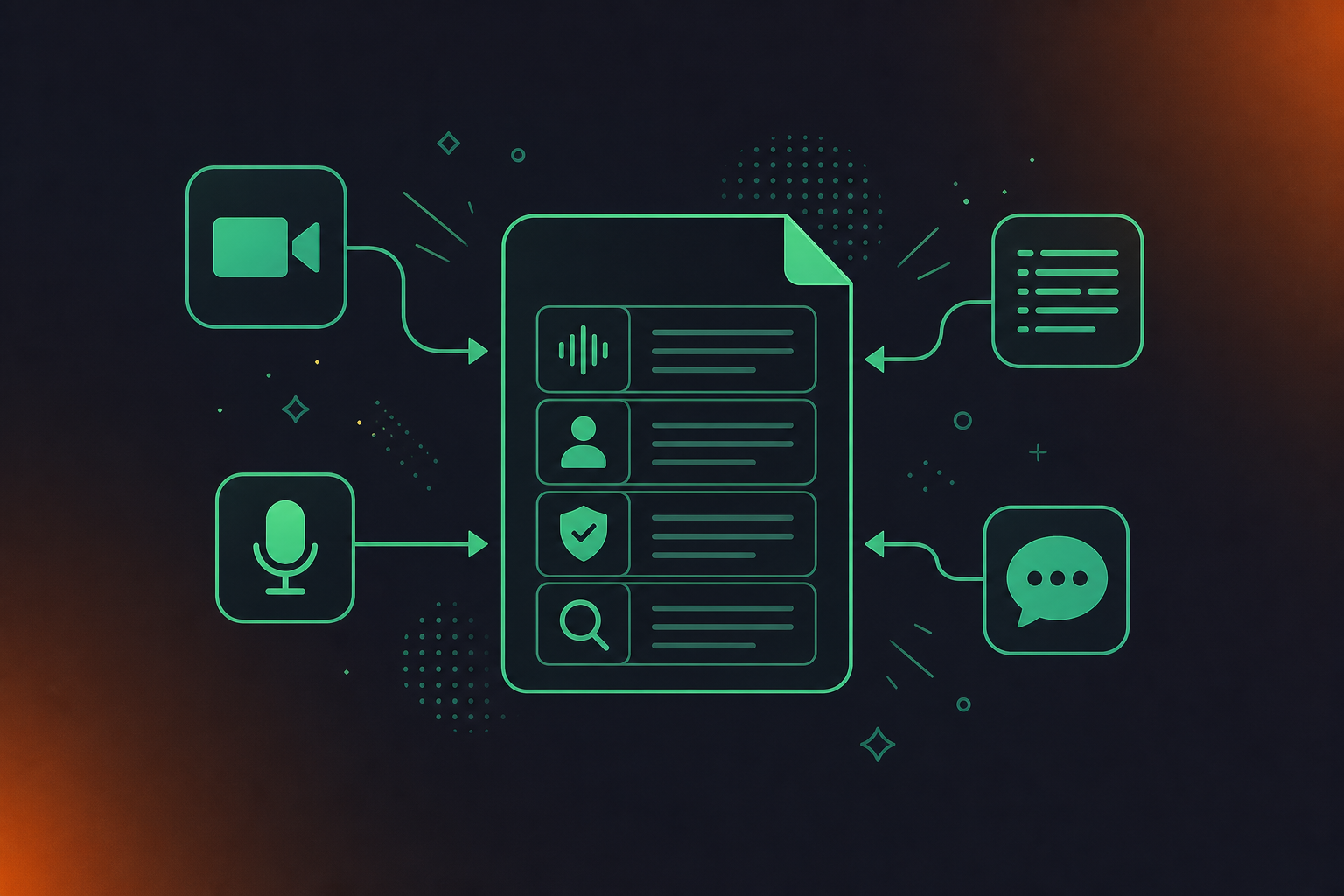
Multimodal capture | Video, audio, transcript, screen share, and in-meeting chat | Transcript alone leaves the record incomplete |
Speaker attribution | Named owners tied to every decision and action item | Prevents items from floating unassigned after the call |
Automated structured output | Decisions, action items, and follow-ups routed at meeting end | Eliminates manual re-entry as the hand-off mechanism |
Full-corpus search | Retrieval across every conversation in the organization | Replaces per-user silos with one queryable record |
Org-level policy controls | Sharing rules set and enforced at the org level | Removes individual discretion from governance decisions |
Configurable retention | Independent retention windows per data type (transcript, summary, video) | Matches different regulatory obligations by data type |
What separates this from a folder of recordings is governance. Any tool can store a file. A system of record makes that file searchable, attributable, policy-governed, and auditable. Without those properties, you have storage, not a record.
How Structured Outputs Route Into Downstream Systems
Storing meeting data is only half the problem. The other half is getting it to the systems where work actually happens, without asking someone to re-type everything after the call ends.
The routing logic looks like this in practice:
- Decisions and action items with named owners flow into Jira tickets from meeting transcripts, Linear, or Asana as structured tickets, not as a raw transcript someone has to parse later.
- Customer context from sales and CS calls updates CRM records in Salesforce or HubSpot via a Google Meet HubSpot integration, including custom field mapping for methodology-specific data.
- Structured summaries sync to Confluence automatically, Notion, or Google Docs so knowledge bases reflect what was actually decided, beyond what was planned.
- Claude and ChatGPT, connected via MCP server and meeting transcripts, can query across the full organizational corpus instead of operating blind to everything that happened in conversation.
Most enterprises are still running the alternative: someone takes notes during the meeting, manually re-enters decisions into the project tracker, updates the CRM by hand, and pastes a summary into the wiki. Every step in that chain is a point where context gets dropped, misattributed, or skipped entirely when time runs short.
The structural difference a system of record introduces is routing by policy, not by individual effort. Outputs are produced at meeting end and directed automatically based on meeting type, participant, or series. A sprint planning session generates Jira tickets. A sales call updates the opportunity record. A cross-functional sync populates the relevant project space. No manual hand-off required.
Recording Consent, Security, and Compliance for Enterprise Meeting Data
A single conversation can contain financial projections, personnel decisions, health information, and legal exposure in one unstructured file. That mix is what makes governance hard, and why regulators are increasingly specific about how enterprises handle it.
The compliance surface breaks into four areas:
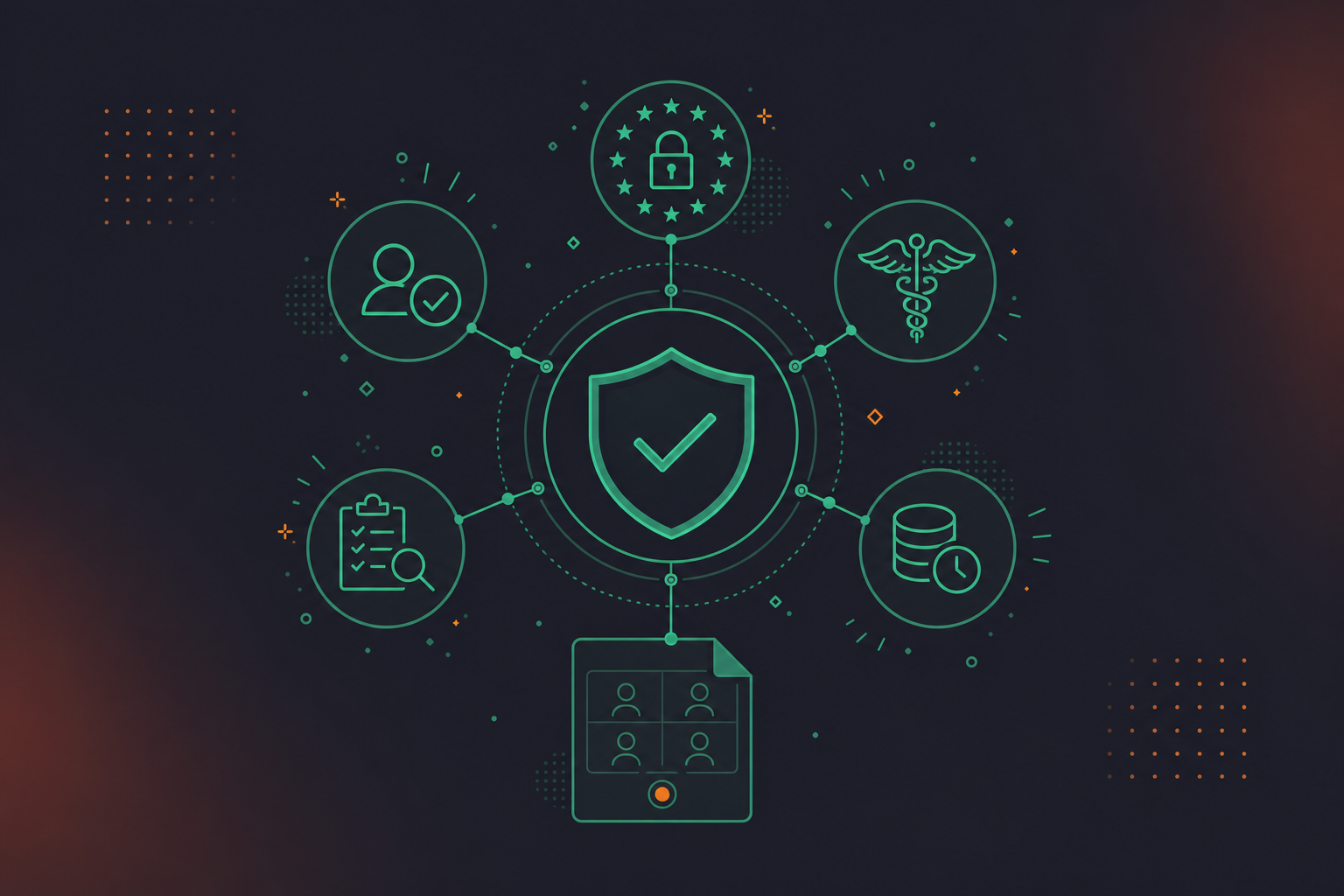
- Consent notification before capture begins. The recording bot must be visible and identified. Enterprises can configure bot naming, custom in-meeting notification text, and waiting-room admission gated on verbal consent.
- Retention configured per data type. Transcript, summary, and video may carry different regulatory obligations. Enterprise-grade retention controls let you set each independently, from one week to indefinite.
- PII handling at the transcript level, including structured identifiers such as payment card and national ID numbers.
- Audit logging and access governance, so you can show who accessed what and when.
The penalty exposure for getting this wrong is concrete. GDPR and HIPAA violation penalties For enterprises in financial services, healthcare, or legal, meeting recordings are governed data by default.
The Shadow IT Problem: Individual Note-Takers at Scale
It starts with good intentions. One engineer installs Fireflies (and there are many Fireflies.ai alternatives available). A sales rep signs up for Otter. The product team picks Fathom. Each person is solving their own problem, and each solution works fine in isolation. Six months later, IT is looking at a dozen unapproved tools processing sensitive conversations, and no one can tell you where any of that data lives.
Shadow AI, the use of AI tools outside any IT-approved framework, is currently the biggest blind spot in enterprise AI governance. Individual note-takers are the clearest example of how it spreads. See Spinach AI vs Fireflies.ai for a direct comparison. The fix is deploying one organizational system, company-wide, with enforced policy instead of letting individuals accumulate personal tools that produce per-user silos with no shared retrieval and no auditable record.
How to Build a Meeting System of Record: An Enterprise Rollout Playbook
According to the 2025 State of Enterprise Data Governance report, 31% of organizations are still in the early stages of AI governance policy development, which means the policy work cannot wait for the tooling to be live.
A practical rollout sequences governance before deployment:
- Define a recording policy first: who can record, what requires explicit consent, and what categories of meeting are excluded.
- Define meeting tiers with distinct capture rules. Board-level, compliance-sensitive, and client-facing meetings carry different retention and access requirements than internal standups.
- Select a centralized tool with org-level enforcement, not per-user settings that individuals can override.
- Configure retention per data type. Transcript, summary, and video may need different windows depending on jurisdiction and meeting category.
- Connect outputs to existing systems: CRM, ticketing, and knowledge base. A system of record has no value if it doesn’t feed the tools where work happens.
- Measure adoption at the org level, not by asking individuals whether they’re using it.
This is a governance initiative that runs through IT, legal, HR, and procurement before a single meeting is recorded.
The Enterprise System of Record for Conversation Data: How It Works in Practice
Spinach AI joins meetings across Zoom, Google Meet, Microsoft Teams, Slack Huddles, and Webex, capturing video, audio, transcript, screen share, and in-meeting chat in 100 languages, and delivering structured outputs when the meeting ends. That multimodal input feeds a single organizational record, not fragmented per-user silos. Collections group and share meetings automatically by participant, title, or series, while SAML SSO and SCIM handle provisioning at the org level.
Retention is configurable per data type on Enterprise, with transcript, summary, and video each set independently from one week to indefinite. Policy-based controls classify and flag regulatory and policy risk against a customer-supplied rule set, surfacing findings for a person to act on.
Structured outputs route automatically into Salesforce, HubSpot, Jira, Confluence, Notion, Slack, and more without manual re-entry. Where individual note-takers stop at per-user summaries with no organizational record, Spinach is the governed, company-wide platform. Spinach AI is SOC 2 Type II, GDPR, and HIPAA compliant, with a BAA available for Enterprise and HIPAA engagements. Customer data is never used to train AI models, and zero data retention terms apply with all LLM providers.
Final Thoughts on Governing Conversation Data Across Your Organization
The gap between what gets decided in meetings and what actually lands in your systems is not a people problem. It’s a governance problem, and it compounds across every quarter of unstructured, ungoverned conversation data. Fixing it means treating meetings the same way you treat any other governed data asset: captured by policy, attributed to owners, and routed automatically to the tools that need it. Spinach AI is built to be that organizational layer across Zoom, Meet, Teams, Slack Huddles, and Webex.
AI agents query whatever is structured and accessible: your CRM, your ERP, your data warehouse. Meeting context never makes it into those systems unless someone manually re-enters it, which means every forecast, proposal, or risk summary your agents produce is built without the decisions, commitments, and reasoning behind the numbers. The blind spot persists because decades of enterprise data investment went toward structured databases while conversation data stayed ungoverned and unretrievable.
The decision hinges on architecture, not features. Native tools like Microsoft Copilot and Zoom AI Companion deliver individual productivity outputs well, but they are not an organizational system of record: querying all of your company’s conversation data with Claude or ChatGPT on a native stack requires either building a centralization layer on their API or asking every employee to share every meeting by hand. Spinach AI is deployed company-wide as the governed layer on top of those platforms, capturing every conversation across Zoom, Google Meet, Teams, Slack Huddles, and Webex into a single organizational record with enforced policy, configurable retention per data type, and direct connections to your CRM, ticketing, and knowledge systems.
Start with policy before tooling: define who can record, what requires explicit consent, and which meeting categories are excluded. Then select a centralized tool with org-level enforcement (not per-user settings that individuals can override), configure retention per data type (transcript, summary, and video may carry different regulatory obligations), and connect structured outputs to your CRM, ticketing, and knowledge base so the record actually feeds the systems where work happens. Individual note-takers like Otter, Fireflies, and Fathom each solve one person’s problem. Deployed across a company, they produce uncontrolled sharing, no shared retrieval, and no auditable organizational record.
Four areas require explicit policy: consent notification before capture begins (the recording bot must always be visible and identified); retention configured per data type, since transcript, summary, and video may carry different compliance obligations depending on jurisdiction; PII handling at the transcript level, including structured identifiers such as payment card and national ID numbers; and audit logging with access governance so you can show who accessed what and when. The penalty exposure for gaps here is concrete: GDPR violations can reach 20 million euros or 4% of annual global revenue, and HIPAA violations can reach $1.5 million per year per provision violated, which means meeting recordings in financial services, healthcare, and legal are compliance-governed data by default.
Gong is purpose-built for sales-coaching and revenue workflows on customer-facing calls; it does that specific use case well, and Spinach is not at feature parity there. The pattern in practice is that organizations keep Gong for customer-facing meetings and deploy Spinach everywhere else (product, engineering, HR, legal, leadership), feeding one queryable organizational corpus from both sources instead of leaving most of the company without any governed conversation record at all.
A system of record is the authoritative input layer that captures and governs data; a single source of truth is the consolidated output the rest of the organization queries for a definitive answer. Your CRM may be your single source of truth for customer relationships, but it only reflects what someone typed in after the call — without a system of record for conversation data feeding it, the CRM is chronically incomplete. These two things must work together, not be treated as interchangeable.
Multimodal capture means recording video, audio, transcript, screen share, and in-meeting chat from a single meeting — not just the words spoken. Transcript alone leaves out shared visuals, in-meeting decisions made via chat, and the full context of what was shown on screen, all of which belong in a governed organizational record. A folder of transcripts is storage; a multimodal, attributed, policy-governed record is a system of record.
Native tools like Microsoft Copilot deliver individual productivity outputs well, but their architecture is not an organizational system of record — querying all of your company’s conversation data with Claude or ChatGPT on a native stack requires either building a centralization layer on their API or asking every employee to share every meeting manually. A dedicated platform sits as a governed layer on top of those tools, capturing every conversation across Zoom, Meet, Teams, Slack Huddles, and Webex into a single organizational record with enforced policy and configurable retention per data type. The distinction is architecture, not features.
A meeting system of record routes outputs by policy at meeting end, not by individual effort after the call. Decisions and action items with named owners flow into Jira or Linear as structured tickets; customer context updates CRM records in Salesforce or HubSpot with custom field mapping; structured summaries sync automatically to Confluence, Notion, or Google Docs. Every step that currently gets dropped, misattributed, or skipped when time runs short is removed from the manual hand-off chain.
Enterprise-grade retention must be configurable per data type independently — transcript, summary, and video can carry different regulatory obligations depending on jurisdiction and meeting category, so setting a single retention window across all three creates compliance gaps. On Spinach’s Enterprise plan, each data type can be set separately from one week to indefinite, which lets organizations apply aggressive deletion for EU employees on transcript while retaining video indefinitely for board records. Business plan retention is a flat one year across all data types.
Define recording policy before any tool goes live: who can record, what requires explicit consent, which meeting categories are excluded, and what retention window applies per data type and jurisdiction. Then tier your meetings by sensitivity — board-level, compliance-sensitive, and client-facing meetings carry different access and retention requirements than internal standups — and select a tool with org-level enforcement rather than per-user settings individuals can override. According to the 2025 State of Enterprise Data Governance report, 31% of organizations are still in early-stage AI governance policy development, which means the policy work cannot wait for the tooling.
Spinach does not use voice biometrics and does not store biometric identifiers — speaker identification is context-based, using meeting metadata, calendar data, and participant information rather than voice signatures. Any future voice-matching capability will be opt-in. Speaker attribution tied to named owners is what separates a genuine system of record from a raw recording: decisions and action items must be attributable to a specific person, not floating unassigned after the call ends.
Yes — Spinach’s MCP server on Business and Enterprise plans connects natively to Claude and ChatGPT with OAuth, admin approval, and user-based permission enforcement, so agents can query across the full organizational corpus instead of working blind to everything that happened in conversation. This closes the AI blind spot where agents produce forecasts, proposals, and risk summaries without the decisions, commitments, and reasoning behind the numbers. The MCP connector is not included on the Pro plan.
GDPR violations from ungoverned meeting data can reach 20 million euros or 4% of annual global revenue; HIPAA violations carry escalating penalties up to $1.5 million per year per provision violated. A single meeting file can contain financial projections, personnel decisions, health information, and legal exposure simultaneously, which is why regulators treat meeting recordings in financial services, healthcare, and legal as compliance-governed data by default. The compliance surface requires explicit policy on consent notification, per-data-type retention, PII handling at the transcript level, and audit logging.
The buying path runs through CIO or Head of Enterprise Technology, CISO and security reviewers, Head of Legal and Compliance, HR for recording consent sign-off, Finance for budget approval, and Procurement for term structuring — often in that sequence. The blocker is almost never summary quality; it is security review, legal review of the DPA and AI addendum, HR consent policy, and procurement timing. Structuring the evaluation with those stakeholders in mind from the start shortens the cycle considerably.
What you should do next
You made it to the end of this article! Here are some things you can do now:
- Our library of meeting agenda templates is designed to help you run more effective meetings.
- Check out Spinach to see how it can help you run a high performing org.
- If you found this article helpful, please share it with others on Linkedin or X (Twitter)

