What Is Conversation Intelligence? (And Why No One Agrees) September 2026
Conversation intelligence has outgrown any single definition. Here's what the category covers and how to pick the right product type. Sep 2026.
 Maintouch
Your sales team uses one tool. Your contact center uses another. Your internal meetings aren’t captured at all. And somehow they all fall under the same category label. Conversation intelligence as a term has outgrown any single definition, and the gap between what vendors mean by it is wide enough to send you down the wrong evaluation path entirely. Here’s what the category actually covers.
TLDR:
- Conversation intelligence analyzes human-to-human conversations, extracting decisions, action items, and risk signals; a recording alone does none of that.
- The category label covers three architecturally different product types: contact center QA, sales revenue intelligence, and enterprise knowledge tools. Identify which one you’re buying.
- Most organizations capture and analyze less than 30% of their conversation data, leaving AI systems without the context behind decisions (AssemblyAI, State of Conversation Intelligence Report).
- Assessing tools on individual vs. organizational architecture matters more than any feature checklist; per-user deployments produce siloed outputs with no shared record.
- Spinach AI deploys company-wide as an enterprise conversation intelligence platform, capturing every conversation and routing structured outputs to Salesforce, Slack, Jira, and AI assistants via MCP.
What Conversation Intelligence Is
Conversation intelligence is the practice of using AI to capture, transcribe, and analyze spoken interactions, turning them into structured, searchable, actionable data. Sales calls, customer support conversations, internal meetings, leadership reviews: all of it becomes a queryable asset instead of a memory that fades when the call ends.
Transcription is only the input step. A raw transcript is a document. Conversation intelligence is what happens after: identifying who said what, extracting decisions and action items, surfacing risk signals, and routing structured outputs into the tools and systems that actually run a business.
Conversation Intelligence vs. Conversational AI
The names are similar enough to cause real confusion, and the confusion matters because it shapes how buyers assess tools.
Conversational AI is the interaction layer: chatbots, voice agents, virtual assistants. It generates responses and talks back. When you ask a customer service bot to check your order status, that’s conversational AI at work.
Conversation intelligence is different in kind. As IBM describes it, conversational AI is the voice you interact with, while conversation intelligence is the brain working behind the scenes to make sense of what people said. It analyzes human-to-human conversations, not human-to-machine ones. A sales call, a leadership sync, a customer support exchange: conversation intelligence captures what happened, extracts meaning from it, and routes that meaning somewhere useful.
One engages. The other analyzes. Mixing them up leads to buying the wrong category entirely.
How Conversation Intelligence Works
Raw audio sitting in a storage folder is not conversation intelligence. It’s a recording. Call recording stores audio and nothing more: you can press play and listen, but nothing gets analyzed, nothing is structured, and nothing surfaces in your CRM unless someone manually writes it up.
The pipeline that separates conversation intelligence from that starts with capture: audio gets recorded and transcribed via speech-to-text. That transcription is a starting point, not a destination. Converting spoken words into a document just gives you a very long, hard-to-read file.
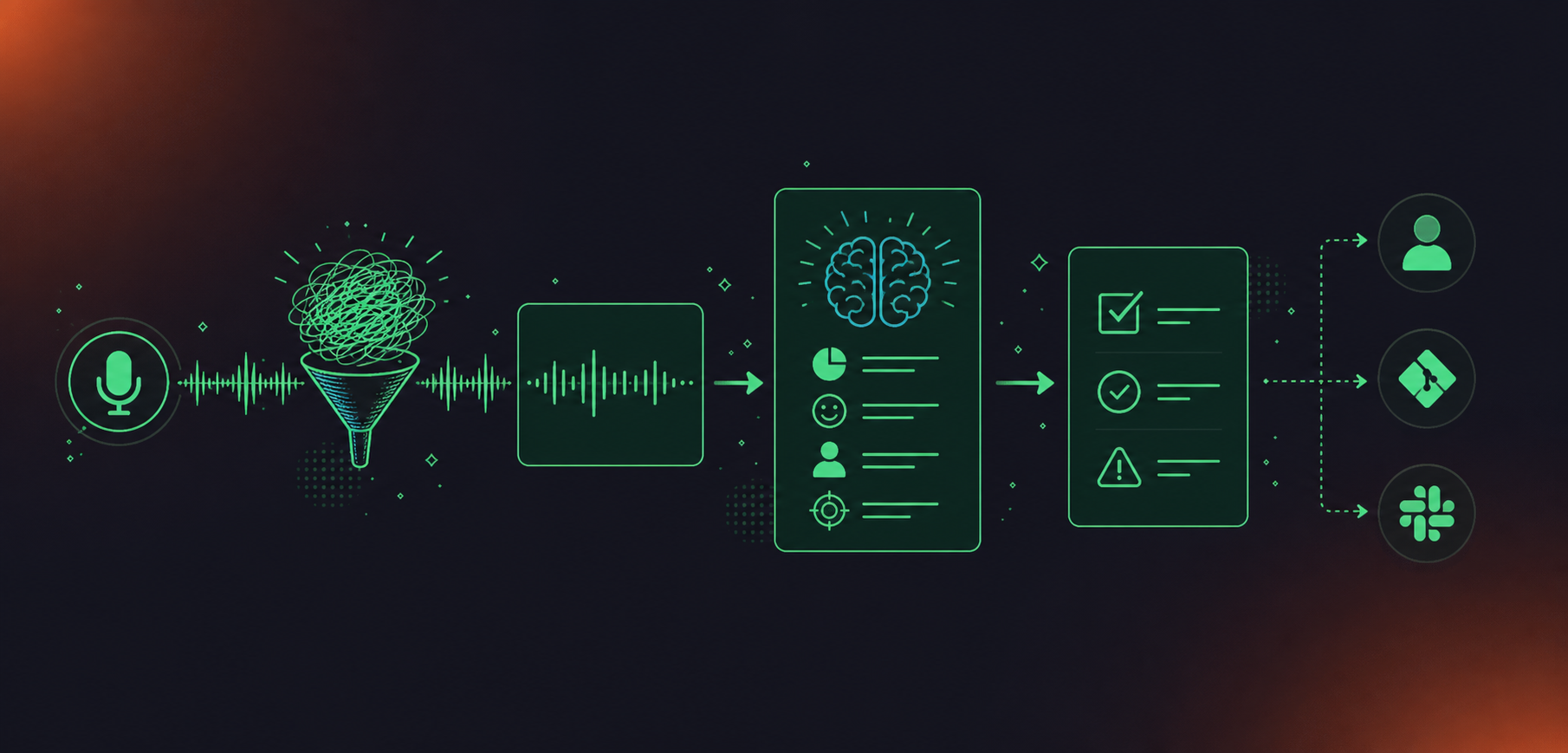
What comes next is where the analysis happens. AI models parse the transcript for meaning: which topics came up, who made which commitments, where sentiment shifted, what questions went unanswered. Speaker identification attributes statements to specific people. Intent detection flags whether a customer was frustrated, a buyer was hesitant, or a teammate agreed to own something.
From there, the system generates structured outputs: action items with named owners, decisions with context, risk signals, sentiment scores. Those outputs then route into downstream tools automatically. A CRM gets updated. A ticket gets filed. A summary lands in Slack. The raw dialogue becomes a data asset without anyone manually re-entering it.
Why the Category Definition Is Still Contested
The label “conversation intelligence” gets applied to at least three distinct product categories: contact center quality assurance tools rooted in compliance and call monitoring, sales revenue intelligence built for coaching and forecasting, and broader meeting or enterprise knowledge tools designed to feed AI systems with governed data. Vendors use the term strategically to capture search intent across all three, which makes evaluation genuinely harder for buyers.
According to AssemblyAI’s State of Conversation Intelligence Report, 76% of companies now embed conversation intelligence in more than half of their customer interactions. That adoption rate makes the category real. The shared definition is still missing.
A contact-center compliance tool is architecturally different from a conversation data system of record built to centralize conversation data across an enterprise and route it to AI agents. One audits call recordings against a regulatory checklist. The other turns every conversation a company has into a queryable, governed data asset. Calling both “conversation intelligence” does not make them interchangeable. When you assess a conversation intelligence tool in this category, the first question is not which features it has. It is which version of the category it was actually built for.
Use Cases Across the Organization
Conversation intelligence gets framed as a sales tool because sales teams were the first to deploy it at scale. The actual scope runs wider.
- Sales: Call recordings analyzed for deal risk, coaching moments, and objection patterns, with CRM fields updated automatically. Managers review calls they didn’t attend; reps get structured feedback tied to specific moments.
- Customer support: Quality monitoring at scale, flagging calls where sentiment dropped, resolution failed, or policy wasn’t followed, without a human listening to every recording.
- HR and recruiting: Interview notes become structured data, hiring patterns surface, and onboarding conversations get captured so context doesn’t vanish when a manager changes.
- Compliance-heavy industries: In financial services meeting AI compliance, healthcare, and legal, conversations are regulatory artifacts. Monitoring them against a rule set, classifying risk, and retaining records per policy is the core use case.
- Product and engineering: Customer calls surface feature requests and friction points. Leadership meetings capture decisions that would otherwise exist only in someone’s memory.
The underlying capability is consistent across all of them: spoken words captured, analyzed, and converted into structured output. What changes is what that output feeds.
Conversation Data as an Enterprise AI Blind Spot
Structured data is already AI-ready. Connect your CRM, your project management tool, your knowledge base, and the data is queryable. The reasoning behind decisions, though (why a strategy shifted, what a customer objected to, what constraints got named in a planning session) almost never makes it into any of those systems. It lives in conversations, and conversations are what enterprises consistently fail to capture at scale.
Most organizations capture and analyze less than 30% of their conversation data (AssemblyAI, State of Conversation Intelligence Report, 2026). Sales calls that reveal why deals stall, support conversations that surface customer crises early, planning sessions where ideas get floated and forgotten: that gap compounds fast across an organization running hundreds of conversations a day.
27% of enterprises have AI-ready connected data. Conversation data is the category most consistently left out of that readiness work, which means AI systems are being built on an incomplete picture of what actually happens inside the organization. Effective meeting data governance is where organizations close that gap.
Consent, Privacy, and Compliance Considerations
Recording conversations at scale is a governance problem, not a technical one.
Meetings can contain commercially sensitive information, personal details, and customer data that were never intended to become part of a permanent analytical system. When conversation intelligence tools route outputs into CRMs and downstream systems, that data crosses boundaries compliance, legal, and HR teams care about deeply.
A few areas that surface in every enterprise evaluation:
- Meeting recording consent policies: Most jurisdictions require at least one-party consent to record; many require all parties to be notified. For external participants, that means a visible bot or a pre-call disclosure, not fine print.
- Enterprise AI data retention policy: How long are transcripts, video, and summaries kept? The answer should be configurable per data type, not a single org-wide toggle.
- PII: Names, payment details, and national ID numbers can appear in conversation. Redaction at the transcript level is the expected control.
- Compliance-heavy industries: Financial services, healthcare, and legal face additional requirements. HIPAA, MiFID II, and state bar rules treat recorded conversations as regulatory artifacts, not productivity data.
The transparency question cuts both ways. A deployment employees do not know about creates legal exposure and erodes trust. Clear notification, visible bots, and defined opt-out paths tend to surface less resistance than buyers expect.
What to Look for When Assessing Conversation Intelligence Tools
Six criteria are worth pressure-testing before you commit to any meeting management software in this category.
Criterion | What to test | Why it matters |
|---|---|---|
Transcription accuracy | Run against your actual audio conditions, languages, and accents | A model optimized for clean American English degrades fast on multilingual teams or noisy environments |
AI depth | Look for sentiment analysis, intent detection, and topic modeling beyond the transcript | Transcription is table stakes; structured outputs (not a formatted document) are what drive downstream value |
Integration quality | Confirm CRM auto-update and downstream routing work without manual re-entry | Sales reps spend 70% of their time on non-selling tasks (Salesforce, State of Sales Report, 2024); automation is what moves that number |
Compliance posture | Verify SOC 2 Type II, GDPR, and HIPAA coverage, and confirm which plan tiers they apply to | Baseline requirements for any enterprise deployment; coverage often varies by tier, not vendor |
Data governance | Check that retention is configurable per data type and that PII redaction operates at the transcript level | A single org-wide retention toggle is not sufficient; access controls are expected, not optional |
Individual vs. org architecture | Determine whether the tool deploys per-user or company-wide | Per-user tools produce siloed outputs with no shared record; an org-level deployment produces a governed, queryable corpus AI systems can actually use |
That last point eliminates more tools than any feature checklist will.
How Enterprise Conversation Intelligence Centralizes Data at Scale
Most conversation intelligence deployments stop at the individual. A rep records their calls. A manager reviews their team’s. Each person picks a different tool, and the organization ends up with disconnected outputs, uncontrolled sharing, and no single record of what was said or decided.
Spinach AI is built for the other model. As an enterprise conversation intelligence platform, it deploys company-wide, capturing every conversation the organization has and turning it into a governed, queryable data asset that people and AI agents can actually use.
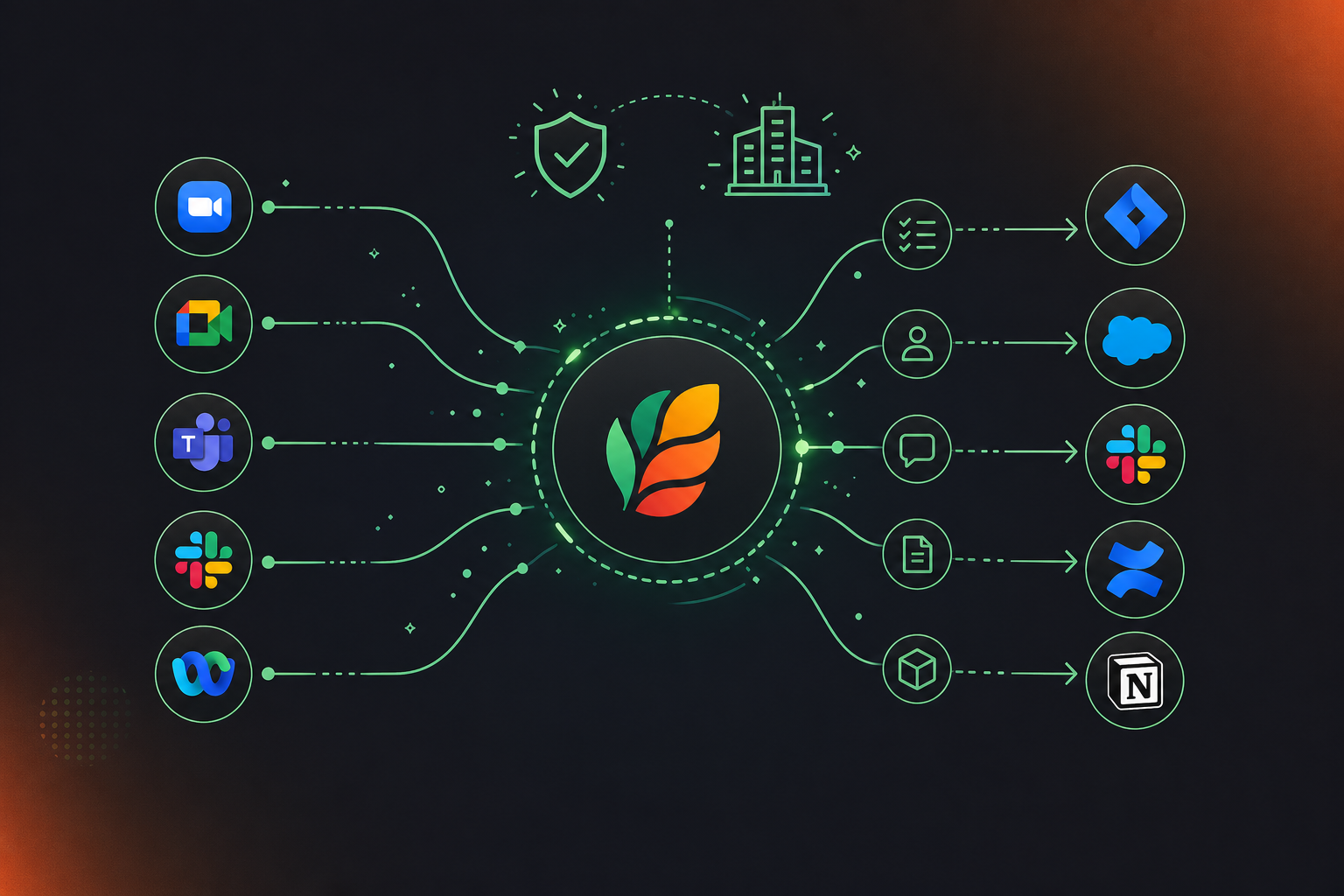
Spinach joins meetings across Zoom, Google Meet, Microsoft Teams, Slack Huddles, and Webex, capturing every modality: video, audio, transcript, screen share, and in-meeting chat. It supports 100 languages using a transcription-model-agnostic approach, selecting the best available model per language instead of locking to one vendor’s accuracy ceiling. At the organizational level, Collections automatically group and route meetings by participant, title, or series. Founder Mode gives executives org-wide read-only visibility without requiring manual sharing from every team member. On Enterprise plans, compliance agents classify and flag regulatory and policy risk for human review.
Structured outputs route automatically into downstream systems: CRM records into Salesforce and HubSpot; decisions and action items with named owners into Jira, Linear, and Confluence; summaries into Notion and Slack. On Business and Enterprise plans, a native MCP server connects natively to Claude and ChatGPT with user-based permission enforcement, so any AI assistant the organization uses can query conversation data without a bespoke integration for every workflow.
Final Thoughts on Conversation Intelligence
The value of conversation intelligence is not the transcript. It’s the structured, routable, queryable record that comes after it. Whether your focus is sales, compliance, recruiting, or feeding AI agents with better context, the category is worth taking seriously. Set up Spinach AI to see how an enterprise conversation intelligence platform captures every conversation and routes structured outputs across your organization.
Conversation data is the most consistently uncaptured category in enterprise AI readiness. Structured data (CRM records, tickets, project briefs) is already queryable, but the reasoning behind decisions, the constraints named in planning sessions, and the objections raised on sales calls almost never make it into those systems. They live in conversations, and most organizations capture and analyze less than 30% of their conversation data (AssemblyAI, State of Conversation Intelligence Report). AI systems built without that input are working from an incomplete picture of what actually happens inside the organization.
Conversation intelligence analyzes human-to-human interactions (sales calls, internal meetings, support exchanges) and converts them into structured, queryable data. Conversational AI is the interaction layer: chatbots and voice agents that generate responses when a person talks to a machine. One analyzes; the other engages. Shopping for tools without distinguishing the two leads to buying the wrong category entirely.
Individual notetakers are built for one person’s meetings and stop at the output for that person. Deployed across a company, they produce a different tool per team, uncontrolled sharing, no shared organizational record, and shadow IT that compliance and legal teams inherit. Spinach deploys company-wide as a single governed platform, centralizing every conversation the organization has into a queryable data asset that both people and AI agents can use: policy-based sharing, configurable retention per data type, and structured outputs that route automatically into Jira, Salesforce, Slack, and other downstream systems.
The technical checklist matters less than the governance architecture. Confirm whether the tool produces a single organizational record or per-user silos, whether retention is configurable per data type (transcript, summary, video) or a single org-wide toggle, and whether sharing is policy-based or requires manual action from every employee. Compliance posture (SOC 2 Type II, GDPR, HIPAA, and BAA availability) should be confirmed against the specific plan tier, not assumed across all tiers. The final question is whether the platform can feed AI agents and downstream systems through an MCP server or API, or whether every workflow requires a bespoke integration.
Most jurisdictions require all participants to be notified that a meeting is being recorded: a visible bot or pre-call disclosure, not fine print. For external participants, organizations need a defined process for meetings where customers or counterparties decline recording. Retention should be configurable per data type, PII redaction should operate at the transcript level, and industries with strict compliance requirements (financial services, healthcare, legal) face additional requirements where recorded conversations are regulatory artifacts, not productivity data. A deployment employees do not know about creates legal exposure; clear notification policies and defined opt-out paths produce less resistance than most buyers expect.
The category covers three architecturally different product types: contact center quality assurance tools built for compliance and call monitoring, sales revenue intelligence tools built for coaching and forecasting, and enterprise knowledge tools designed to feed AI systems with governed conversation data. Identifying which type you are buying matters more than comparing feature lists, because a compliance QA tool and a company-wide conversation data system solve fundamentally different problems.
Call recording stores audio and nothing more — you can play it back, but nothing gets analyzed, structured, or routed anywhere without manual effort. Conversation intelligence picks up after capture: AI models parse the transcript for decisions, commitments, sentiment shifts, and risk signals, then route structured outputs like action items and CRM updates into downstream tools automatically.
Per-user tools work for one person’s meetings but produce siloed outputs, uncontrolled sharing, and no shared organizational record when deployed across a company — which is how shadow IT accumulates. A company-wide deployment produces a single governed, queryable corpus that AI agents and downstream systems can actually use, with policy-based sharing and configurable retention rather than manual action from every employee.
Speaker identification attributes statements in a transcript to specific individuals so structured outputs — action items, decisions, risk signals — carry named owners rather than anonymous labels. Context-based speaker identification does not use voice biometrics and does not store biometric identifiers; enterprise buyers in regulated industries should confirm this distinction before deployment, as biometric data triggers separate compliance requirements.
At minimum, look for CRM auto-update with custom field mapping (Salesforce, HubSpot), project management ticket creation (Jira, Linear, Asana), knowledge base routing (Confluence, Notion), and chat delivery (Slack) — all without manual re-entry. For organizations running AI agents, a native MCP server or API that lets Claude or ChatGPT query conversation data directly is the integration that closes the gap between meeting context and the systems that run the business.
The two tools cover different scopes rather than the same ground: a revenue intelligence tool handles customer-facing sales calls with deep coaching and forecasting features, while an enterprise conversation intelligence platform captures every other conversation the organization has — internal meetings, recruiting, leadership reviews, product planning — and feeds a single queryable record. The common pattern is retaining the revenue tool for its specific sales-coaching use case and deploying an org-wide platform for everything else, then consolidating over time.
Transcription accuracy in non-English languages depends almost entirely on which speech-to-text model a platform uses, and most platforms are locked to a single vendor’s model. A transcription-model-agnostic approach — selecting the best available model per language rather than applying one model universally — is why accuracy leads in languages like Hebrew, where a single locked model degrades significantly. Before deploying any platform across a multilingual organization, test it against your actual audio conditions and languages, not a vendor-supplied demo.
In these industries, recorded conversations are regulatory artifacts, not productivity data — HIPAA governs healthcare, MiFID II applies to financial services firms in relevant markets, and state bar rules cover legal proceedings. The baseline requirements for enterprise deployment are SOC 2 Type II, GDPR compliance, and HIPAA compliance with a BAA available; confirm which plan tiers each certification covers, because coverage often varies by tier, not just by vendor.
A transcript is a starting point, not a deliverable. The structured outputs that drive downstream value are: action items with named owners, decisions with context, sentiment and intent signals, risk flags, and topic classifications — all routed automatically into CRM records, project management tickets, knowledge bases, and AI assistants. If a platform delivers a formatted document rather than discrete, routable data objects, it has not crossed the line from transcription into conversation intelligence.
Compliance agents monitor conversation data against a customer-supplied rule set, then classify and flag meetings that contain regulatory or policy risk for human review — they surface risk for a person to act on rather than taking automated action themselves. This capability matters most in financial services, healthcare, and legal environments where specific conversation content (pricing discussions, clinical information, privileged communication) creates legal exposure if left unmonitored at scale.
What you should do now
Now that you've read this article, here are some things you should do:
- If communication is a challenge for your team, you should check out our library of meeting agenda templates.
- Learn more about Spinach and how it can help you run a high performing org.
- If you found this article helpful, please share it with others on Linkedin or X (Twitter)

