What Is Conversation Intelligence? Enterprise Guide (2026)
Cut through the category noise with this August 2026 enterprise guide to conversation intelligence, covering workflows, security, and platform selection.
 Maintouch
The gap between what gets said in meetings and what ends up in your systems is bigger than most teams realize. Deals get shaped on calls, strategies shift in planning sessions, and product direction changes in design reviews, but your CRM, your tickets, and your knowledge base only know what someone manually re-entered afterward. If you’re looking at enterprise conversation intelligence and want to cut through the category noise, here’s what actually matters.
TLDR:
- Conversation intelligence turns spoken dialogue into governed, queryable data by running through five stages: capture, transcription, AI analysis, insight generation, and integration.
- Most organizations analyze less than 30% of their conversation data (AssemblyAI), leaving the richest AI input ungoverned while spending heavily on CRMs and knowledge bases.
- Conversation intelligence and conversational AI are not the same thing; conflating them causes real buying mistakes at the enterprise level.
- Enterprise deals stall on consent policy, PII handling, and retention controls, not output quality; SOC 2 Type II, GDPR, and HIPAA compliance are table-stakes requirements.
- Spinach AI is deployed company-wide as the enterprise system of record for conversation data, capturing every conversation and routing structured outputs, such as decisions, action items with named owners, tickets, and CRM records, into Salesforce, HubSpot, Jira, Linear, Confluence, and more.
What Is Conversation Intelligence?
Conversation intelligence is the practice of capturing, transcribing, and analyzing spoken conversations to extract structured insights organizations can act on. The goal is not recording for its own sake. It’s turning unstructured dialogue into governed, queryable data that feeds decisions, workflows, and AI systems across the enterprise.
Every organization runs on conversations, but most of those conversations disappear the moment the call ends. What was decided? Who owns the follow-up? What did the customer actually say? Conversation intelligence answers those questions by making spoken language as searchable and structured as any other enterprise data source.
The market reflects that urgency. The conversation intelligence software market is projected to grow from $22.89 billion in 2024 to $49.52 billion by 2032 (SNS Insider, Nov 2025), driven by enterprises that need conversation data wired into the systems and agents that actually run the company.
How Conversation Intelligence Works
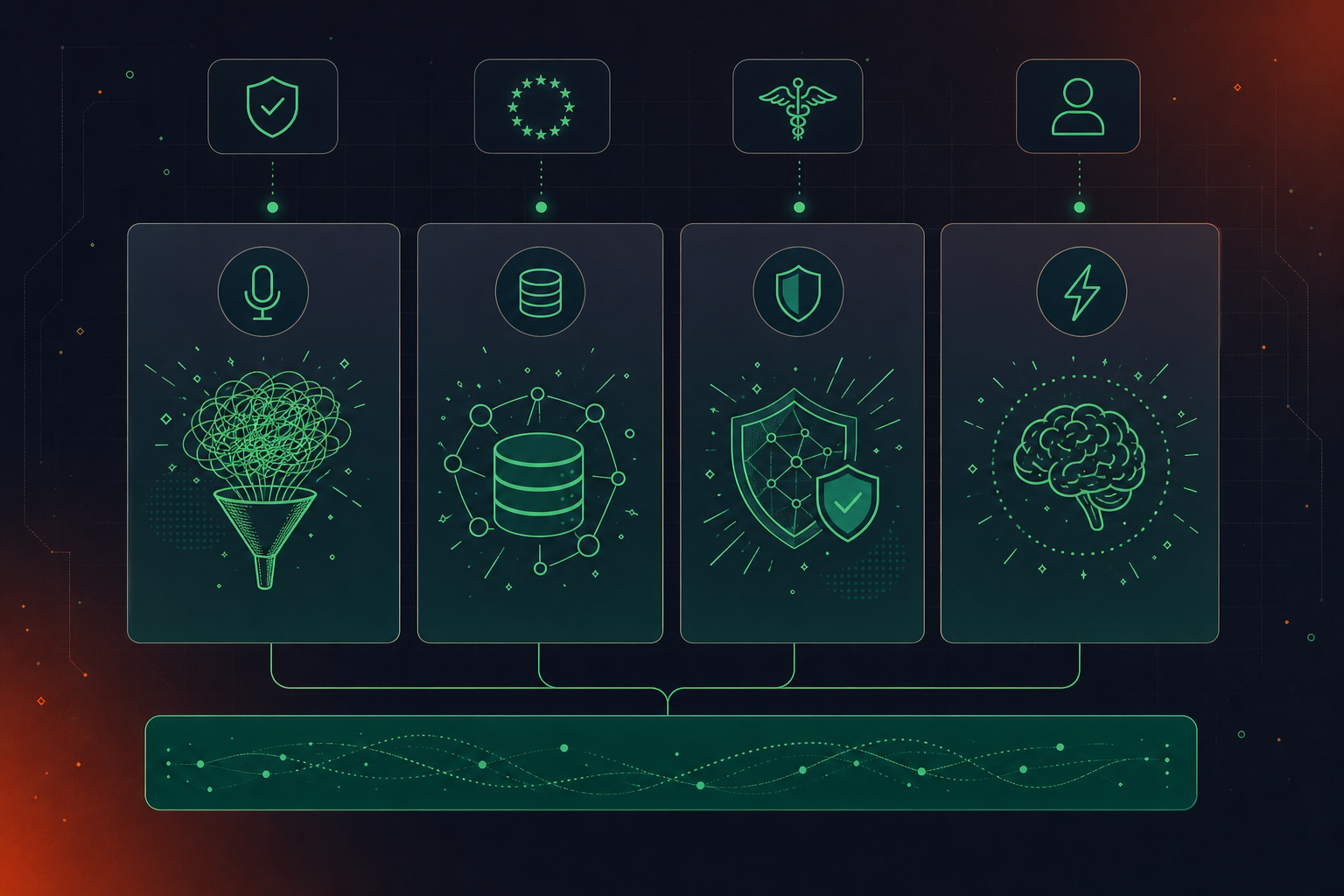
The process runs in five stages, each building on the one before it.
Capture
A conversation intelligence system joins or ingests the meeting across video calls, phone lines, or recorded uploads, capturing every available signal: audio, video, screen share, and in-meeting chat. The broader the capture, the richer the downstream data.
Transcription
Audio becomes text through AI transcription tools, with speaker identification layered on top so each statement is attributed to the right person. Accuracy varies by model, language, and audio quality.
AI Analysis
The transcript gets analyzed for patterns: topics discussed, sentiment changes, keywords, objections raised, questions asked. Raw text starts becoming usable intelligence.
Insight Generation
Structured outputs follow: summaries, decisions, action items from meeting transcripts with named owners, risk signals, coaching flags. A sales call might surface deal risk and next steps. A planning session might produce spec decisions and open blockers.
Integration
Those outputs route into the systems that need them. CRM records get updated. Tickets get filed. Knowledge bases get populated. Without this step, insight generation produces a notification nobody acts on.
Value scales with integration depth. The best AI transcription software only solves a search problem. A system that completes the full chain is a data infrastructure question.
Conversation Intelligence vs. Conversational AI
These two terms show up in the same searches constantly, and they describe fundamentally different things.
Conversational AI refers to systems that generate responses in a dialogue. Chatbots, virtual assistants, and LLM-powered interfaces all qualify. The output is a reply.
Conversation intelligence analyzes conversations between humans. The output is meaning extracted from what was said: decisions, risks, patterns, structured data. One creates dialogue; the other interprets it.
Where they overlap in enterprise deployments is worth understanding. Once a conversation intelligence system has built a governed corpus of analyzed meetings, a conversational AI interface can sit on top of it. Ask a question in plain language, get an answer drawn from months of actual company conversations. Conversation intelligence supplies the structured data layer; conversational AI supplies the retrieval interface.
Conflating the two causes real buying mistakes. A team that deploys a chatbot expecting meeting analysis ends up with neither.
Use Cases Across the Enterprise
Conversation intelligence gets framed as a sales tool because that’s where the category started. Enterprise buyers deploy it across every function, and the ROI case grows when you stop treating it as a single-department purchase.
Sales and Revenue Teams
The clearest use case: coaching, deal risk signals, and CRM auto-update. According to Allego’s conversation intelligence research (2024), sales reps who receive conversation intelligence-based coaching see measurable improvement in quota attainment. Beyond coaching, the system flags objections, surfaces stalled deals, and updates CRM fields without manual re-entry after every call.
Customer Service and Contact Centers
Quality assurance teams can review flagged calls instead of random samples. Agent performance data becomes structured instead of anecdotal. Customer complaint trends surface across thousands of calls simultaneously, giving product and operations teams signal they’d otherwise miss.
HR and People Teams
Interview notes vary wildly by interviewer. Conversation intelligence standardizes what gets captured, making hiring decisions easier to defend and compare. Onboarding conversations, performance discussions, and communication coaching all generate structured inputs instead of scattered notes.
Product and Engineering
Decisions made in planning sessions rarely make it into the ticket. Specs discussed in a design review disappear by the following sprint. Conversation intelligence captures that context in structured form, links it to existing tickets, and gives coding agents the background they need to work accurately. Cross-team misalignment surfaces before it becomes a missed deadline.
The pattern across all four areas is the same: spoken context that used to evaporate becomes a governed data asset the whole organization can query. This matters especially when choosing AI tools for remote teams, where conversation data is often the only shared record.
Conversation Data: The Enterprise AI Blind Spot
Most enterprise AI deployments are wired into CRMs, project management tools, and knowledge bases. Those systems hold structured records, but they hold a fraction of the actual signal. The decisions, objections, strategic context, and human intent that drive those records originate somewhere else: in conversations.
According to AssemblyAI, most organizations analyze less than 30% of their conversation data. The other 70% goes unexamined. That gap matters beyond the meetings themselves. When AI agents and assistants draw on incomplete inputs, they produce incomplete outputs. An agent that can query your CRM but not the sales call where the deal terms were actually negotiated is working with a partial picture. The CRM entry reflects what a rep remembered to type. The call reflects what actually happened.
This is the enterprise AI blind spot: organizations spend heavily on AI infrastructure, then feed it the clean, structured data while leaving the richest signal ungoverned. Fixing it requires treating conversation data as a first-class enterprise asset, not a folder of per-user notes.
Enterprise Governance, Security, and Compliance Requirements
Enterprise deals rarely stall on output quality. They stall on recording consent policy, data retention controls, PII handling, and security certifications.
Enterprise buyers reviewing conversation intelligence software move through a predictable sequence: security review, legal sign-off on the DPA, HR approval on consent workflows, then procurement. Each stage surfaces specific requirements:
- Consent and notification: the recording bot must always be visible, with org-configurable branding and in-meeting notification text that legal can approve before deployment
- Configurable retention per data type: transcript, summary, and video each set separately, from one week to indefinite on Enterprise
- PII redaction at the transcript level, covering structured identifiers like payment card and national ID numbers
- SOC 2 Type II, GDPR, and HIPAA compliance, with a BAA available for healthcare engagements
- Admin controls that enforce org-wide defaults instead of relying on per-user settings
- Multiparty-consent handling for global teams, where recording laws vary by jurisdiction
The compliance monitoring question comes up frequently. The accurate framing is classify-and-flag: surfacing regulatory risk for a human reviewer, not automated remediation or deletion.
How to Assess Enterprise Conversation Intelligence Software
Eight criteria separate a point tool from an organizational system. Work through them in sequence before shortlisting any vendor.
Evaluation Criteria | Individual Note Taker | Enterprise Conversation Intelligence |
|---|---|---|
Meeting platform coverage | One or two platforms | All major platforms, cross-setting |
Transcription accuracy | Single model, English-dominant | Model-agnostic, best model per language |
Integration depth | Export or copy-paste | Native CRM, PM, knowledge base routing |
AI output quality | Summary, basic action items | Structured decisions, named owners, tickets, CRM fields |
Governance controls | Per-user settings | Org-enforced defaults, admin dashboard |
Security certifications | Varies | SOC 2 Type II, GDPR, HIPAA, BAA |
Deployment model | Individual adoption | Company-wide, record-by-default |
Pricing structure | Per seat, per person | Per org coverage, scales without shadow IT |
The structural gap between rows one and seven explains most failed deployments. Individual note takers get adopted person-by-person, producing a different tool per team, uncontrolled sharing, and no single governed record. That pattern is covered in depth in the Spinach AI vs Fireflies comparison. Enterprise conversation intelligence gets deployed once, top-down, with policy enforced from day one.
On pricing, org-wide coverage changes the math. A per-user tool that half the company ignores costs more per captured conversation than a governed deployment everyone runs on.
How Spinach AI Captures, Centralizes, Manages, and Powers the Enterprise
Spinach AI is the system of record for conversation data, deployed company-wide and not adopted person-by-person, powering thousands of organizations including public enterprises across Zoom, Google Meet, Microsoft Teams, Slack Huddles, and Webex.
The four-verb model maps directly to the evaluation criteria above:
- Capture: Every modality across every meeting, video, audio, transcript, screen share, and in-meeting chat, in 100 languages using a transcription-model agnostic architecture that picks the best available model per language.
- Centralize: One governed organizational record, searchable across the full corpus. Collections group and share meetings automatically by participant, title, or series, with no per-user silos.
- Manage: SAML SSO and SCIM provisioning (Enterprise), org-enforced defaults, configurable retention per data type from one week to indefinite, PII redaction at the transcript level, compliance monitoring that classifies and flags regulatory risk for human review, and a BAA for HIPAA engagements.
- Power: Ask Spinach queries the full meeting corpus in plain language. MCP connectors for Claude and ChatGPT (Business and Enterprise) let AI assistants draw on governed conversation data. Outputs route natively into Salesforce, HubSpot, Jira, Linear, Confluence, and more.
Tools like Fireflies.ai and other per-person note takers produce shadow IT and no organizational record. Native platform AI delivers individual productivity features, but querying all of your organization’s conversation data on that architecture means either building a centralization layer or asking every employee to share every meeting by hand.
Spinach starts free. Pro runs $2.90 per meeting hour. Business is $29/user/month, or $19/user/month billed annually. Enterprise is custom pricing. All plans include a 14-day free trial with no credit card required. For a direct feature breakdown, see the Spinach AI vs Fathom comparison.
Final Thoughts on Building a Conversation Intelligence System
The difference between a useful conversation intelligence deployment and a folder of per-user notes comes down to governance, integration depth, and whether the whole organization runs on one record. Your AI agents, your CRM, and your teams can only work with the context they can actually access. Getting that context out of individual inboxes and into a governed, queryable corpus is the structural shift that makes everything else more accurate. Try Spinach AI free and see how quickly a company-wide record comes together.
Most enterprise AI infrastructure connects to CRMs, project management tools, and knowledge bases — structured systems that hold clean records. The problem is those records capture what someone remembered to type, not what actually happened. The decisions, objections, and strategic context that drive those records originate in conversations, and according to AssemblyAI, organizations analyze less than 30% of their conversation data. AI agents drawing on incomplete inputs produce incomplete outputs, which is why treating conversation data as a governed, queryable asset — not a folder of per-user notes — is the structural fix.
The short answer: one governed conversation intelligence platform deployed company-wide, not a collection of per-person note takers. Individual tools like Otter, Fireflies, or Fathom solve one person’s problem and produce shadow IT, uncontrolled sharing, and no organizational record when adopted at scale. Native platform AI from Zoom, Microsoft Teams, or Google Meet delivers individual productivity features well, but their architecture is not an organizational system of record — querying all your company’s conversation data on that stack requires either building a centralization layer or asking every employee to share every meeting by hand. Spinach AI is built for company-wide deployment with SAML SSO and SCIM provisioning, org-enforced defaults, configurable retention per data type, and compliance agents that classify and flag regulatory risk for human review.
For sales-coaching depth and revenue workflows, Gong remains the category benchmark. The more common pattern in enterprise deployments: organizations keep their revenue intelligence tool for customer-facing calls, roll out a conversation intelligence platform like Spinach AI everywhere else, and feed one governed data asset from both sources — with consolidation happening over time. Spinach’s advantages in this model are org-wide scope, a single retrieval layer across all conversation data, buildability via API and MCP for custom pipelines, and materially lower cost for company-wide coverage.
Recording consent requires the bot to always be visible — never covert — with org-configurable branding and in-meeting notification text that legal can approve before deployment. On PII, redaction operates at the transcript level and covers structured identifiers including payment card and national ID numbers. Enterprise retention is configurable per data type — transcript, summary, and video can each be set separately, from one week to indefinite. For regulated industries, SOC 2 Type II, GDPR, and HIPAA compliance apply, with a BAA available for healthcare engagements. These controls are enforced at the org level, not left to per-user settings.
Gong is purpose-built for sales coaching and revenue workflows — if that is the primary use case, it remains the deeper tool for that specific function. Spinach AI is built for company-wide deployment: capturing conversations across every team and function, centralizing them into a single governed data asset, and powering both people and AI agents with that context via MCP connectors for Claude and ChatGPT, native CRM and project management integrations, and an API for custom pipelines. The buying pattern that plays out most often is running both in parallel, with Spinach covering the 80% of the organization that a sales-focused revenue intelligence tool was never deployed to reach.
An individual AI note taker solves one person’s problem — it captures and summarizes meetings for a single user. A conversation intelligence platform is deployed company-wide, creating one governed organizational record where data is searchable, policy-enforced, and routable into CRMs, project management tools, and AI agents across the enterprise, rather than scattered across per-user inboxes.
After a meeting ends, the platform structures outputs — decisions, action items with named owners, deal signals, or spec details — and routes them natively into connected systems without manual re-entry. For example, a sales call can update CRM fields in Salesforce with custom field mapping, while a planning session can generate and link tickets directly in Jira or Linear.
You get shadow IT: uncontrolled sharing, no organizational record, and data trapped in per-user silos with no consistent governance or retention policy. Security and compliance teams have no visibility into what was captured or where it went, which is why enterprise IT and legal reviews almost always require consolidating on a single governed platform.
Yes, but accuracy varies significantly by vendor architecture. A model-agnostic approach — using the best available transcription model per language rather than a single locked model — produces materially better accuracy for non-English meetings. This is a primary reason organizations in Hebrew, and other non-English-dominant environments switch providers.
Record-by-default means every meeting is captured automatically under org-enforced policy rather than relying on individuals to opt in meeting by meeting. It shifts conversation data from an inconsistent, user-driven practice into a governed organizational asset — with admin controls setting defaults for sharing scope, retention, and bot behavior across the entire company.
Native platform AI delivers individual productivity features — summaries, action items, notes — and does that well for a single user on a single platform. The architectural gap is that it is not a system of record: querying all of your organization’s conversation data across every platform requires either building a centralization layer on their API or asking every employee to share every meeting by hand. An enterprise conversation intelligence platform closes that gap by design.
The five stages are: capture (joining the meeting across video, audio, screen share, and chat), transcription (converting audio to attributed text), AI analysis (identifying topics, sentiment, objections, and patterns), insight generation (producing decisions, action items, risk signals, and structured summaries), and integration (routing those outputs into CRM, project management, and knowledge base systems). Value builds at each stage and scales with how deeply the final stage connects to the rest of your stack.
One platform deployed company-wide produces a single governed data asset that any team, agent, or system can query — sales calls, product planning sessions, HR interviews, and executive forums all feeding one organizational record. Buying per-department creates the same shadow IT problem as per-person tools: different retention policies, no cross-functional retrieval, and a security review required for each vendor rather than one.
Compliance agents monitor conversation data against a customer-supplied rule set, then classify and flag content that may carry regulatory or policy risk for a human reviewer to act on. The accurate framing is classify-and-flag — the agent surfaces the risk; a person makes the remediation decision. Automated deletion or cleanup is outside what compliance agents do.
Conversation data captures decisions, objections, strategic context, and human intent that never get typed into structured systems — the CRM entry reflects what a rep remembered to enter, while the call reflects what actually happened. When AI agents can query a governed corpus of analyzed meetings alongside CRM and project data, they work from a complete picture rather than the clean but partial records that most enterprise AI infrastructure runs on today.
What you should do next
Now that you've read this article, here are some things you should do:
- If communication is a challenge for your team, you should check out our library of meeting agenda templates.
- Check out Spinach to see how it can help you run a high performing org.
- If you found this article helpful, please share it with others on Linkedin or X (Twitter)

