Knowledge Management’s Missing Layer (September 2026)
Tacit knowledge lives in meetings, not wikis. See why KM programs fall short and how to close the conversation gap. September 2026.
 Maintouch
A lot of organizations invest in knowledge management and still can’t answer a basic question: why did we make that call six months ago? The written policies are there. The Confluence docs exist. But the reasoning, the constraints, the trade-offs that shaped the decision? That all happened in a meeting. And meetings, for most organizations, are still a complete blind spot in how they think about capturing what they know.
TLDR:
- Most KM tools only capture explicit knowledge; tacit knowledge lives in conversations and walks out when employees leave
- Employees waste 19.8% of work time searching for information, roughly one full day per week (Interact)
- A 17,700-person org loses $47M per year to inefficient knowledge sharing (Panopto)
- Most institutional knowledge sits with individual employees, and median employee tenure hit a 22-year low of 3.9 years as of January 2024, the latest BLS figures available as of publication
- AI agents need a governed, queryable corpus to function; an ungoverned knowledge base returns bad answers faster, not better ones
- Spinach AI captures conversation data org-wide across Zoom, Meet, Teams, Slack Huddles, and Webex, making decisions and reasoning queryable via MCP on Business and Enterprise plans
What Knowledge Management Actually Is
Knowledge management is the deliberate practice of capturing, organizing, sharing, and applying what an organization knows. The goal is straightforward: make knowledge usable by people and systems beyond the individual who originally held it.
Without that practice, expertise stays locked in whoever has it. When they leave a meeting, switch teams, or quit, the knowledge walks out with them.
KM covers documented processes, training materials, and the reasoning behind strategic decisions. The core question is always the same: if the person who knows this isn’t available, can the organization still act on it?
Three Types of Knowledge Every Organization Holds
Most organizations treat knowledge management as a documentation problem. The knowledge worth capturing rarely sits in documents.
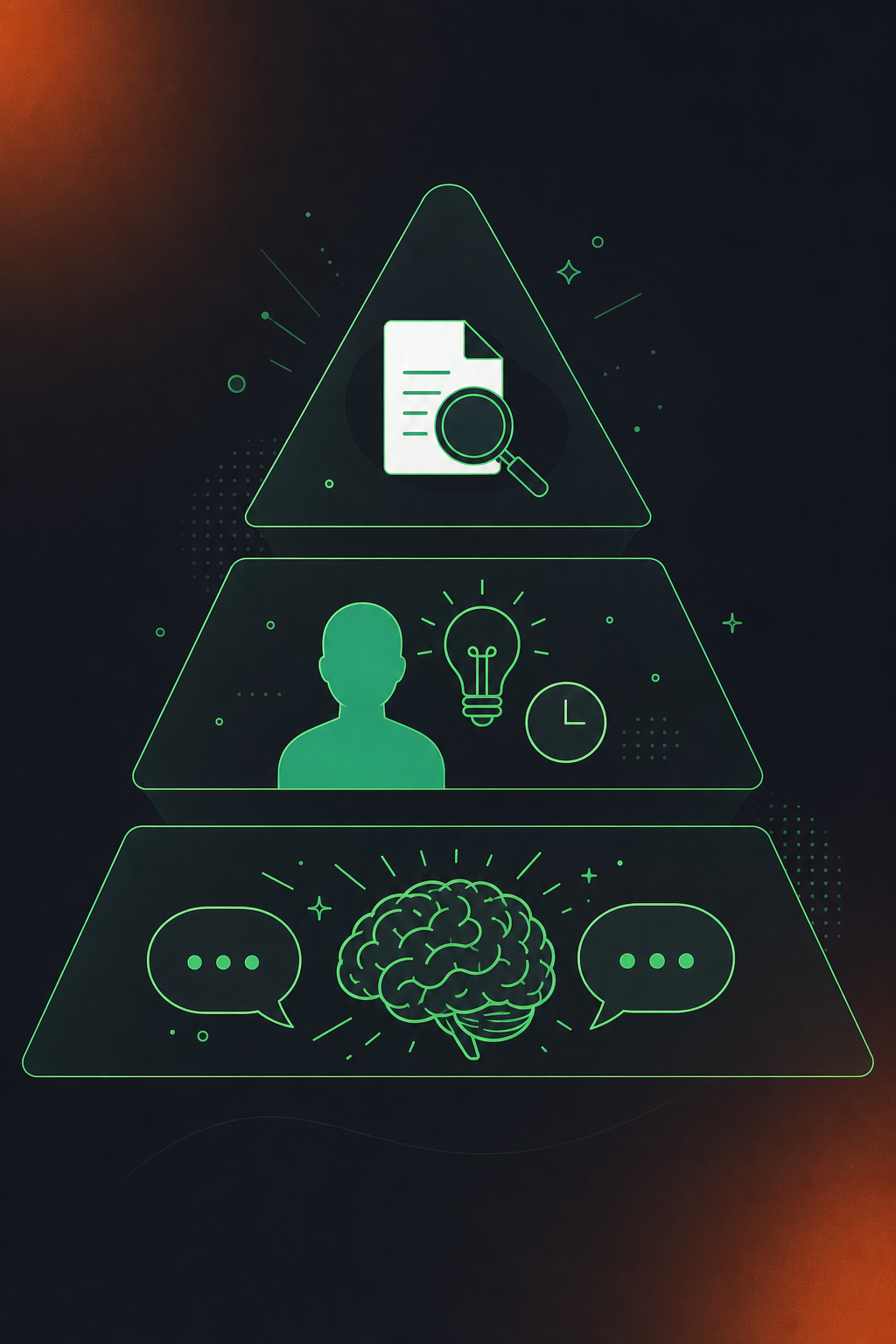
There are three distinct types of organizational knowledge, and most KM investments only reach the first.
Explicit Knowledge
The easy layer: written policies, recorded procedures, org charts, product specs, compliance requirements. It’s already structured. Search indexes it, wikis host it, onboarding decks repeat it. Most KM tools are built almost entirely for this type.
Implicit Knowledge
Undocumented but teachable. A senior engineer’s debugging sequence, a sales rep’s instinct for when to push on price, a PM’s read on which stakeholder needs early alignment. It can be articulated and transferred if someone takes the time to ask, but no one builds that habit deliberately.
Tacit Knowledge
The hardest to capture and the most valuable to retain. Tacit knowledge is judgment built from experience: why a particular architectural call was right given the constraints at the time, or why a customer relationship needs handling a specific way. Almost no conversation intelligence enterprise investment systematically captures this third layer. You can’t extract it with a form. It surfaces in conversations, in live reasoning, in the back-and-forth of a decision being made.
The Real Cost of Poor Knowledge Management
Interact research puts the cost in stark terms: 19.8% of business time, roughly one full day per working week, is wasted by employees searching for information they need to do their jobs.
That’s not a productivity inconvenience. It’s a structural tax on every hour your organization runs.
The financial picture is just as direct. Panopto’s modeling for a 17,700-person company puts the annual cost of inefficient knowledge sharing at $47 million. Scale that figure for your headcount, and the number stays uncomfortable.
KM failures show up as financial infrastructure failures, not vague cultural friction. Budgets get planned without the context behind last quarter’s decisions. Engineers re-solve problems that were already solved in a meeting nobody documented. New hires spend weeks reconstructing institutional reasoning that existed somewhere, just not anywhere findable. Cross-functional team collaboration breaks down when context disappears between sessions.
How Employee Turnover Turns KM Into a Crisis
42% of institutional knowledge resides solely with individual employees, meaning a single departure can leave an organization unable to handle a large portion of what that person managed.
That number gets worse when you factor in tenure trends. The Bureau of Labor Statistics puts median employee tenure at 3.9 years as of January 2024 (the latest figures available as of publication), the lowest reading since 2002. The cycle from “new hire building context” to “departing employee taking it with them” is compressing fast.
The instinct is to treat knowledge loss as an exit interview problem: schedule a handoff, write a transition doc, hope the institutional memory survives. But that assumes the person had time to document what they knew, and that they even knew what was worth documenting. Most tacit knowledge is invisible to the person holding it.
Turnover forces a reframe. Knowledge capture has to be continuous and built into daily work, not triggered by an offboarding checklist.
Common Knowledge Management Systems and What They Actually Do
54% of organizations use five-plus platforms for documenting and sharing information. Choosing the right enterprise meeting management software is part of resolving that fragmentation.
Tool Category | Designed For | Knowledge Type Handled Well |
|---|---|---|
Wikis and knowledge bases | Structured documentation, policies, how-tos | Explicit |
Document management systems | Version control, file storage, compliance records | Explicit |
Enterprise search | Cross-system retrieval | Explicit, some implicit |
Collaboration tools | Team communication, project context | Implicit (partially) |
Learning management systems | Training, onboarding, skill transfer | Explicit, implicit |
Each category solves a real problem. None of them were built to capture tacit knowledge as it forms, which means the most valuable layer of what your organization knows stays outside every one of these systems by design.
Why Most KM Programs Fail to Deliver
Roughly 95% of generative AI pilots showed no measurable profit-and-loss impact in mid-2025, according to MIT’s Project NANDA. The models weren’t the problem. The knowledge feeding them was unstructured, ungoverned, and incomplete. That’s the gap enterprise conversation intelligence platforms are built to close.
That finding describes most KM programs accurately. Capture gets treated as the finish line: a wiki gets built, a Confluence space gets organized, policies get documented. Then adoption stalls, content goes stale, and retrieval returns results nobody trusts.
The failure modes cluster around the same patterns:
- Siloed ownership with no clear accountability for keeping content current
- Governance gaps that leave nobody deciding what belongs in the system and what doesn’t
- A retrieval experience so inconsistent that people stop trying and ask a colleague instead, which means tacit knowledge never gets captured
Most KM investments optimize for input, not output. Getting knowledge into the system is the metric. Whether someone can find it, trust it, and act on it gets measured much later, if at all.
How AI Is Reshaping Knowledge Capture and Retrieval
AI changes what knowledge management can do, but only if the underlying corpus is worth querying.
The Gartner Data & Analytics Summit (Orlando, March 9-11, 2026) was direct: 2026 is the year of the AI agent. A chatbot answers one question and stops. An agent executes multi-step tasks autonomously, and at every step it needs governed, persistent knowledge to draw from. That dependency is what makes knowledge management suddenly urgent for teams that previously treated it as a documentation housekeeping task.
The concrete improvements AI brings are real: semantic search that retrieves by meaning instead of keyword matching, automated classification that tags content at ingestion, and summarization that condenses long documents into queryable form. These lower the cost of getting knowledge in front of the right person or agent at the right moment.
The caveat worth naming: AI amplifies whatever corpus it touches. A well-governed knowledge base becomes dramatically more useful. An ungoverned or incomplete one gets queried faster and returns bad answers more confidently. The stakes for getting the underlying corpus right go up, not down.
The KM Blind Spot: Conversation Data
Structured data already exists in your systems. CRMs hold account history. Project tools hold ticket context. Document repositories hold specs and policies. Connect them to an AI agent and you have a corpus worth querying, but building a true conversation data system of record requires capturing what happens in meetings too.
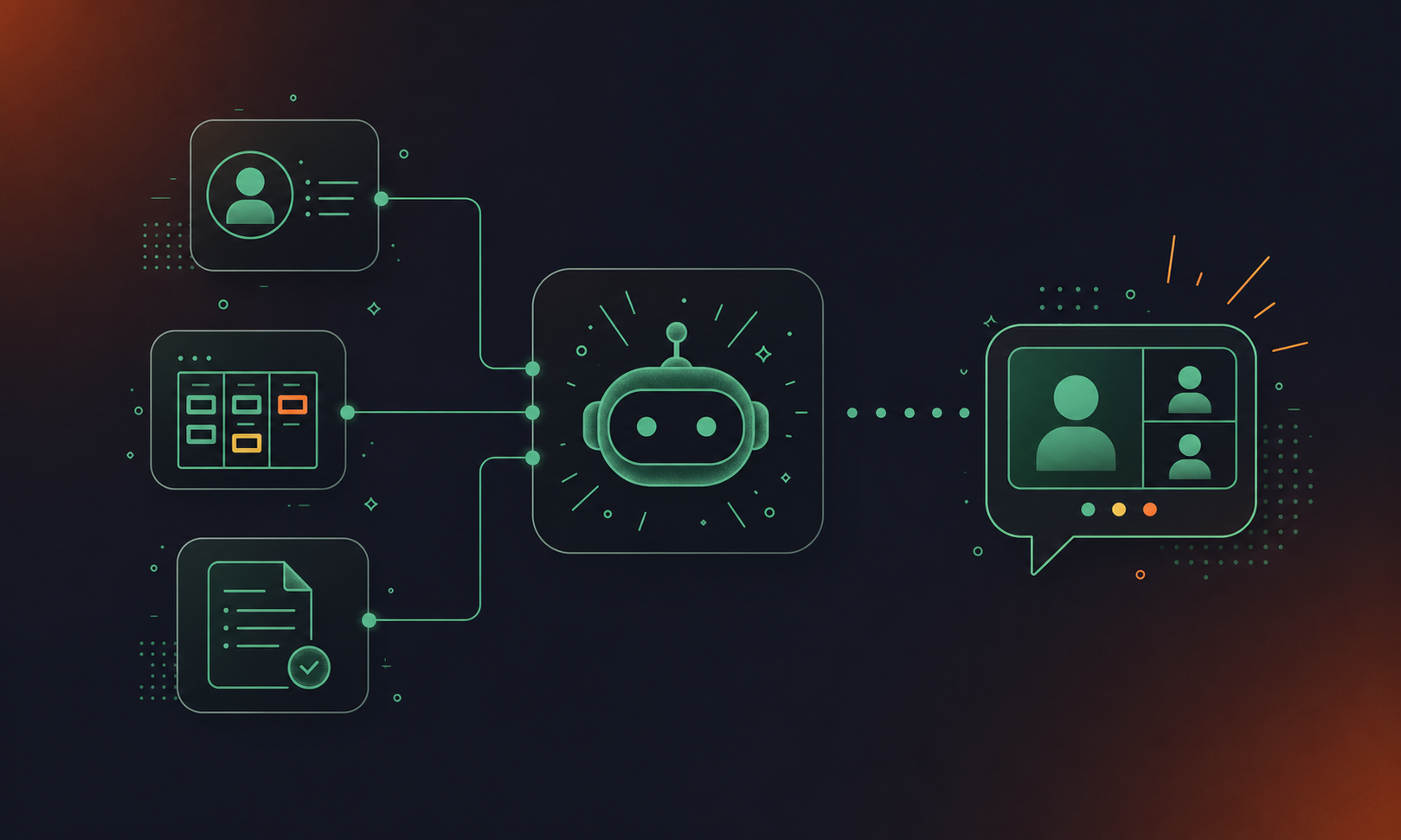
Conversations are different. The meeting where the architectural call was made, the customer call where the real objection surfaced, the standup where two engineers caught a dependency conflict before it became a week of rework: none of that is in your Confluence space. It happened, it informed decisions, and then it was gone.
The structural problem is access. Most organizations run three or four video and calling tools simultaneously. Data from any one stays with whoever was in the room. There is no organizational record by default, which means there is no dataset to point an AI agent at. Conversation data, for most organizations, simply does not exist as a retrievable asset.
What makes this a blind spot is what conversations actually contain. An email saying “let’s build the Slack integration” gives an agent almost nothing. The meeting where that was decided contains why, what was ruled out, what constraints were named, what the team was worried about. That reasoning is exactly what never gets written down.
What a Governed Knowledge Program Actually Looks Like
Governance is what separates an organizational knowledge program from an archive nobody trusts.
A governed program starts with policy decisions that have nothing to do with software: what gets captured, who can retrieve it, how long it lives, and who is accountable when those rules break. The software enforces what the policy already defines.
The core design tension
The resolution is classification, not exclusion. Tag the conversation by type and apply retrieval rules to that tag. The corpus stays intact while access stays scoped.
In practice, the two classification categories that surface first in nearly every governed rollout are the same two: is this personal, and is this HR-related? Those are the first design decisions a knowledge governance lead has to make before anything else functions correctly.
Retention is the other axis. A video recording and its transcript may warrant different retention windows. A summary may be kept longer than raw audio. Meeting recording consent policies must be defined before any of those retention decisions can be enforced. Setting data retention for enterprise AI tools per data type, instead of applying a single org-wide policy, lets a governance program satisfy legal requirements without destroying institutional memory wholesale.
These are design disciplines first. The tools that enforce them come after.
Closing the Conversation Gap in Enterprise Knowledge Management
Spinach AI joins meetings on Zoom, Google Meet, Microsoft Teams, Slack Huddles, and Webex, capturing video, audio, transcript, screen share, and in-meeting chat. When the meeting ends, it delivers structured outputs: decisions, action items with named owners, and summaries routed into the tools your teams already use. Capture is company-wide by default, not per-user opt-in.
That distinction matters for knowledge management. Individual AI notetakers create a different silo per person, per team, per tool choice. Spinach AI is deployed once, org-wide, with enforced policy. Collections group and share meetings automatically by participant, title, or series. Retention is configurable per data type on Enterprise, so transcripts, summaries, and video each carry different windows from one week to indefinite.
On Business and Enterprise plans, the MCP server for meeting AI lets Claude and ChatGPT query the full organizational conversation corpus directly. The reasoning behind decisions, the constraints named in planning sessions, the objections surfaced on customer calls: all of it becomes a governed, queryable layer that agents can draw from. SOC 2 Type II, GDPR, and HIPAA compliance, PII redaction at the transcript level, and zero data retention with LLM providers cover the governance requirements that make enterprise deployment possible.
Final Thoughts on Making Organizational Knowledge Manageable
The most valuable knowledge your organization holds never makes it into a wiki. It lives in the back-and-forth of a planning call, the customer objection that reshaped a roadmap, the architectural trade-off your senior engineer explained once and never wrote down. Your AI agents are only as good as the corpus behind them, and right now that corpus has a large gap where conversation data should be. Get started with Spinach AI to turn your meeting history into a governed, queryable knowledge layer.
Individual notetakers like Otter and Fireflies solve one person’s problem: each employee picks a different tool, producing separate silos with no organizational record and no governed retrieval layer. Spinach AI is deployed company-wide once, with enforced policy, so every conversation across Zoom, Google Meet, Teams, Slack Huddles, and Webex feeds a single, queryable corpus. For knowledge management purposes, that architectural difference determines whether your conversation data exists as an asset at all.
Tacit knowledge surfaces in live conversation, not documentation, which is why wikis and Confluence spaces never capture it. Spinach AI joins meetings as they happen, captures the full exchange (including why a call was made and what was ruled out), and routes structured outputs (decisions, action items with named owners, summaries) into the tools your teams already use. The result is a governed, searchable record of organizational reasoning that persists after any individual leaves.
Conversation data is the structured record of what was said, decided, and committed to across your organization’s meetings and calls, distinct from documents, tickets, or CRM entries. It matters because most tacit knowledge and real-time decision context lives exclusively in those conversations, never making it into any system of record. Without a governed conversation data layer, AI agents querying your knowledge base are working from an incomplete corpus that is missing the reasoning behind nearly every consequential decision.
Individual team choice produces shadow IT, uncontrolled sharing, and no organizational record. That’s exactly the pattern that stalls AI agent deployment, because agents need a governed corpus to draw from. A CIO-level rollout treats conversation data the same way it treats CRM or project data: captured company-wide by default, retention configured per data type, access policy-enforced, and queryable by both people and agents. Spinach AI is built for that deployment model, with SAML SSO, SCIM, compliance monitoring, and configurable retention per data type on Enterprise.
Spinach AI is SOC 2 Type II, GDPR, and HIPAA compliant, with a BAA available for Enterprise and HIPAA engagements. Retention is configurable per data type: transcript, summary, and video each carry separate windows from one week to indefinite on Enterprise, so legal requirements and institutional memory preservation don’t require the same policy. No customer data is used to train AI models, and Spinach maintains zero data retention terms with its LLM providers (OpenAI, Anthropic, Google). Start a free trial at spinach.ai with no credit card required.
Explicit knowledge is already written down — policies, specs, org charts — and most knowledge management tools handle it well. Implicit knowledge is undocumented but teachable, like a senior engineer’s debugging sequence. Tacit knowledge is the hardest to capture: judgment built from experience, like why a particular architectural call was right given the constraints at the time — and it almost exclusively surfaces in conversation, not documentation.
The models themselves are rarely the problem — the knowledge corpus feeding them is. MIT’s Project NANDA found that roughly 95% of generative AI pilots showed no measurable profit-and-loss impact in mid-2025, largely because the underlying data was unstructured, ungoverned, and missing the conversational context where most real decisions get made. An AI agent querying an incomplete knowledge base returns confident wrong answers, not better ones.
Median employee tenure hit a 22-year low of 3.9 years as of January 2024 (Bureau of Labor Statistics), which means the cycle from ‘new hire building context’ to ‘departing employee taking it with them’ is compressing fast. The instinct to fix this at offboarding — a transition doc, a handoff meeting — fails because most tacit knowledge is invisible to the person holding it. Knowledge capture has to be continuous and built into daily work, not triggered by an offboarding checklist.
Wikis and knowledge bases are well-suited for explicit knowledge — policies, how-tos, and structured documentation — but they were never built to capture tacit knowledge as it forms. The reasoning behind a decision, the constraints named in a planning call, and the trade-offs your team weighed all surface in conversation, not in a Confluence page someone fills out after the fact. A governed conversation data layer is the missing piece that wikis can’t fill on their own.
Employees waste 19.8% of their working time — roughly one full day per week — searching for information they need to do their jobs, according to Interact research. Panopto’s modeling puts the annual cost of inefficient knowledge sharing at $47 million for a 17,700-person organization. That’s a structural tax on every hour the organization runs, not a vague cultural friction problem.
The dependency is architectural: AI agents need a governed, persistent, and queryable corpus to draw from, and most organizations don’t have one for conversation data. The practical path is capturing every meeting org-wide into a single governed data asset — not per-user silos — and exposing it via an MCP server or API so agents like Claude and ChatGPT can query the full corpus directly. Spinach AI’s MCP server on Business and Enterprise plans does exactly this, covering Zoom, Google Meet, Teams, Slack Huddles, and Webex.
The answer is classification, not exclusion — tag the conversation by type, apply retrieval rules to the tag, and the corpus stays intact while access stays scoped to the right people. In practice, the first two classification decisions that surface in almost every governed rollout are the same: is this personal, and is this HR-related? Defining those two categories before any other governance decision is the starting point for a knowledge program that captures comprehensively without exposing sensitive conversations to a general query layer.
The most direct path is a platform that routes structured outputs — decisions, action items with named owners, summaries — natively into the tools your teams already work in, rather than requiring manual re-entry or middleware. Spinach AI delivers structured meeting outputs into Jira, Linear, Slack, Salesforce, HubSpot, Confluence, Notion, and other systems natively, and the MCP server on Business and Enterprise plans lets Claude and ChatGPT query the full conversation corpus directly without additional build work.
An MCP (Model Context Protocol) server is a standardized connector that lets AI assistants like Claude and ChatGPT query an external data source directly, with access permissions enforced at the user level. For knowledge management, it means your AI agents can retrieve the reasoning behind decisions, constraints named in planning sessions, and context from customer calls — not just documents and tickets. Spinach AI’s MCP server is included on Business and Enterprise plans, giving both people and agents governed query access to the full organizational conversation corpus.
The trigger is almost always shadow IT: when different teams are running Otter, Fireflies, Fathom, or other individual tools simultaneously, each producing a separate silo with no organizational record and no governed retrieval layer. At that point, the knowledge management problem isn’t a note quality problem — it’s an architecture problem. A single org-wide deployment with enforced policy, configurable retention per data type, and a queryable corpus solves what no collection of individual tools can.
What you should do next
You made it to the end of this article! Here are some things you can do now:
- You should check out our library of meeting agenda templates for every type of meeting.
- Learn more about Spinach and how it can help you run a high performing org.
- If you found this article helpful, please share it with others on Linkedin or X (Twitter)

