Data Retention for Enterprise AI Tools (August 2026)
Get the August 2026 breakdown of data retention policies, covering GDPR, HIPAA, SOX, and what to ask AI vendors about retention configuration.
 Maintouch
Most data retention policies were written before AI tools started joining every meeting and processing employee conversations at scale. That means a lot of enterprise policies have a gap right in the middle of their highest-risk data flows. Before your next AI tool procurement, it’s worth knowing exactly what your policy should cover and what questions will separate the vendors who take this seriously from the ones who don’t.
TLDR:
- A data retention policy defines what data you keep, for how long, and what happens at expiration across all data types.
- Retention periods vary by framework: HIPAA requires 6 years, SOX requires 7 years, and GDPR sets no fixed floor but requires documented purpose justification.
- Backup copies are not exempt from your retention schedule; the clock runs from the original collection date, not the backup date.
- AI tools that join your meetings become data processors subject to your retention obligations, making vendor configuration a procurement gate.
- Spinach AI is an enterprise conversation intelligence platform deployed company-wide; on Enterprise, retention is configurable per data type (transcript, summary, video) from one week to indefinite, and customer data is never used to train AI models. Zero data retention applies with LLM providers including OpenAI, Anthropic, and Google.
What Is a Data Retention Policy?
A data retention policy is a formal governance document that defines how an organization stores, maintains, and disposes of its data. It answers three questions: what data gets kept, for how long, and what happens when the retention window closes. That third answer is usually deletion, destruction, or transfer to long-term archival storage, depending on data type and regulatory context.
The policy covers both digital and physical records, from emails and database entries to printed contracts and personnel files. It also governs storage format and location throughout the data lifecycle, which is what gives it real governance weight.
Why Data Retention Policies Matter
Without retained conversation data, decisions vanish, compliance gaps widen, and formal audits fail. A data retention policy sets the rules for how long your organization keeps specific data types, where that data lives, and when it gets deleted.
For enterprise AI tool buyers, this matters in a concrete way: every AI tool you deploy processes, stores, or transmits data. Without a governing policy, you have no defensible answer when a regulator, auditor, or customer asks what happened to that information.
GDPR, HIPAA, and ISO 27001 each carry their own retention requirements, and the cost of getting it wrong ranges from reputational damage to eight-figure fines (GDPR fines totaled ~€5.65B by early 2025, including a €310M fine against LinkedIn, per Drata 2025).
Key Components of a Data Retention Policy
A data retention policy covers several interdependent components. Getting any one of them wrong can expose your organization to regulatory penalties or litigation risk.
Scope and Data Classification
The policy should specify which data types fall under it: structured records like contracts and invoices, unstructured data like meeting notes and action items and emails, and any personal data governed by GDPR or HIPAA. Classification tiers (confidential, internal, public) help map each category to the right retention window.
Retention Periods
Each data category needs a defined retention period tied to a legal, regulatory, or business justification. GDPR requires that personal data not be kept longer than necessary for its original purpose, while ISO 27001 expects documented justification for every retention decision.
Disposal and Deletion Procedures
The policy must specify how data is destroyed when its retention period ends, whether through secure deletion, anonymization, or physical destruction of media. Disposal should be logged and auditable.
Legal Hold Provisions
When litigation or a regulatory investigation is pending, normal deletion schedules must pause. The policy needs a defined process for placing data under legal hold and lifting it once the matter resolves.
Roles and Accountability
GDPR’s accountability principle requires that someone owns each data category. The policy should name data owners, assign review responsibilities, and set a cadence for policy updates as regulations change.
How Long Should You Keep Data? Retention Periods by Regulation and Data Type
Retention periods vary by regulation, data type, and geography, so a single blanket rule rarely holds across an enterprise. The table below maps the most common frameworks to their required or recommended retention windows.
Regulation / Standard | Data Type | Retention Period |
|---|---|---|
GDPR | Personal data | No fixed term; retain only as long as necessary for the stated purpose |
GDPR (common practice) | Financial / tax records | 7 years |
GDPR (common practice) | Audit logs | 10 years |
ISO 27001 | Security records and logs | Minimum 3 years |
HIPAA | Medical records (adults) | 6 years from creation or last use |
NIST SP 800-53 | Audit and accountability records | 3 years minimum |
SOX | Financial records | 7 years |
CCPA | Consumer data | Tied to disclosed purpose; no fixed maximum |
Key Principles Across Frameworks
A few consistent rules apply regardless of the specific regulation you fall under.
- GDPR’s data minimisation principle requires that personal data not be held beyond the purpose for which it was collected, making purpose documentation as important as the retention window itself.
- The accountability principle under GDPR means organizations must be able to prove compliance, not simply claim it, so audit trails and retention logs carry their own separate retention requirements.
- ISO 27001 treats retention as part of a broader information security management posture, meaning documented schedules and evidence of enforcement both factor into certification audits.
- Employee records often carry distinct timelines from customer data, frequently governed by labor law instead of privacy regulation, and those windows commonly extend to 7 years post-termination depending on jurisdiction.
When in doubt, build your retention schedule around the strictest applicable requirement for each data category, then document the legal basis for that decision.
Regulatory Frameworks That Govern Data Retention
Three major regulatory frameworks set the baseline for how organizations must handle data retention today.
GDPR
The General Data Protection Regulation governs personal data for anyone processing information about EU residents. Its data minimisation principle requires collecting only what is necessary, and the storage limitation principle prohibits keeping data longer than needed for its stated purpose. GDPR does not prescribe fixed retention periods, which means your policy must align each category’s timeline with a documented purpose.
HIPAA
The Health Insurance Portability and Accountability Act requires covered entities to retain HIPAA-related documentation for a minimum of six years from creation or last effective date. State law may extend this further for medical records in particular.
SOX
The Sarbanes-Oxley Act requires certain financial records to be retained for seven years. Violations carry criminal penalties, so retention schedules for audit trails and financial communications need explicit documentation.
ISO 27001 adds a further layer: the standard requires organizations to define retention periods as part of their information security controls, making a documented data retention policy a prerequisite for certification, not an optional governance artifact.
Data Retention vs. Data Backup vs. Data Archiving
These three terms get conflated often enough that the confusion shows up in actual audit findings.
Organizations frequently assume backup copies fall outside their retention schedule. They do not. A backup of personal data is still personal data, and its retention window runs from the original collection date, not from when the backup was made. Running six-month backup cycles without expiring the underlying records is one of the more common findings in GDPR compliance reviews.
Common Data Retention Policy Failures
Most enterprise AI tool deployments expose the same recurring gaps in data retention policy enforcement.
- Policies exist on paper but aren’t configured in the AI tools for remote teams that actually process data, so vendor defaults quietly override internal rules.
- Retention schedules cover structured databases but miss unstructured sources like AI transcription tools outputs: meeting transcripts, AI-generated summaries, and conversation logs.
- Legal hold procedures aren’t mapped to AI tool outputs, creating discovery risk when litigation arises.
- Employees adopt unsanctioned AI note-takers independently, so each team ends up with a different tool, producing shadow IT, uncontrolled sharing, and no organizational record.
These gaps compound quickly across an enterprise. A policy that doesn’t account for where AI tools store data, and for how long, is incomplete by design. The structural fix is replacing per-person tool sprawl with one governed platform deployed company-wide, so retention schedules, deletion controls, and legal hold procedures apply uniformly and not merely on paper.
How to Build a Data Retention Policy: A Step-by-Step Process
Start with ownership, not writing. A policy drafted without legal, IT, compliance, and HR aligned from the start will have gaps that auditors find faster than you will.
- Assign cross-functional ownership, since each function governs different data categories and a policy written by one team tends to miss entire data classes.
- Inventory all data the organization holds, including unstructured sources like AI meeting notes, AI-generated summaries, and conversation logs.
- Map each data type to applicable regulations and business obligations so every category has a legal basis before you set a retention window.
- Define retention periods and the trigger dates that start each clock, because “creation date” and “last use date” are not interchangeable across frameworks.
- Document deletion, archiving, and legal hold procedures, including who executes each step and what gets logged as evidence.
- Draft, review, and formally approve the policy with legal sign-off.
- Communicate org-wide and configure enforcement controls in every tool that processes data, so vendor defaults cannot quietly override your rules.
- Schedule a recurring review cadence tied to regulatory change cycles. A policy that is never updated is a liability waiting to surface at the worst possible moment.
Data Retention Best Practices
Follow a consistent, documented approach across your organization when setting and enforcing retention periods.
- Define retention periods by data category, not by system or department. Customer contracts, HR records, financial data, and meeting logs each carry distinct legal obligations and risk profiles.
- Apply a legal hold process before deleting anything subject to active litigation or regulatory inquiry. Deletion during a hold can constitute spoliation.
- Audit your retention schedule annually. Regulations change, and a policy written two or three years ago may already be non-compliant with GDPR updates or sector-specific rules.
- Verify that third-party AI tools (reviewing Otter AI pricing and similar vendors’ terms is a good starting point) respect your retention rules at the data layer, beyond the interface level.
What Enterprise AI Tool Buyers Must Ask About Vendor Data Retention
Any AI tool that joins your meetings or processes employee-generated content becomes a data processor subject to your organization’s own retention obligations. That moves vendor retention from a secondary concern into a procurement gate.
Before signing any AI tool contract, get explicit answers to these questions:
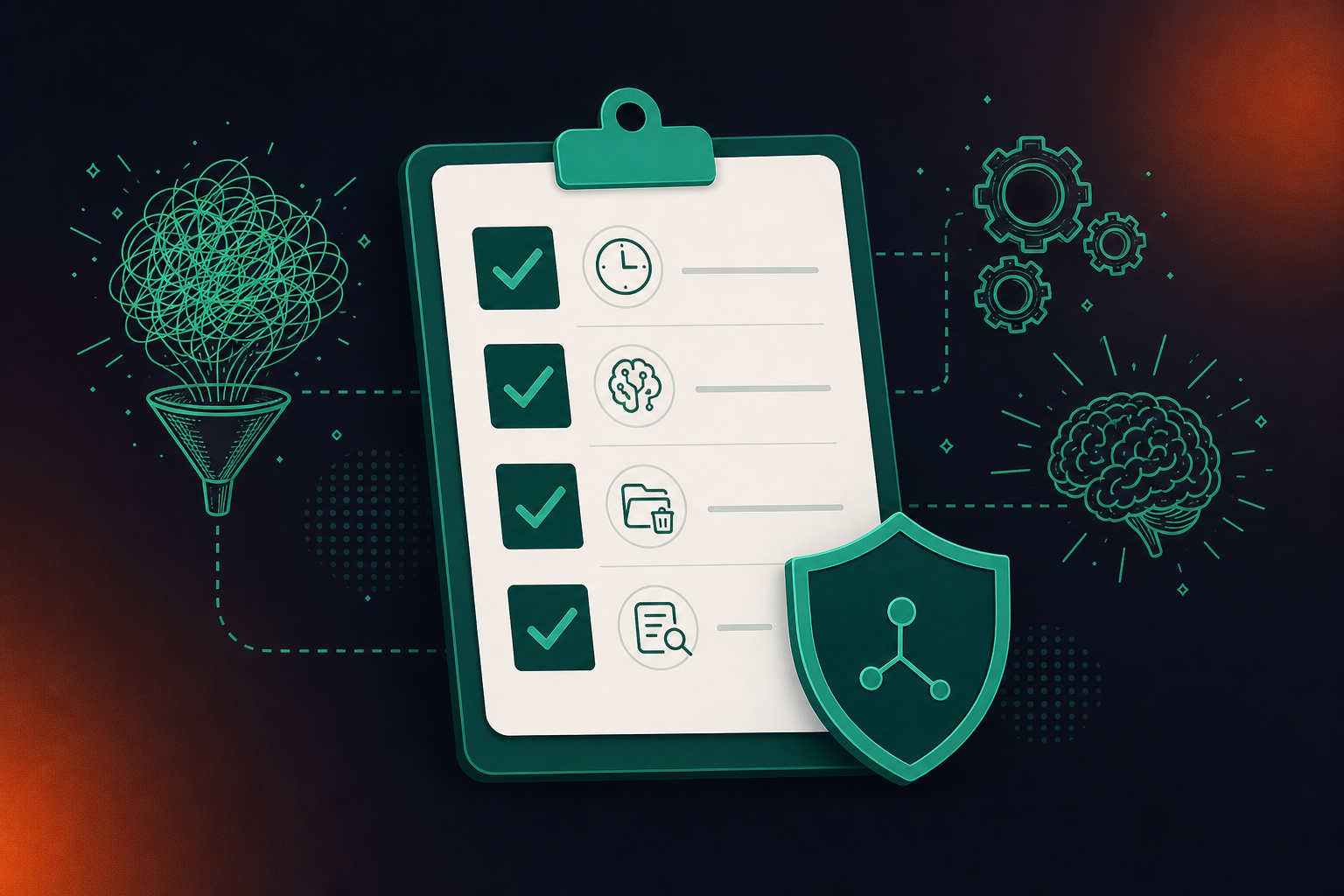
- Does the vendor retain conversation data by default, and if so, for how long? (Reviewing Otter.ai alternatives for accurate meeting notes often surfaces these gaps.)
- Can retention windows be configured separately per data type, such as transcript, summary, and video?
- Does the vendor use customer data to train its models?
- Do the vendor’s LLM providers retain customer data on their end?
- Are deletion controls available at the organizational level, or only per individual user account?
- What audit logs exist to verify that deletions actually occurred?
Shadow IT compounds the risk. Tools like Fireflies, covered in the Spinach AI vs Fireflies.ai comparison, are commonly adopted this way. When employees adopt unsanctioned AI tools independently, that usage sits entirely outside your official policy, creating a retention liability with no governance mechanism to contain it.
How Spinach AI Meets Enterprise Data Retention Requirements
Spinach AI is an enterprise conversation intelligence platform, the system of record for conversation data, deployed company-wide instead of as a per-person tool. That distinction matters here: because Spinach captures every conversation across the organization in one governed data asset, retention schedules, deletion controls, and legal hold procedures can be enforced at the org level, not left to individual users or individual vendor defaults.
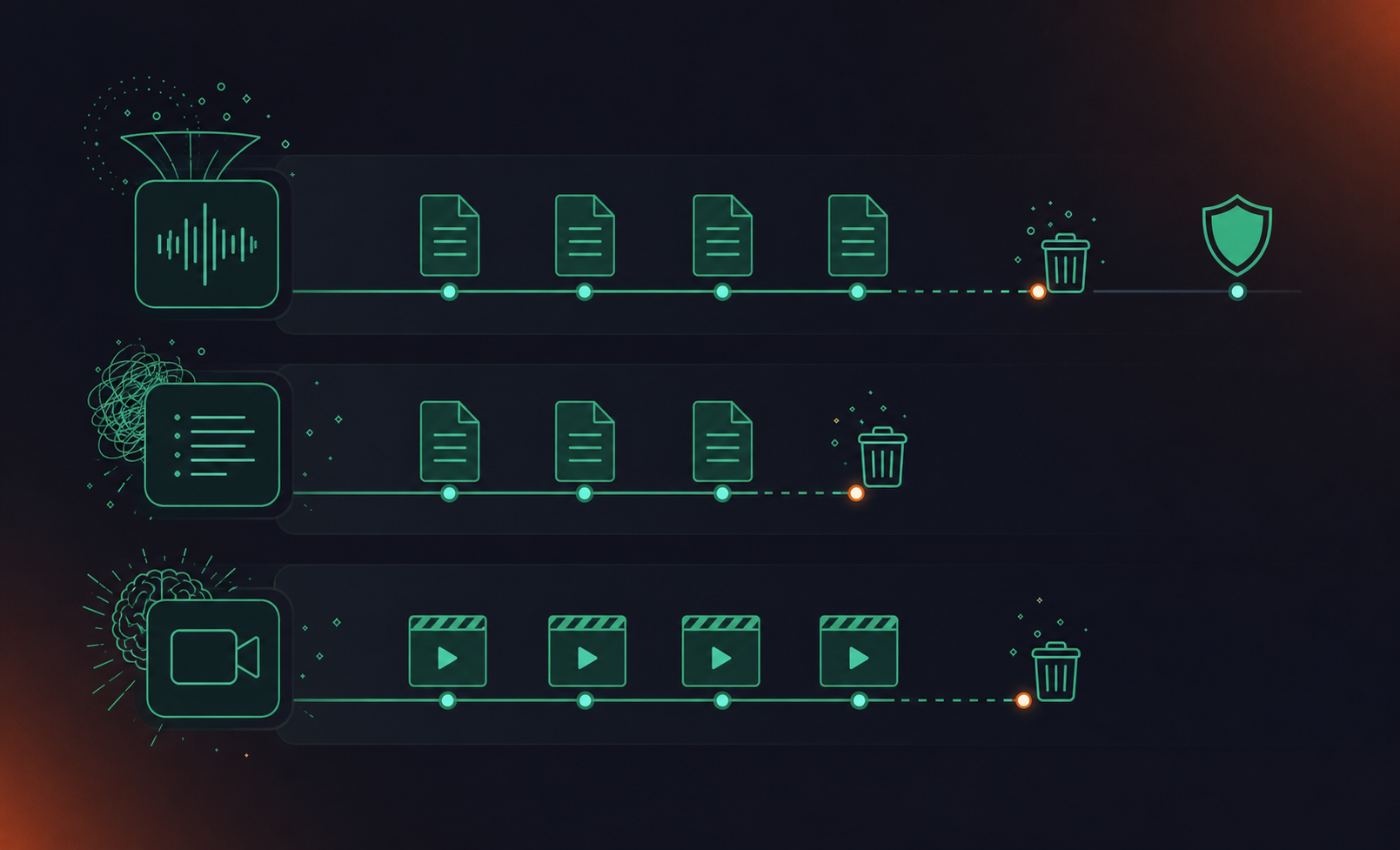
On Enterprise, retention is configurable per data type: transcript, summary, and video can each be set separately, from one week to indefinite. That precision matters when EU employees and domestic teams carry different regulatory timelines for the same conversation data. Org-level enforced settings mean a single admin can apply the correct retention window across every meeting, every participant, and every data type, without relying on individual users to configure their own accounts correctly.
Spinach does not use customer data to train AI models, and zero data retention applies with its LLM providers (OpenAI, Anthropic, and Google), so customer data is not retained by model providers. PII redaction is available at the transcript level, including structured identifiers such as payment card and national ID numbers. The admin dashboard includes audit logging and usage reporting to support defensible compliance records. For organizations under HIPAA, a BAA is available on Enterprise engagements.
Security and compliance documentation, including the DPA, subprocessor list, and privacy policy, is available at trust.spinach.ai for buyers working through a formal security review.
Final Thoughts on Managing Data Retention Across Your Organization
Data retention gets complicated fast once you factor in multiple regulations, data types, and tools that each have their own default behavior. The organizations that handle it well treat retention as a configuration problem, not merely a policy one. You need written rules and enforced rules, and those two things are not the same thing. Replacing per-person AI note-taker sprawl with one governed platform, where every meeting is captured into a single organizational record with enforced retention, deletion, and legal hold controls, is one of the fastest ways to close the gap between what your policy says and what your tools actually do. That is the gap Spinach AI is built to close across the enterprise.
Ask whether retention windows are configurable per data type (transcript, summary, video separately), whether the vendor uses customer data to train AI models, and whether its LLM providers retain customer data on their end. You also need to confirm that deletion controls exist at the organizational level, not just per individual user account, and that audit logs verify deletions actually occurred. Spinach AI’s Enterprise plan covers all of these: retention is configurable per data type from one week to indefinite, no customer data is used for model training, and zero data retention applies with LLM providers including OpenAI, Anthropic, and Google.
GDPR sets no fixed retention floor — personal data must be deleted once it is no longer needed for its stated purpose, though financial and tax records commonly run seven years and audit logs ten years in practice. HIPAA requires medical records to be retained for a minimum of six years from creation or last use. ISO 27001 expects security records and logs to be kept for at least three years, and treats a documented retention schedule as a prerequisite for certification rather than an optional governance artifact.
A data retention policy is the governing framework — it defines what data exists, for how long, and what happens at expiration. Backups and archives are subject to that policy, not exempt from it. A backup of personal data is still personal data, and its retention window runs from the original collection date, not from when the backup was made — a gap that shows up as a recurring finding in GDPR compliance reviews.
A GDPR-compliant data retention policy needs documented purpose justification for every retention window, a legal hold process that pauses deletion during litigation or regulatory inquiry, named data owners to satisfy the accountability principle, and auditable disposal procedures that log when and how data was destroyed. The data minimisation principle means the retention window alone is not enough — you must also show why each category is kept for that duration against its original collection purpose.
On Enterprise, Spinach AI lets admins set retention windows separately for transcript, summary, and video — each configurable from one week to indefinite. That matters when EU employees and domestic teams carry different regulatory obligations for the same conversation data. The admin dashboard includes audit logging and usage reporting to support defensible compliance records, and a BAA is available for organizations under HIPAA. Security documentation including the DPA, subprocessor list, and privacy policy is available at trust.spinach.ai for buyers working through a formal security review.
A data retention schedule is the operational document that lists each data category alongside its specific retention window and trigger date — it is the working table your policy governs. The policy sets the rules and accountability structure; the schedule is the per-category implementation of those rules. Without both, you have governance intent but no enforceable mechanics.
Yes — AI-generated transcripts and summaries are data records subject to the same regulatory obligations as email, and most frameworks treat them as personal data if they contain identifying information about employees or customers. The common gap is that retention schedules written before widespread AI tool adoption cover email and database records but leave meeting transcripts and AI summaries ungoverned by default. Mapping those unstructured outputs to the right data category and retention window closes that gap.
A legal hold is triggered when litigation, a regulatory investigation, or a government inquiry is reasonably anticipated — at that point, normal deletion schedules must pause for all data categories covered by the hold. Your policy needs a named process for placing specific data types under hold, notifying data owners, and lifting the hold once the matter resolves. Any automated deletion that runs during an active hold can constitute spoliation, which carries its own legal exposure separate from the underlying matter.
Data minimisation requires that personal data collected about EU residents be limited to what is strictly necessary for the stated purpose and deleted once that purpose is fulfilled. In practice, this means every retention window in your policy needs a documented purpose justification — storing data longer than the purpose supports is a GDPR violation even if no fixed retention limit applies to that data type. For AI tools that capture employee conversations, that justification needs to exist before you deploy the tool, not after an audit surfaces the gap.
The NIST SP 800-53 standard requires audit and accountability records to be retained for a minimum of three years and treats retention configuration as part of a broader access-control and audit framework. Organizations in US federal contracting, defense supply chains, or sectors where NIST compliance is a contractual requirement should use it as a baseline; for others, it functions as a rigorous floor that aligns well with ISO 27001 requirements. Building your data retention policy template around NIST and then layering GDPR or HIPAA obligations on top is a practical approach when you operate across multiple jurisdictions.
ISO 27001 treats a documented retention schedule as a prerequisite for certification — not an optional governance artifact — and requires evidence of enforcement, not just a written policy. That means every AI tool in your environment needs configurable, admin-enforced retention controls you can demonstrate to an auditor, because vendor defaults that override your policy will appear as a control gap during certification review. When evaluating vendors against an ISO 27001 data retention policy template, confirm that retention is enforceable at the organizational level and that deletion events are logged for audit purposes.
The most frequent failure is that written policies are never configured in the AI tools that actually process data, so vendor defaults quietly govern retention instead of your rules. A close second is disposal procedures that lack audit trails — if you cannot produce a log showing when data was deleted and by whom, you cannot demonstrate compliance to a regulator or auditor. Mapping your disposal procedures to every tool in your stack, including AI meeting and conversation platforms, is the step most organizations skip.
You can build a unified template that covers all three frameworks if you structure it around data categories rather than regulations — each category gets a retention window set to the strictest applicable requirement, with the legal basis documented alongside it. A financial record subject to both SOX’s seven-year requirement and GDPR’s purpose-limitation principle keeps the longer window but carries a documented purpose justification that satisfies GDPR’s accountability standard. Free data retention policy templates available online rarely account for this layering, so any template you adopt should be reviewed by legal before it governs regulated data.
A private company’s data retention policy needs the same core components as any policy — scope, data classification, retention periods by category, disposal procedures, legal hold provisions, and named accountability — but without the SEC disclosure obligations that govern public companies under SOX or the grant-compliance retention requirements that affect nonprofits. The practical difference is that private companies have more flexibility in setting retention windows for business records but still face GDPR, HIPAA, and sector-specific obligations that are mandatory regardless of corporate structure. Starting from a sample document retention policy designed for your specific regulatory exposure beats adapting a public-company or nonprofit template.
Employee records frequently carry retention windows governed by labor law rather than privacy regulation, and those windows commonly extend to seven years post-termination depending on jurisdiction — a different clock than the purpose-based GDPR logic that governs customer data. Your employee data retention policy needs to account for HR records, performance data, and conversation data captured in internal meetings separately from customer-facing records, because the legal basis and applicable framework often differ. Treating all personal data as a single category in your policy is one of the most common sources of audit findings.
What should you do now
Next, here are some things you can do now that you've read this article:
- Our library of meeting agenda templates is designed to help you run more effective meetings.
- Learn more about Spinach and how it can help you run a high performing org.
- If you found this article helpful, please share it with others on Linkedin or X (Twitter)

