What Is Conversation Intelligence? A 2026 Enterprise Guide (August 2026)
Get the enterprise buyer's guide to conversation intelligence software in August 2026, covering use cases, compliance, and evaluation criteria.
 Maintouch
A lot of teams buy a conversation intelligence tool thinking they’re solving a data problem, then realize they’ve just added another silo. The difference between a tool that records your calls and one that actually governs conversation data across your whole organization is bigger than most buyers expect. If you’re building out your evaluation criteria, here’s what that difference looks like in practice.
TLDR:
- Conversation intelligence captures, transcribes, and analyzes spoken conversations to surface structured data from audio your teams already produce
- The system runs a three-stage sequence: capture audio, analyze with AI models, then deliver outputs to CRM records, dashboards, or coaching workflows
- Conversation intelligence and conversational AI are distinct: one extracts signal from human dialogue, the other powers machine responses
- Verify integration depth, deployment scope, and compliance certifications before any proof of concept, not after
- Spinach AI deploys company-wide as the system of record for conversation data, routing decisions and action items with named owners into your tools when meetings end
What Is Conversation Intelligence?
Conversation intelligence refers to the capture, transcription, and analysis of spoken conversations, typically sales calls, customer support interactions, and internal meetings, using AI to surface patterns, insights, and actionable data.
At its core, conversation intelligence software records and transcribes calls, then applies AI to identify themes, keywords, sentiment, and behaviors. The result is structured data from what was previously unstructured audio, giving revenue and operations teams visibility into what is actually being said across every customer and internal interaction.
Enterprise buyers reviewing conversation intelligence solutions will encounter the term applied across several distinct contexts: dedicated sales coaching tools like Gong, CRM-native features in Salesforce and HubSpot, and org-wide conversation intelligence platforms built to govern and retrieve conversation data at scale. Teams comparing AI meeting notes tools will find these categories treated very differently in vendor pitches.
How Conversation Intelligence Works
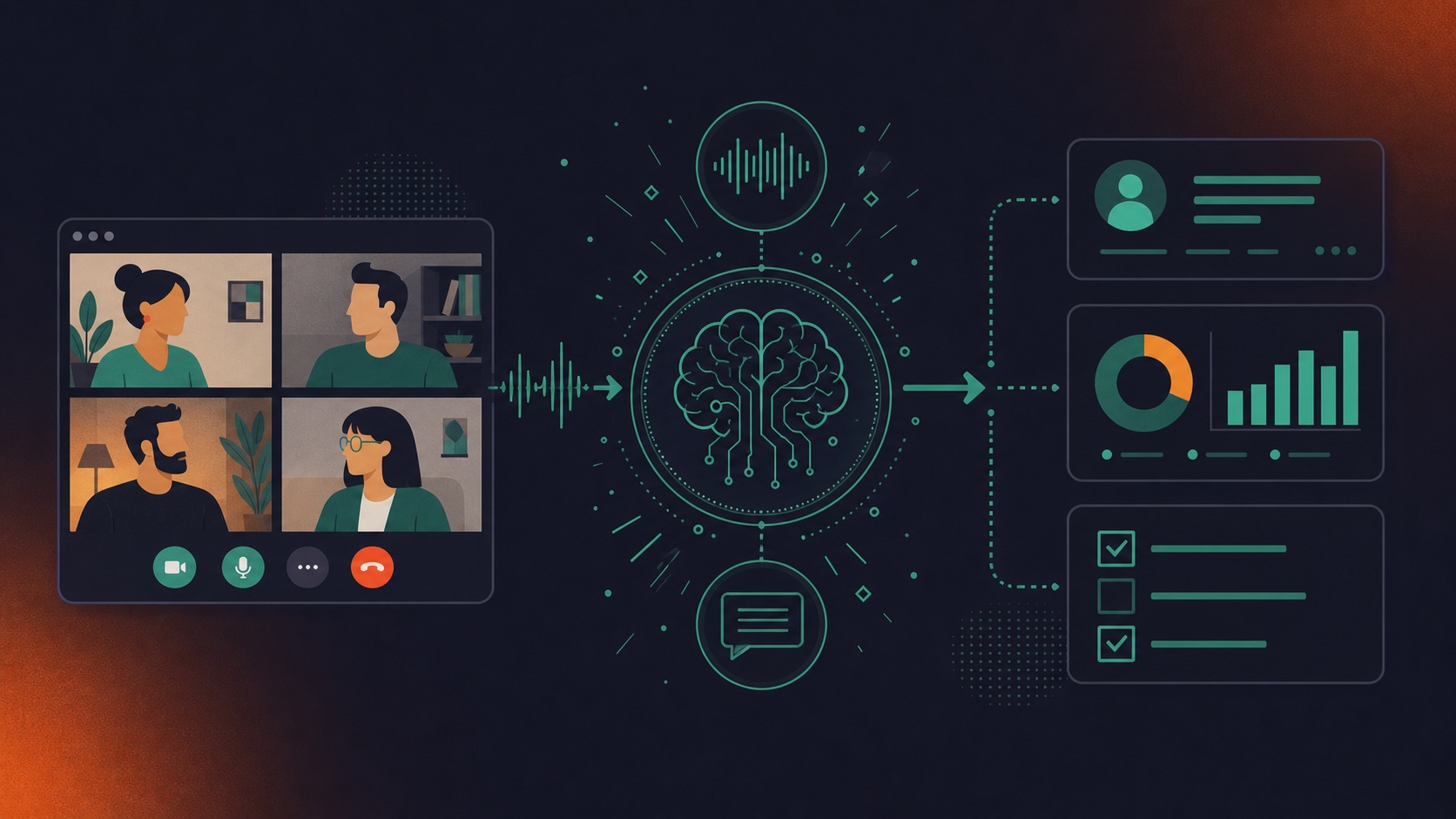
Audio from calls, video meetings, and customer interactions gets ingested, transcribed, and analyzed by AI models trained to extract meaning from spoken language. The system identifies speakers, maps conversation structure, flags key moments like objections or commitments, and surfaces patterns across hundreds of interactions.
Most conversation intelligence software follows a three-stage sequence: capture, analyze, and deliver. Audio or video is captured during or after a call, run through AI transcription tools, then passed to AI models that score behavior, tag topics, and generate summaries or alerts. The output lands in CRM records, dashboards, or coaching workflows.
Where tools differ is in scope. Some process only sales calls. Others cover every meeting type across an organization, feeding structured conversation data into the systems and agents that need it.
Conversation Intelligence vs. Conversational AI
These two terms get conflated constantly, but they describe different things.
Conversational AI is the tech that powers two-way dialogue between humans and machines, think chatbots, voice assistants, and LLM-based agents. Buyers comparing Zoom AI meeting notes with standalone conversation intelligence tools encounter this distinction quickly. The goal is generating a response.
Conversation intelligence is the practice of capturing, analyzing, and acting on what gets said in real human conversations, typically sales calls, customer support interactions, or internal meetings. The goal is extracting signal from that dialogue and routing it somewhere useful.
A chatbot runs on conversational AI. A sales team reviewing call transcripts to coach reps is using conversation intelligence software. The two can intersect, but the use cases and buyer needs are distinct.
Types of Data Conversation Intelligence Analyzes
Conversation intelligence systems analyze several distinct data streams simultaneously, each contributing a different layer of meaning to the conversation record.
- Speech and audio signals capture tone, pace, talk-to-listen ratios, and filler word frequency, giving managers a view into rep confidence and engagement patterns that a transcript alone cannot provide.
- Transcript text is parsed for keyword mentions, competitor references, objection phrases, and topic coverage, making it searchable and reportable at scale.
- Structural metadata tracks call duration, question frequency, monologue length, and silence gaps, which reveal conversational dynamics without requiring anyone to listen to a recording.
- CRM and deal context ties conversation data to pipeline stage, account history, and opportunity value, so behavioral patterns can be mapped against revenue outcomes.
The combination of these streams is what separates conversation intelligence software from basic call recording. A rep who talks 80% of every discovery call shows up in the structural data before a manager ever listens to a single recording.
Use Cases Across the Enterprise
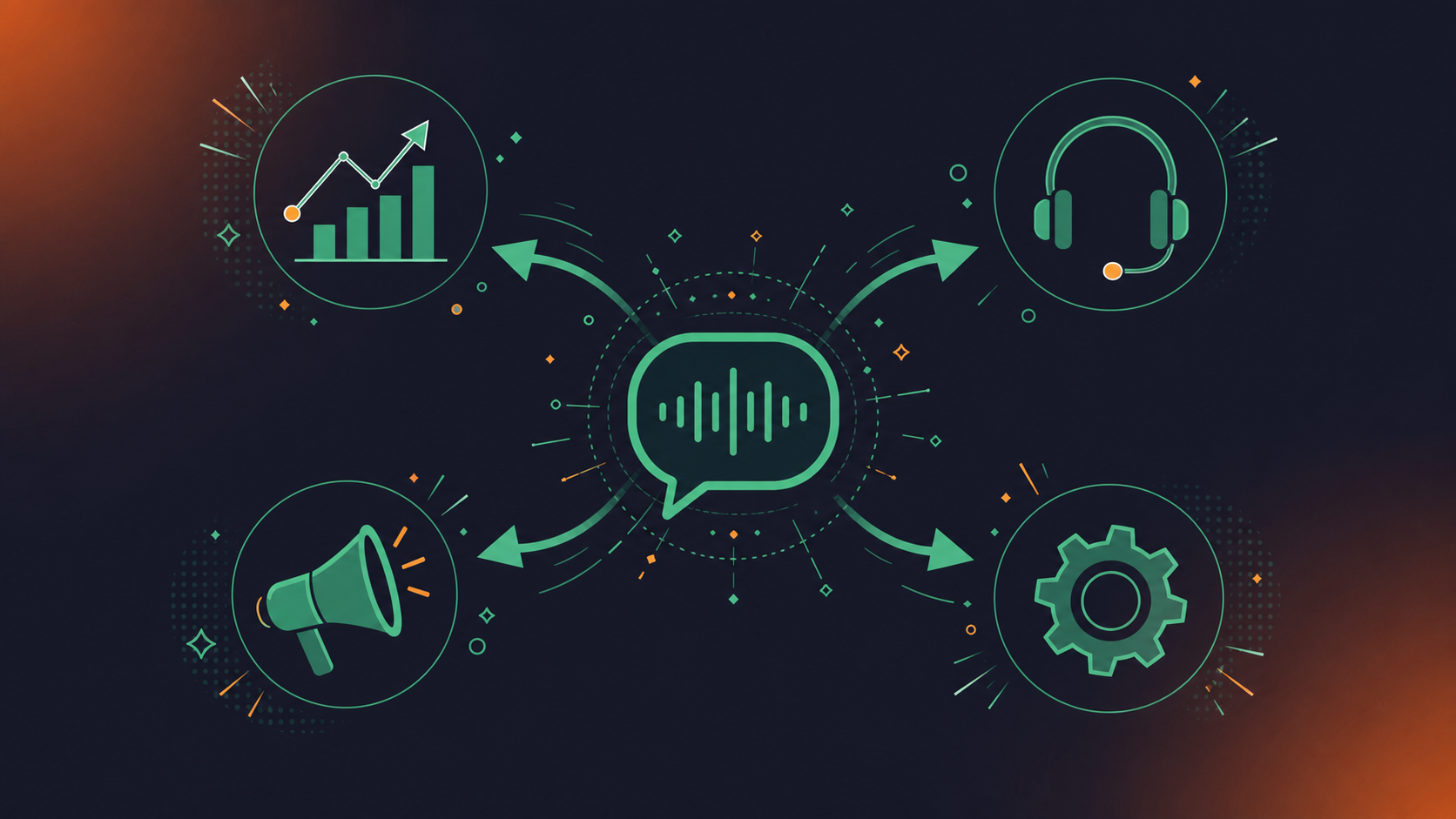
Conversation intelligence finds its footing across nearly every revenue-facing and customer-adjacent function in the enterprise.
Sales teams use it to review rep call patterns, identify where deals stall, and replicate the behaviors of top performers. Support organizations analyze call volume by issue type, surface recurring friction points, and track whether agents follow compliance scripts. Marketing uses conversation data to extract real customer language for messaging and campaign strategy. Engineering and ops teams often want to automatically create action items from meeting transcripts instead of processing them by hand. HR and L&D teams review onboarding and training calls to standardize coaching quality across regions.
The common thread: every team that runs high-stakes conversations can turn those conversations into governed, searchable, actionable data.
Benefits for Enterprise Organizations
At the enterprise scale, conversation intelligence moves from a convenience to a governance requirement. Sales orgs gain structured call libraries that feed coaching, forecasting, and onboarding without relying on rep self-reporting. Customer success teams surface recurring objections and churn signals across every account conversation, including the ones no one remembered to document. Leadership gets an auditable record of how strategic priorities land across departments.
The organizational impact is measurable. Salesforce’s State of Sales Report found that conversation intelligence features led to a 40% improvement in understanding customer needs and 39% better visibility into sales rep activity. Organizations that analyze conversation data report improvements in new hire ramp time, forecast accuracy, and at-risk account detection, because the signal was always there in conversations and now it has a searchable home.
Privacy, Compliance, and Consent in Conversation Intelligence
Recording a conversation creates legal obligations the moment it crosses state or national lines. In the US, as of August 2026, eleven states require all-party consent, including California, Florida, and Illinois; in the EU, GDPR governs retention and access; in heavily compliance-driven industries like healthcare and finance, requirements go further still.
Enterprise-grade conversation intelligence software handles this with configurable consent mechanisms, retention controls, and audit trails. Look for tools that make the bot visible to all participants, support custom in-meeting notification text, and give admins pause/resume controls. The Spinach AI vs Fireflies.ai comparison covers how each platform handles consent and bot visibility in detail. On the data side, retention should be configurable per data type, and PII redaction at the transcript level is a meaningful differentiator for compliance-sensitive buyers.
Security certifications to verify before purchasing: SOC 2 Type II, GDPR compliance, and HIPAA compliance with a BAA available on Enterprise for healthcare use cases.
How to Choose Conversation Intelligence Software
Before committing to any conversation intelligence software, define your evaluation criteria. The right tool depends on where your conversations happen, what you need to do with the data afterward, and how your organization governs it.
Here are the core factors worth assessing:
Evaluation Criterion | What to Look For | Red Flag |
|---|---|---|
Integration depth | Writes structured deal summaries back to the opportunity record in your CRM (e.g., Salesforce, HubSpot) | Integration that only pushes call duration, not structured output |
Compliance coverage | SOC 2 Type II, HIPAA, and GDPR available on your target pricing tier | Certifications gated behind a higher tier than the one you’re reviewing |
Deployment scope | Org-wide, record-by-default policy that produces a governed corpus agents and analysts can query | Individual-rep tool that produces fragmented, ungoverned data across a team |
Transcription accuracy | Tested against your real call environment: technical jargon, accented speakers, noisy audio | Accuracy shown only on clean studio audio in a vendor demo |
Output quality | Structured summaries, action items with named owners, and CRM-ready fields | Raw transcript only; you still have to process it by hand |
- Integration depth matters more than integration count. A tool that lists Salesforce as a supported integration but only pushes call duration is not the same as one that writes structured deal summaries back to the opportunity record. Revenue teams running on HubSpot can review Google Meet HubSpot integration options to gauge what structured output actually looks like in practice.
- Data governance and compliance requirements should be confirmed before a proof of concept, not after. Check whether SOC 2 Type II, HIPAA, and GDPR coverage are available on your target pricing tier.
- Deployment scope shapes the value. A tool built for individual reps produces fragmented data across a team. An org-wide deployment with record-by-default policy produces a governed corpus your agents and analysts can actually query.
- Accuracy under real conditions varies. Test against your actual call environment, including technical jargon, accented speakers, and noisy audio, not a vendor demo with clean studio audio.
- Output quality separates tools quickly. Ask whether the system produces structured summaries, action items with named owners, and CRM-ready fields, or just a raw transcript you still have to process by hand. The Spinach AI vs Fathom comparison shows how that output gap plays out across two tools commonly in the running.
Spinach AI and the Enterprise Conversation Intelligence System of Record
Spinach AI joins every meeting across your organization, on Zoom, Google Meet, Microsoft Teams, Slack Huddles, and Webex, capturing during the meeting and delivering governed outputs when the meeting ends: decisions, action items with named owners, structured summaries, and CRM or project management records routed automatically into your tools.
Where individual conversation intelligence tools produce a separate, uncontrolled data silo per user, Spinach deploys company-wide under a single admin dashboard with audit logging, usage reporting, configurable retention per data type, and PII redaction at the transcript level. Teams across functions such as sales, product, engineering, and customer success get structured, routable outputs from every conversation, including tickets filed directly to Jira and CRM records updated without manual re-entry. Every meeting, every team, one governed record.
That architecture is what makes Spinach the system of record for conversation data, not another tool that stops at the transcript.
Final Thoughts on Choosing the Right Conversation Intelligence Software
Conversation intelligence works best when it covers your whole organization, beyond any single team’s calls. The structural metadata, transcript data, and CRM context it captures only becomes useful when there’s a governed place for it to live and a consistent policy for how it gets captured. Your conversations are already happening; the question is whether your current setup is turning them into anything actionable. Get started with Spinach AI, the enterprise conversation intelligence tool that captures every meeting, centralizes the data, and powers your people and agents with it.
Conversation intelligence software captures, transcribes, and analyzes real human conversations (sales calls, customer support interactions, and internal meetings) to extract structured signal and route it into the systems that need it. Conversational AI, by contrast, powers two-way dialogue between humans and machines, such as chatbots and voice assistants. The distinction matters for enterprise buyers: conversation intelligence is an analytical and governance layer over existing human conversations, not a dialogue engine.
Gong is built for sales-coaching and revenue workflows and does that job well for customer-facing meetings. Spinach AI captures every conversation across the organization, sales calls included, and feeds a single governed data asset that your people, agents, and tools can query. The common pattern in enterprise deployments: organizations keep Gong for the sales-specific use case, roll out Spinach everywhere else, and consolidate later as the value of a unified company-wide record becomes clear.
Enterprise-grade conversation intelligence software gives admins configurable consent mechanisms, configurable retention per data type, and audit trails. For Spinach AI: the bot is always visible and never covert, organizations can set custom in-meeting notification text, and admins have pause/resume/kick controls mid-meeting. Retention is configurable per data type (transcript, summary, and video) separately, from one week to indefinite on Enterprise. SOC 2 Type II, GDPR compliance, and HIPAA compliance with a BAA are available for compliance-sensitive buyers.
Conversation intelligence systems analyze four distinct data streams simultaneously: speech and audio signals (tone, pace, talk-to-listen ratios), transcript text (keyword mentions, competitor references, objection phrases), structural metadata (call duration, question frequency, monologue length), and CRM or deal context (pipeline stage, account history, opportunity value). The combination is what separates conversation intelligence tools from basic call recording: behavioral patterns surface in structural data before a manager ever listens to a single recording.
Start with five criteria: integration depth (a Salesforce integration that only pushes call duration is not the same as one that writes structured deal summaries back to the opportunity record), compliance coverage on your target pricing tier, deployment scope (individual-rep tools produce fragmented data; org-wide record-by-default policy produces a governed corpus your agents can query), transcription accuracy under your actual call conditions including technical jargon and accented speakers, and output quality (structured summaries and action items with named owners versus a raw transcript you still have to process by hand). Test against your real environment, not a vendor demo with clean studio audio.
Call recording software captures and stores audio files; conversation intelligence software captures audio and then applies AI to extract structured data — speaker identification, sentiment, keyword mentions, objection phrases, talk-to-listen ratios, and action items with named owners. The output of conversation intelligence is searchable, routable data that lands in your CRM, coaching dashboards, or project management tools, not a folder of audio files your team has to manually review.
Salesforce and HubSpot integrations are available on Spinach AI’s Business and Enterprise tiers, with custom field mapping on Salesforce so structured deal summaries write back directly to the opportunity record rather than just logging call duration. When evaluating any conversation intelligence solution for CRM, confirm that the integration pushes structured output — named action items, deal context, and next steps — not just metadata.
HubSpot’s built-in conversation intelligence feature records and transcribes calls made through HubSpot, then surfaces keyword tracking, call outcomes, and rep talk-time data in the analytics dashboard. The stats section covers metrics such as call duration, talk-to-listen ratio, keyword frequency, and call disposition — useful for sales managers tracking rep activity, though the scope is limited to calls logged directly inside HubSpot rather than every meeting type across the organization.
Gong is built for sales-coaching and revenue workflows and performs well for customer-facing calls; it is not designed to capture internal meetings, engineering syncs, or cross-functional conversations. The common enterprise pattern is keeping Gong for the sales-specific use case while deploying an org-wide conversation intelligence solution like Spinach AI everywhere else, feeding both into a single governed data asset that leadership and agents can query across the full organization.
Confirm SOC 2 Type II, GDPR compliance, and — for healthcare and financial services — HIPAA compliance with a BAA available on your target pricing tier before starting a proof of concept. Check whether those certifications are gated behind a higher-cost tier than the one you are evaluating, and ask the vendor whether customer data is used to train AI models and whether LLM providers retain data after processing.
Accuracy across languages varies significantly depending on whether the vendor is locked to a single transcription model or uses a model-agnostic approach that selects the best available model per language. Spinach AI supports 100 languages and uses a transcription-model-agnostic architecture, which is one of the primary reasons organizations with non-English-dominant teams — particularly those operating in Hebrew and other languages — switch from single-model tools.
Judith E. Glaser’s conversational intelligence — detailed in her book ‘Conversational Intelligence: How Great Leaders Build Trust and Get Extraordinary Results’ — is a leadership and neuroscience framework focused on how the quality of human dialogue builds or erodes organizational trust. Conversation intelligence software, by contrast, is a technology category that captures, transcribes, and analyzes spoken conversations to extract structured business data. The two share terminology but describe different things: one is a leadership methodology, the other is an enterprise data infrastructure category.
Conversation intelligence for sales teams creates searchable libraries of real calls — top-performer discovery conversations, objection-handling examples, and successful close sequences — that new hires can study without shadowing a tenured rep. Organizations that deploy conversation intelligence consistently report shorter ramp times because the coaching signal that previously lived only in experienced reps’ heads becomes a governed, queryable asset that onboarding programs can build around.
Individual conversation intelligence tools — such as Otter, Fireflies, or Fathom — are built around one person’s meetings and produce a separate, uncontrolled data silo per user; deployed across a company, this creates shadow IT, inconsistent sharing, and no organizational record. An org-wide conversation intelligence solution deploys company-wide under a single admin dashboard with enforced policy, configurable retention, and a governed corpus that agents, analysts, and leadership can query across every team and meeting type.
Enterprise-grade conversation intelligence software applies PII redaction at the transcript level, removing structured identifiers such as payment card numbers and national ID numbers before the transcript is stored or routed downstream. Spinach AI offers this at the transcript level as a distinct capability from audio or video editing — redaction applies to the text record, and retention for transcript, summary, and video can each be configured separately on Enterprise from one week to indefinite.
What should you do now
You made it to the end of this article! Here are some things you can do now:
- You should check out our library of meeting agenda templates for every type of meeting.
- Check out Spinach to see how it can help you run a high performing org.
- If you found this article helpful, please share it with others on Linkedin or X (Twitter)

