Company Brains in 2026: The Gaps Still Unsolved
What's still missing from company brain tools in October 2026: context graphs, governance, and agent permissioning.
 Maintouch
There’s a version of a company brain that vendors will demo for you, and then there’s what most organizations actually have. The two don’t look much alike once you get past the proof of concept. Here’s where the real gaps still live in late 2026, including a few we haven’t closed ourselves.
TLDR:
- Most company brain implementations are vector stores with a search interface, not context graphs that track why decisions were made or when facts stopped being true
- Gartner found 60% of AI projects will be abandoned through 2026 due to AI-ready data gaps, and conversation data is the category least prepared
- Agents inherit org-wide permissions by default: Teleport’s 2026 report found organizations with excessive AI permissions face 4.5x more security incidents than those enforcing least privilege
- Build the corpus before the agents, not after: an agent pointed at an unclassified archive surfaces whatever it finds, including HR data nobody tagged as off-limits
- Spinach AI is the system of record for conversation data, deployed company-wide: it captures conversations across Zoom, Google Meet, Teams, Slack Huddles, and Webex, then routes decisions and action items with named owners into downstream systems when the meeting ends
What a Company Brain Actually Is (And Is Not)
A company brain is a governed, queryable layer of organizational knowledge that both people and AI agents can reason against. It holds decisions, the context behind them, and how facts have changed over time.
Most things sold as knowledge management are retrieval systems. Enterprise search returns what’s close. RAG returns what’s similar. Neither tracks whether a fact is still true, and neither surfaces the reasoning behind a decision, only the conclusion.
A wiki is a filing system. A transcript archive is a recording. As the distinction between a knowledge base and organizational memory makes clear, a company brain is narrower and harder: a source of truth that stays current, handles conflicting information, and is queryable by agents that haven’t been built yet.
The Maturity Gap: Where Most Organizations Actually Are
Most organizations are at stage one: AI transcribes meetings, someone gets a summary, action items appear in an email. That is the floor, and the majority of the market is still on it.
Gartner found that 60% of AI projects will be abandoned through 2026 due to AI-ready data gaps, a forward-looking projection across all AI project types. A separate Gartner analysis focused on generative AI found that 50% of generative AI projects were abandoned after proof of concept, measured through the end of last year, due to poor data quality, inadequate risk controls, or unclear business value. Organizations reach the demo stage, find the underlying data isn’t ready, and stall.
Conversation data is the category almost nobody has made AI-ready. Teams pick individual notetakers, each person opts in or out, and the result is a fragmented collection of per-user notes with no organizational record anyone can query. That is the opposite of building an enterprise knowledge base AI agents can use. That is an archive, not a brain.
The Conversation Blind Spot Still Hasn’t Been Solved
Structured data is already AI-ready in most organizations. Connect Jira, connect your CRM, connect your docs. The ingestion problem there is largely solved. Conversations are different in kind.
Three reasons the gap persists: voice communication happens across multiple tools inside the same org, access to recordings is per-participant by default, and nothing centralizes conversation data across channels. The result is that no dataset exists to point AI at.
The quality argument matters as much as the coverage one. An email saying “let’s build that integration” gives an agent almost nothing. The meeting where that was decided contains why it was decided, what alternatives were rejected, what constraints were named, and what the team is still worried about. That reasoning is exactly what an agent needs to act well, and it is exactly what never gets written down, which is the core problem enterprise conversation intelligence is meant to solve.
A June 2026 BARC study found that only 29% of organizations fully know where their AI-relevant unstructured data resides, and 70% say less than half is discoverable and usable for AI. Conversation data is the largest share of that blind spot.
A Company Brain Without a Context Graph Is a Searchable Archive
Retrieval finds what’s similar. A context graph maps what’s consequentially connected, and those are not the same thing.
A context graph is a permission-aware map linking people, documents, tools, decisions, and activity signals across time. When an agent queries it, the response includes the fact plus its relationships: who made the decision, what project it touched, what constraint was named, what changed afterward. Without that map, you have a vector store, and most company brain implementations today are vector stores dressed up with a search interface, not a genuine conversation data system of record.
The gap shows up in agent behavior. Ask a retrieval-only system why a product decision was reversed last quarter and it returns the document mentioning the reversal. Ask a context graph and it surfaces the meeting where the constraint changed, the person who named it, and the downstream tickets that followed.
Bi-temporal awareness, tracking what a fact is and when it stopped being true, is even rarer. Almost no vendor has shipped this at any meaningful depth across conversation capture tools, enterprise search products, or general knowledge management systems. In late 2026, most organizations have searchable archives they call company brains. The distinction matters when an agent acts on a fact that was accurate nine months ago but no longer is.
Per-Agent Permissioning Does Not Exist in Most Implementations
Most company brain implementations today have one permission model: if an agent can query the corpus, it can query all of it. A customer support agent and a finance planning agent drawing from the same knowledge layer without scoped access means the support agent can reach financial data it has no legitimate reason to touch.
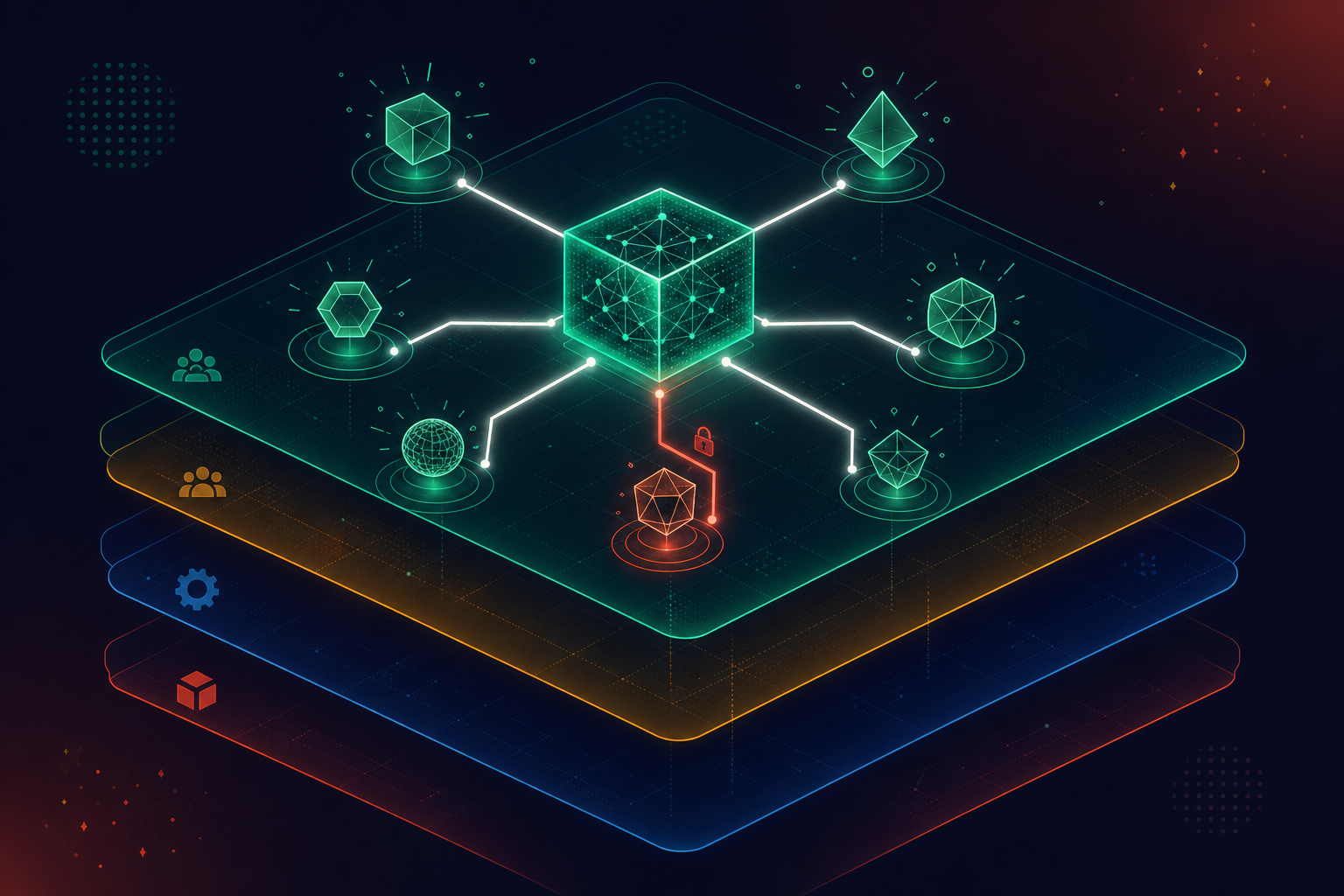
The data here is not theoretical. Teleport’s 2026 report found that organizations giving AI systems excessive permissions experience 4.5x more security incidents than those enforcing least privilege, and 70% grant AI higher access than humans need for the same task. Oso and Cyera’s 2026 research across 2.4 million workers and 3.6 billion permissions found that 96% of granted enterprise permissions go unused, a measure of human employee access broadly, not AI-agent behavior. The implication for agents follows from that baseline: when agents inherit those same unused permissions, dormant access becomes active at machine speed.
Traditional access control was designed for humans who exercise discretion. An agent follows every reachable path. Per-agent permission scoping, a core piece of meeting data governance, is not a feature most company brain implementations can credibly claim today.
Observability: You Cannot Govern What You Cannot See
A database query returns a row and logs it. An agent reasoning over a company brain does something harder to pin down: it retrieves, synthesizes, infers, and acts across multiple knowledge sources in a single non-deterministic pass. What data it touched, what it surfaced, and to whom are not automatically recorded at a level that satisfies an auditor.
Observability tooling exists, but the gap between monitoring and control remains wide. The Cloud Security Alliance’s April 2026 survey of enterprise security teams found that 65% reported at least one AI agent-related security incident in the past year; yet only 11% of organizations have controls set to automatically block an agent when it exceeds its scope; 38% require human approval after the fact, and 24% require only that it be logged. The practical implication: an agent that has already exfiltrated data or triggered a downstream action is not stopped by a log entry. The same survey found that 82% of enterprises had identified previously unknown agents in their environments, despite 68% reporting high confidence in their visibility. Confidence and coverage are measuring different things. Watching is not governing.
In financial services, healthcare, and legal, auditability is a hard requirement, a baseline covered in any meeting recording security and compliance review. A company brain that cannot produce a verifiable record of what an agent retrieved, why, and what it did with it is not deployable in those industries without accepting risk the compliance team will not sign off on. That is the governance-containment gap, and most company brain implementations in late 2026 have not closed it.
Authentication Across a Multi-Agent System Is Unsolved
A single AI assistant with a long-lived API key is a convenient shortcut. An org-wide multi-agent system built on that same pattern is a security liability.
Each agent in a chain needs its own identity, scoped credentials, and a way to pass task context forward without inheriting the access scope of every agent that preceded it. The right architecture uses short-lived, task-scoped credentials that expire when the task does. Most implementations use broad API keys set at deployment and never rotated, passing permissions wholesale to downstream agents instead of re-scoping for what each one actually needs.
Only 3% of organizations have automated controls governing AI behavior at machine speed, per Teleport’s 2026 report. The company brain is only as trustworthy as what gates access to it, and in most cases that gate is a static credential with org-wide read access and no expiry.
The Stale Knowledge Problem: Company Brains Do Not Self-Correct
Beyond who can access the corpus, there’s the question of whether the corpus is even still true. A company brain built today starts decaying tomorrow. Strategies shift, people leave, commitments get walked back in a follow-up call that was never linked to the original one. The corpus holds both states, flags neither, and serves whichever one an agent retrieves first.
This is structurally different from a stale database record. A database has a single row per entity; update it and the old value is gone. A conversation corpus has two meetings: the one where the commitment was made and the one where it was quietly reversed. Nothing connects them. An agent querying for current strategy may surface the original decision with full confidence, because the corpus contains no signal that the context changed.
Bi-temporal awareness would solve this: tracking when a fact was recorded and when it stopped being true. The concept circulates in data architecture discussions. It is not shipped as a standard feature in any company brain tooling available today, including ours.
The Agent-First Mistake: Building Agents Before the Corpus Is Ready
The sequence matters: capture first, then enrich and classify, then make it retrievable, then build agents. Most organizations skip directly to step four.
An agent pointed at an unstructured archive returns whatever is reachable, not whatever is relevant or appropriate. Without classification running ahead of retrieval, there is no signal about what should be excluded, what is HR-sensitive, what is outdated, or what belongs to a cancelled project. The agent surfaces what it finds.
The other failure mode is agents that solve capture for themselves, each building its own ingestion layer and tagging logic. None of that work compounds. A governed corpus built once makes every subsequent agent cheaper to build and safer to deploy. Skipping it means paying the foundation cost repeatedly, per use case, with no organizational asset accumulating underneath.
An agent deployed without a classified corpus is a liability.
Consent, Classification, and Governance Are Not Default
Recording everything without classifying anything first is how organizations build a liability instead of a knowledge asset.
Two design questions most implementations skip: whose consent governs a multi-participant conversation (the subject of setting meeting recording consent policies) and what gets classified as off-limits before ingestion instead of after a retrieval error surfaces the wrong thing. HR discussions, M&A conversations, personal coaching sessions, and executive one-on-ones need to be tagged and excluded from general agent access at the point of capture. An agent that retrieves a performance review because nobody classified it as HR-sensitive has already failed, not merely threatened to.
Opt-out design adds another unresolved layer, closely tied to data retention for enterprise AI tools. A frictionless toggle causes reflexive opt-outs and fragments the corpus. Heavy friction is coercive and creates legal exposure. Most implementations ship neither with any rigor.
Where the Conversation Gap Is Solved and Where the Hard Problems Still Live
Spinach AI is an enterprise conversation intelligence platform and the system of record for conversation data, built to solve the first and hardest gap in this article: the conversation blind spot. An organization deploys it once, company-wide, instead of leaving each team with its own notetaker. It joins meetings on Zoom, Google Meet, Microsoft Teams, Slack Huddles, and Webex, captures video, audio, transcript, screen share, and in-meeting chat during the meeting, and delivers governed, structured outputs when the meeting ends, the pattern laid out in this enterprise conversation intelligence buyer’s guide. Recording and transcription are the input; decisions, action items with named owners, tickets, and CRM records are the output. Those route into downstream systems automatically and power agent workflows via the MCP server on Business and Enterprise plans.
The harder problems named above, a full context graph, per-agent permission scoping, multi-agent authentication chains, bi-temporal self-correction, are not fully shipped features in any tool, including ours.
Gap | Spinach AI | Industry-wide status (late 2026) |
|---|---|---|
Conversation capture (Zoom, Meet, Teams, Slack Huddles, Webex) | Solved | Fragmented: per-user opt-in, no org-wide record |
Structured outputs routed to downstream systems | Solved | Partial: most tools stop at transcript or summary email |
Agent-queryable corpus via MCP server | Available on Business & Enterprise plans | Rare: most knowledge bases lack a structured agent interface |
Full context graph (decisions + reasoning + relationships) | Not fully shipped | Not shipped in any tool |
Per-agent permission scoping | Not fully shipped | Not shipped: most implementations use one corpus-wide permission model |
Multi-agent authentication chains | Not fully shipped | Not shipped; broad static API keys remain the norm |
Bi-temporal self-correction (tracks when facts stop being true) | Not fully shipped | Not shipped in any company brain or knowledge management tool |
What that means practically, including for financial services meeting AI compliance teams: organizations that wait for a complete solution will lose the data that makes any future solution worth building. Every unrecorded meeting is context that cannot be recovered. Start capturing, classifying, and governing now. The rest of the infrastructure will catch up to a corpus that’s ready for it.
Final Thoughts on Closing the Enterprise AI Knowledge Gap
The company brain limitations that stall most organizations are less about AI capability and more about the data underneath it. Your conversations hold the reasoning behind decisions alongside the decisions themselves, and that context is exactly what agents need to act well. Spinach AI, the system of record for conversation data, is deployed company-wide to capture every conversation, centralize it into one governed, AI-ready data asset, and power people and agents with it, starting with the conversations your org is having right now.
A company brain is a governed source of truth that tracks decisions, the reasoning behind them, and whether facts are still current — enterprise search tools return what’s similar to a query, not what’s still accurate or why something was decided. Glean and Notion AI are retrieval systems; a true company brain requires classification, bi-temporal awareness, and per-agent permission scoping that neither ships today. If your agents are acting on retrieved facts without knowing whether those facts are nine months stale, you have a searchable archive, not a brain.
Most stall because the underlying data was never made AI-ready before the agent was built. Gartner found that through 2026, organizations will abandon 60% of AI projects unsupported by AI-ready data, and a separate Gartner analysis found at least 50% of generative AI projects were abandoned after proof of concept due to poor data quality, inadequate risk controls, or unclear business value. Conversation data is the category almost nobody has classified and governed before pointing an agent at it — which means the corpus the agent queries is a fragmented collection of per-user notes with no organizational record.
Govern the data first. Capture, classify, and structure the corpus before deploying agents against it — an agent pointed at an unstructured archive surfaces whatever is reachable, including HR-sensitive material, outdated decisions, and context from cancelled projects. Every agent you build on top of a governed corpus is cheaper and safer to deploy than one built on raw transcripts; skipping the foundation means paying that cost repeatedly, per use case, with no organizational asset accumulating underneath.
Spinach captures conversations across Zoom, Google Meet, Microsoft Teams, Slack Huddles, and Webex — every modality, every channel — and delivers governed, structured outputs when the meeting ends: decisions, action items with named owners, tickets, and CRM records routed automatically into downstream systems. The MCP server on Business and Enterprise plans makes that structured conversation data queryable by Claude and ChatGPT, so agents have the reasoning behind a decision, not just the conclusion. That solves the input problem; the harder gaps named in this article — a full context graph, per-agent permission scoping, bi-temporal self-correction — are not fully shipped in any tool as of late 2026, including Spinach.
Over-permissioned agents are the primary risk. Teleport’s 2026 report found that organizations giving AI systems excessive permissions experience 4.5x more security incidents than those enforcing least privilege, and Oso and Cyera’s 2026 research across 2.4 million workers found that 96% of granted enterprise permissions go unused — when agents inherit those permissions, dormant access becomes active at machine speed. Most company brain implementations today use a single permission model where any agent can query the full corpus, meaning a customer support agent can reach financial data with no architectural barrier stopping it.
Bi-temporal awareness means tracking not just what a fact is, but when it stopped being true — so an agent querying your knowledge base knows whether a decision made nine months ago is still current. Most tools store the fact but not its expiry, which means two conflicting meeting records can coexist in the same corpus with no signal about which one governs. As of late 2026, no company brain tooling ships this as a standard feature at any meaningful depth.
A vector store returns what’s similar to a query; a context graph maps what’s consequentially connected — who made a decision, what project it touched, what constraint was named, and what changed afterward. RAG retrieves the conclusion; a context graph surfaces the reasoning behind it, which is what agents need to act well. Most company brain implementations today are vector stores dressed up with a search interface, not genuine context graphs.
AI-ready data is classified, governed, and retrievable by agents without manual intervention — meaning the corpus has clear ownership, access rules, and enough structure for an agent to know what to include and what to exclude. Conversation data almost never meets that bar out of the box: per-user note silos, no org-level record, and no classification running ahead of retrieval. A June 2026 BARC study found only 29% of organizations fully know where their AI-relevant unstructured data resides, and 70% say less than half is discoverable and usable for AI.
No — individual notetakers are built for one person’s meetings, so deploying them across a company produces a different tool per team, shadow IT, uncontrolled sharing, and no single organizational record anyone can query. The result is a fragmented collection of per-user notes rather than a governed corpus an agent can reason against. A company brain requires org-wide capture with enforced policy and a centralized, classified data asset underneath it.
An agent pointed at an unclassified archive surfaces whatever is reachable — including HR-sensitive material, outdated decisions, and context from cancelled projects — because there’s no signal about what should be excluded. Building agents before the corpus is governed means every use case pays the classification and governance cost separately, with no organizational asset accumulating underneath. Getting the sequence right means every subsequent agent is cheaper to build and safer to deploy.
HR discussions, M&A conversations, personal coaching sessions, and executive one-on-ones need to be tagged and excluded from general agent access at the point of capture — not after a retrieval error surfaces the wrong thing. On the consent side, organizations need a clear policy on who governs a multi-participant conversation and what the opt-out design looks like, since a frictionless toggle fragments the corpus while heavy friction creates legal exposure. Neither challenge has a default solution in most company brain implementations today.
You need per-agent permission scoping — a separate access model for each agent that limits retrieval to the data it has a legitimate reason to touch, rather than inheriting org-wide read access. Most company brain implementations today use a single permission model where any agent can query the full corpus, which means there’s no architectural barrier between a support agent and financial records. Teleport’s 2026 report found organizations giving AI systems excessive permissions experience 4.5x more security incidents than those enforcing least privilege.
Structured data already has schemas, ownership, and defined update paths — connecting Jira or a CRM to an AI layer is largely a solved ingestion problem. Conversation data is different in kind: it happens across multiple tools inside the same org, access to recordings is per-participant by default, and nothing centralizes it across channels, so no queryable dataset exists to point an agent at. The quality gap compounds the coverage gap — an email saying ‘let’s build that integration’ gives an agent almost nothing, while the meeting where it was decided contains the reasoning, the rejected alternatives, and the open concerns.
Each agent in a chain needs its own scoped, short-lived credentials that expire when the task ends — not a shared long-lived API key that passes full org-wide read access to every downstream agent. Most implementations today use broad keys set at deployment and never rotated, which means dormant access becomes active at machine speed across every agent in the chain. Only 3% of organizations have automated controls governing AI behavior at machine speed, per Teleport’s 2026 report, which makes this an unsolved gap in most company brain architectures.
Auditability is a hard baseline: the system must produce a verifiable record of what an agent retrieved, why, and what it did with that data — at a level a compliance team can sign off on. Beyond that, verify per-data-type retention configuration, PII redaction at the transcript level, consent and notification controls for recorded conversations, and whether a BAA is available if HIPAA applies. A company brain that can’t satisfy those requirements in a security and legal review is not deployable in regulated environments regardless of how well the demo performs.
What you should do next
Now that you've read this article, here are some things you should do:
- If communication is a challenge for your team, you should check out our library of meeting agenda templates.
- Learn more about Spinach and how it can help you run a high performing org.
- If you found this article helpful, please share it with others on Linkedin or X (Twitter)

