The Missing Link in Your Company Brain, October 2026
Search improvements won't fix missing context. Learn why conversation data is essential for AI knowledge bases in 2026.
 Maintouch
Most AI knowledge investments go into retrieval: better search, smarter chunking, cleaner indexing. That’s all useful, but it’s solving the wrong problem first. If the reasoning behind your decisions never made it into the corpus to begin with, no amount of retrieval improvement will surface it. The missing piece isn’t search quality. It’s what gets captured upstream.
TLDR:
- Your knowledge base holds conclusions; the reasoning behind them died in the meeting room and never got captured.
- Gartner found 60% of AI projects will be abandoned through 2026 without AI-ready data, and conversation data is the category almost no organization has actually made AI-ready.
- A working company brain requires four steps: capture, structure, store, then build agents. Most organizations skip to step four.
- Governance means classifying conversations before they become retrievable, not after. Skipping classification while retaining everything creates the most risk.
- Spinach AI is the enterprise conversation intelligence platform and system of record for conversation data, deployed company-wide across Zoom, Meet, Teams, Slack Huddles, and Webex, centralizing every conversation into one governed, AI-ready data asset that powers both people and agents via its MCP server (Business and Enterprise plans).
What Enterprise AI Knowledge Management Actually Means
Knowledge management AI is often described as smarter search, but that framing undersells the actual problem. Search finds things you know exist. What enterprise AI knowledge management actually does is determine what context any AI system can access, reason over, and act on across the organization. It is the data infrastructure layer beneath every agent, every assistant, every automated workflow: the foundation of what’s often called enterprise conversation intelligence.
That distinction matters because the quality of any AI output is bounded by the quality of its inputs. An AI that can only see your Confluence wiki and your Jira tickets will answer questions based on those. If the real reasoning behind your decisions happened in a meeting and was never written down anywhere, the AI will not know it exists.
Most organizations have not fully reckoned with what their knowledge base actually contains versus what it should.
The Ingestion Asymmetry: Why Some Data Is Already AI-Ready
Connecting structured data to an AI system is mostly a procurement decision. You authorize the Salesforce integration, point it at your CRM, and the records are queryable. Same with Jira tickets, Slack messages, Google Docs. The data exists, it has structure, and ingesting it is an engineering task you can finish in an afternoon.
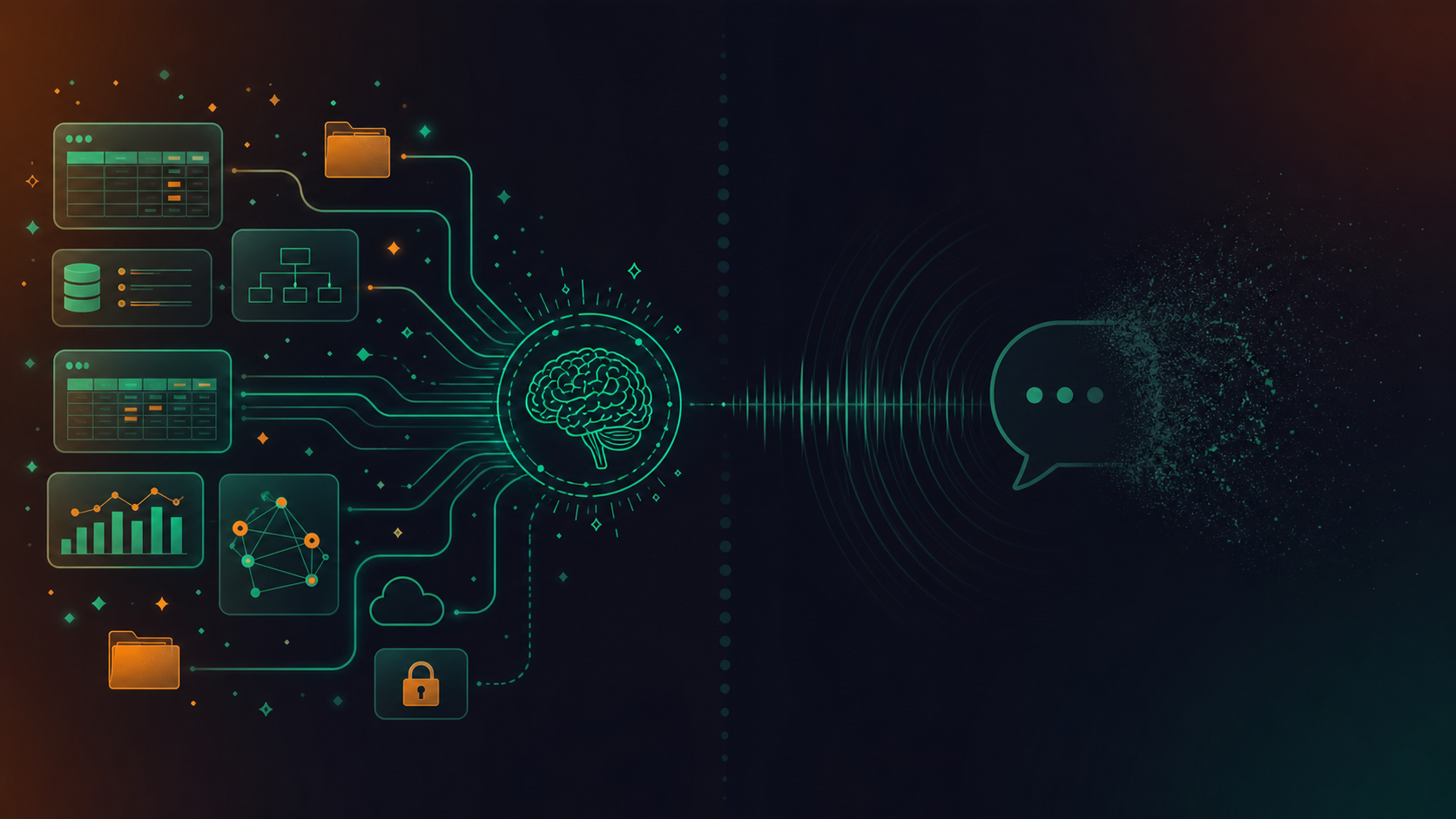
Conversations are a different problem entirely. There is no system to connect to. If you want to know what was decided in last quarter’s planning meeting, there is no API returning that answer, because the decision was spoken aloud, never written down, and the meeting ended. Gartner found that through 2026, organizations will abandon 60% of AI projects unsupported by AI-ready data. In our view, conversation data is the category most often left unaddressed.
Why Conversation Data Is Qualitatively Better Than Written Records
Consider what actually exists in most knowledge bases: a Confluence page that says “we chose vendor X.” No rationale. No record of what was rejected, or why. Someone wrote the conclusion down; the reasoning died in the room.
The meeting that produced that page contained something far richer: the three alternatives considered, the constraint that ruled two of them out, the pricing concern someone raised, and the condition under which the team would revisit. An AI agent with access to that meeting can answer follow-up questions. An AI agent reading the Confluence page cannot.
Written artifacts are summaries of thought. Conversations are the thought itself. A knowledge base built entirely on documents will always reason shallowly because it holds conclusions without the logic connecting them.
How AI Knowledge Management Systems Currently Handle Unstructured Data
Most knowledge management AI systems handle unstructured data through document parsing, semantic search, and AI-assisted categorization. Point a system at your Google Drive, your Confluence space, or your email archive, and it will chunk the content, embed it, and make it retrievable. Retrieval quality has improved considerably, and surfacing relevant documents across a sprawling wiki is genuinely useful.
The limit is not the retrieval layer. It is what that layer has access to. These systems read what was written: emails, docs, tickets, chat messages. Spoken conversations sit outside their reach by default, because no transcript exists unless someone deliberately created one. That is a capture problem, not a search quality problem, and it sits one step upstream from anything the knowledge management layer can solve, touching meeting recording security and compliance as much as retrieval.
The Three Reasons Conversation Data Never Makes It Into the Knowledge Base
Most teams already use a meeting tool. The gap persists anyway, for three specific reasons.
- Per-participant access is the default. Even when a notetaker is present, the recording belongs to whoever hosted. Other attendees may never see it. Multiply that across hundreds of meetings and you have dozens of individual archives that no AI system can query as one corpus.
- Organizations rarely run one video environment. Zoom for external calls, Teams for internal ones, Slack huddles for quick syncs, Webex for one legacy customer. Each produces its own siloed output. No single tool covers the full conversation corpus.
- Without systematic capture across all of those channels, there is no dataset. Per-user exports are not a knowledge base. They are scattered files that happen to contain transcripts.
The difficulty here is upstream from anything a knowledge management system can fix. You cannot retrieve what was never captured into a shared, queryable store.
What a Company Brain Actually Requires to Work
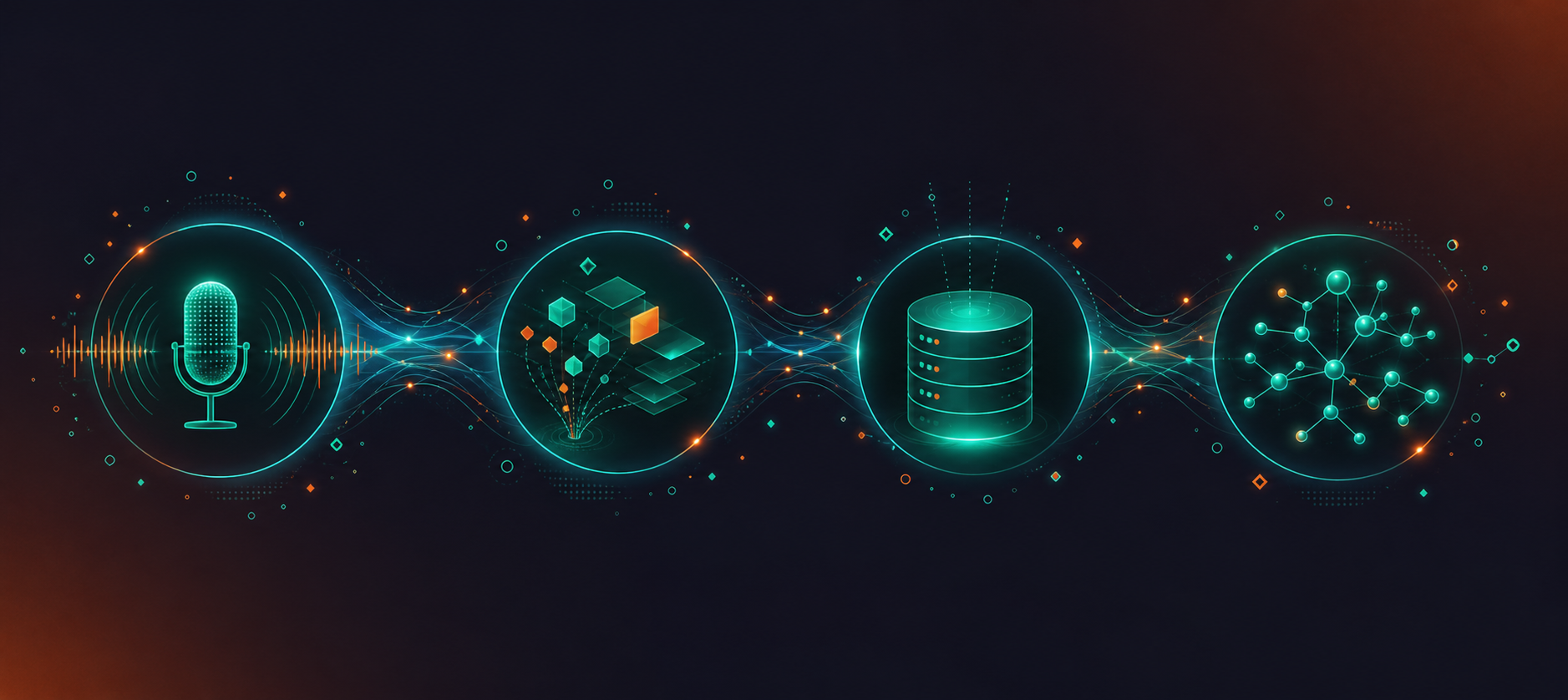
Four inputs separate a working company brain from an expensive archive.
Step | What it requires | Where most organizations stall |
|---|---|---|
1. Capture | Record every conversation systematically across all channels and modalities: Zoom, Teams, Meet, Slack Huddles, Webex. | Per-participant access and siloed tools mean no shared, queryable corpus ever forms. |
2. Structure | Mine raw transcripts: classify conversation type, tag sensitivity, attach project and role context. | Raw transcripts without classification are unsearchable and ungovernable. |
3. Store | Place structured data in a conversation data system of record that agents can query across the full corpus. | Scattered per-user exports are not a knowledge base; they are files that happen to contain transcripts. |
4. Build agents | Construct AI agents on top of the resulting governed data asset. | Organizations fund this step without completing step 1, so each agent then re-solves capture for its own use case and none of that work compounds. |
The failure pattern is straightforward: organizations fund step four without completing step one. Each agent then re-solves capture and context for its own use case, and none of that work compounds into anything the next agent can use. Gartner found that organizations with successful AI initiatives invest up to four times more in foundational data and analytics areas than those with poor outcomes, a finding about data infrastructure broadly. In our view, conversation capture is the specific part of that foundation that almost no organization has actually built.
Governance: Why Capturing Everything Is Not the Same as Indexing Everything
Capturing every conversation is the first step. Indexing all of it indiscriminately is a different problem.
The gap between those two is governance. A rules-based tagging layer classifies each conversation before it becomes retrievable: is this personal? Is it HR-related? Does it touch M&A, legal review, or a compliance-sensitive topic? Tagged material stays captured but sits outside what agents can query. The corpus grows without becoming a liability.
The legitimate concern is worth naming plainly: recording everything creates new legal surface area. If a conversation was never written down, it was one person’s word against another’s. Once captured and retained, that changes. Organizations are right to think carefully about this, which is why clear meeting recording consent policies matter.
The counter-argument is equally real. The same visibility that creates risk also surfaces risk that was always happening invisibly. Running classification over conversation data can improve compliance posture by making the corpus visible for the first time: once you know what is in it, you can apply retention controls accordingly.
“Every interaction within the enterprise within 3 years will be recorded and I think the default is going to be record on.” – Thomas Laffont, Co-Founder, Coatue (Uncapped podcast, ep. 29)
Practical governance comes down to two controls: retention configured per data type, and classification that runs ahead of access. Transcript, summary, and video can each carry different retention periods. Classification determines what an agent can reach. Skipping classification while retaining everything is the version of this that creates the most risk.
Enterprise AI Knowledge Management for Compliance-Sensitive Industries
Industries with strict compliance requirements face knowledge management challenges that go well beyond retrieval quality. In healthcare, HIPAA governs what patient-adjacent conversation data can be retained, who can access it, and under what terms. Financial services organizations operate under similar constraints around client communications and trade discussions, which is why financial services meeting compliance requires its own controls. Legal teams carry privilege considerations that make blanket indexing legally untenable.
For knowledge infrastructure in particular: retention must be configurable per data type, not organization-wide. Transcript, summary, and video often carry different obligations. Classification must run before access, not after. Any system handling protected information needs SOC 2 Type II certification, GDPR compliance, and a BAA for HIPAA-covered engagements.
The conversation data problem is actually sharper in compliance-heavy environments. These organizations have the most context locked in spoken interactions and the strictest requirements for how that context gets handled. The governance layer is the product, not an afterthought bolted onto search; a point any enterprise conversation intelligence buyer’s guide should make explicit.
How the Conversation Gap Gets Closed in Enterprise Knowledge Management
Spinach AI is the enterprise conversation intelligence platform. The system of record for conversation data. Deployed company-wide across Zoom, Google Meet, Microsoft Teams, Slack Huddles, and Webex, Spinach joins every meeting, captures every conversation modality (video, audio, transcript, screen share, and in-meeting chat), and delivers structured, governed, AI-ready knowledge that powers both people and agents across the organization.
The distinction from per-user tools is architectural. Spinach centralizes conversation data into one system of record. Through its MCP server, included on Business and Enterprise plans, that corpus becomes queryable via Claude connectors and ChatGPT, so the reasoning behind every decision sits alongside the decision itself, retrievable for the first time. API and webhooks, including ChatGPT agents via webhooks, are available on Enterprise plans.
Governance runs ahead of access, not after. PII redaction operates at the transcript level, and access to that data through an MCP server for meeting transcripts runs on top of the same governance. Retention is configurable per data type on Enterprise: transcript, summary, and video can each carry separate retention periods. The admin dashboard provides audit logging and usage reporting. Spinach holds SOC 2 Type II, GDPR, and HIPAA compliance, with a BAA available for Enterprise engagements.
The structured data your organization already has (CRM records, Jira tickets, Confluence pages) gets more useful when the reasoning that produced it is finally queryable alongside it, including when it feeds enterprise search tools like Glean agents through custom connectors. That is what Spinach AI adds to every knowledge management investment you have already made.
Final Thoughts on Enterprise Conversation Intelligence and the Company Brain
The organizations that get the most out of AI are the ones that treated data capture as the foundation, not an afterthought. Your spoken decisions, rejected alternatives, and meeting context are the richest data your company produces, and right now, almost none of it is queryable. Building a real knowledge base means starting one step upstream from search. Spinach AI is where that foundation gets built.
Individual note takers like Otter, Fireflies, and Fathom are built for one person’s meetings, which means each team member ends up with a separate tool, a separate archive, and no shared organizational record. Spinach AI is the enterprise conversation intelligence platform deployed company-wide across Zoom, Google Meet, Microsoft Teams, Slack Huddles, and Webex — centralizing every conversation into one governed, AI-ready data asset that people and agents can query through Claude and ChatGPT via the MCP server. The distinction matters for enterprise AI knowledge management because no knowledge system can retrieve context that was never captured into a shared, queryable store.
Start with four requirements before looking at features: configurable retention per data type (transcript, summary, and video should carry separate periods), classification that runs before access and not after, certifications matched to your compliance environment (SOC 2 Type II, GDPR, HIPAA with a BAA for covered engagements), and org-wide policy enforcement instead of per-user settings. The blocker in most enterprise deployments is almost never summary quality; it is security review, legal, HR recording-consent policy, and procurement timing. Any tool under consideration should answer each of those before a pilot begins.
Structured records like Confluence pages and Jira tickets hold conclusions: the decision, the outcome, the ticket status. The reasoning behind them, the alternatives considered, the constraint that ruled two options out, the condition under which the team would revisit: that context died in the meeting room. An AI agent reading your Confluence page can answer questions about what was decided; an agent with access to the meeting that produced that page can answer questions about why, which makes every downstream query more accurate and every follow-up decision better informed.
Spinach holds SOC 2 Type II, GDPR, and HIPAA compliance, with a BAA available for Enterprise engagements. HIPAA coverage and BAA availability apply to Enterprise only, not Starter, Pro, or standard Business. Retention is configurable per data type on Enterprise: transcript, summary, and video each carry separate retention periods, from one week to indefinite, which matters for organizations subject to GDPR’s data minimization requirements. Business plan retention is flat one year across all data types. PII redaction operates at the transcript level. Classification runs ahead of access, so sensitive material (HR, legal, compliance-sensitive topics) stays captured but sits outside what agents can query.
The pattern in real deployments is consolidation, not replacement: organizations keep Gong for customer-facing sales meetings where its coaching and revenue-workflow features are the focus, roll out Spinach across every other function (product, engineering, HR, legal, leadership) and feed one company brain from both sources. Spinach’s advantages in that model are org-wide scope, a single retrieval layer across all conversation data queryable via Claude and ChatGPT, buildability through the API and MCP server, and materially lower cost for company-wide coverage. Spinach is not at feature parity with Gong for the specific sales-coaching use case, and the stronger argument is one platform for the full organizational record over a head-to-head replacement.
Capture conversations systematically across every meeting platform first, then apply classification before storage, since engineering agents on top of uncaptured data is the step most organizations skip to and fail at. A platform that joins Zoom, Google Meet, Microsoft Teams, Slack Huddles, and Webex and centralizes the output into one governed corpus removes the need to build a custom pipeline for each tool.
Yes, through an MCP server that exposes your organization’s conversation corpus as a connector, included on Business and Enterprise plans. Without that layer, Claude and ChatGPT can only reason over whatever documents and tickets you manually feed them, missing the context from meetings that never got written down.
Retrieval quality is bounded by what’s in the corpus, and most corpora hold written conclusions without the spoken reasoning behind them. A Confluence page that says a decision was made contains no record of the alternatives considered or the constraint that ruled them out, so no amount of better search or chunking can surface context that was never captured.
Recording produces a file per meeting owned by whoever hosted it; a system of record centralizes every recording across the organization into one governed, queryable corpus that agents and people can search across. Per-user recordings scattered across individual Zoom or Teams accounts are not a knowledge base, they’re files that happen to contain transcripts.
Before. Running classification ahead of access lets sensitive conversations (HR matters, legal review, M&A discussions) stay captured but outside what agents can query, while retaining everything without classification creates the most legal and compliance exposure.Decide the classification rules before any agent gets query access, not after a retrieval layer is already live.
Frame it around the Gartner finding that organizations will abandon 60% of AI projects through 2026 without AI-ready data, and point out that conversation data is the category almost no organization has made AI-ready despite having the systems to do it. The case is defensive as much as offensive: every AI agent built without this foundation re-solves capture for its own use case instead of compounding on shared infrastructure.
No. Systems that parse documents, emails, and tickets have nothing to read unless a transcript already exists, and spoken conversations sit outside their reach by default. That’s a capture gap one step upstream from retrieval, not something better search or AI-assisted categorization can fix on its own.
Risk increases when an organization captures everything but skips classification, leaving sensitive conversations retrievable by anyone with corpus access instead of tagged and restricted. The same visibility that creates exposure also surfaces compliance risk that existed invisibly before, so the real risk driver is missing governance, not the act of recording itself.
Ask whether retention is configurable per data type (transcript, summary, video separately), whether classification runs before or after agent access, and which certifications apply to your specific tier, since HIPAA and BAA coverage often apply only to Enterprise engagements, not Starter, Pro, or standard Business. Also confirm whether PII redaction operates at the transcript level, since that’s the regulated-buyer differentiator that matters most for healthcare and financial services deployments.
Transcription produces a text file of what was said; conversation intelligence classifies, governs, and routes that content into a queryable asset that agents and people can act on. A transcript sitting in one person’s Google Drive folder answers nothing until it’s centralized with the rest of the organization’s conversations and made retrievable under enforced policy.
What you should do next
Now that you've read this article, here are some things you should do:
- You should check out our library of meeting agenda templates for every type of meeting.
- Learn more about Spinach and how it can help you run a high performing org.
- If you found this article helpful, please share it with others on Linkedin or X (Twitter)

