Governed Data: Your Untapped Edge, October 2026
Learn what governed data means, why most enterprises lack it, and how it fuels trustworthy AI outcomes in October 2026.
 Maintouch
Owning a lot of data and being able to act on it are two very different things. Most organizations are sitting somewhere in the middle: massive volumes of information that nobody fully trusts, can’t easily find, and isn’t sure who’s responsible for. That’s the gap where governed data actually matters, and why it’s becoming the thing that separates fast-moving organizations from ones that are stuck.
TLDR:
- Governed data has four properties: classification, named ownership, access controls, and documentation an AI agent can act on.
- Only 8% of organizations have a thorough AI governance framework, while 88% use AI in at least one business function (Economist Impact, via Evolvance Market Research).
- Gartner predicts 80% of organizations pursuing digital expansion will hit obstacles from outdated data and analytics governance, a broad structural barrier that affects how quickly any AI initiative can move from pilot to production.
- Poor data quality cost organizations an average of $12.9 million annually (Gartner, 2021), a figure that predates the current wave of AI deployment and compounds further as AI agents multiply the consequences of ungoverned inputs.
- Spinach AI captures conversation data across Zoom, Google Meet, Teams, Slack Huddles, and Webex and brings it into the governed tier alongside your structured data, with PII redaction, configurable retention per data type, SOC 2 Type II and GDPR compliance, and HIPAA compliance with BAA available on Enterprise engagements.
What Governed Data Actually Means
Governed data is data your organization can actually act on. Possession is not the same thing as usability. Most enterprises sit on enormous volumes of data that nobody trusts, nobody can find, and nobody knows who owns.
Four properties separate governed data from raw data:
- It has been classified so people know what it is and what it represents.
- It has an assigned owner who is accountable for its accuracy.
- It is secured with access controls that reflect who should actually see it.
- It is documented well enough that a downstream system or AI agent can use it without second-guessing its source.
The gap between “we have the data” and “we can use the data” is exactly where governance lives.
Governed Data vs. Ungoverned Data
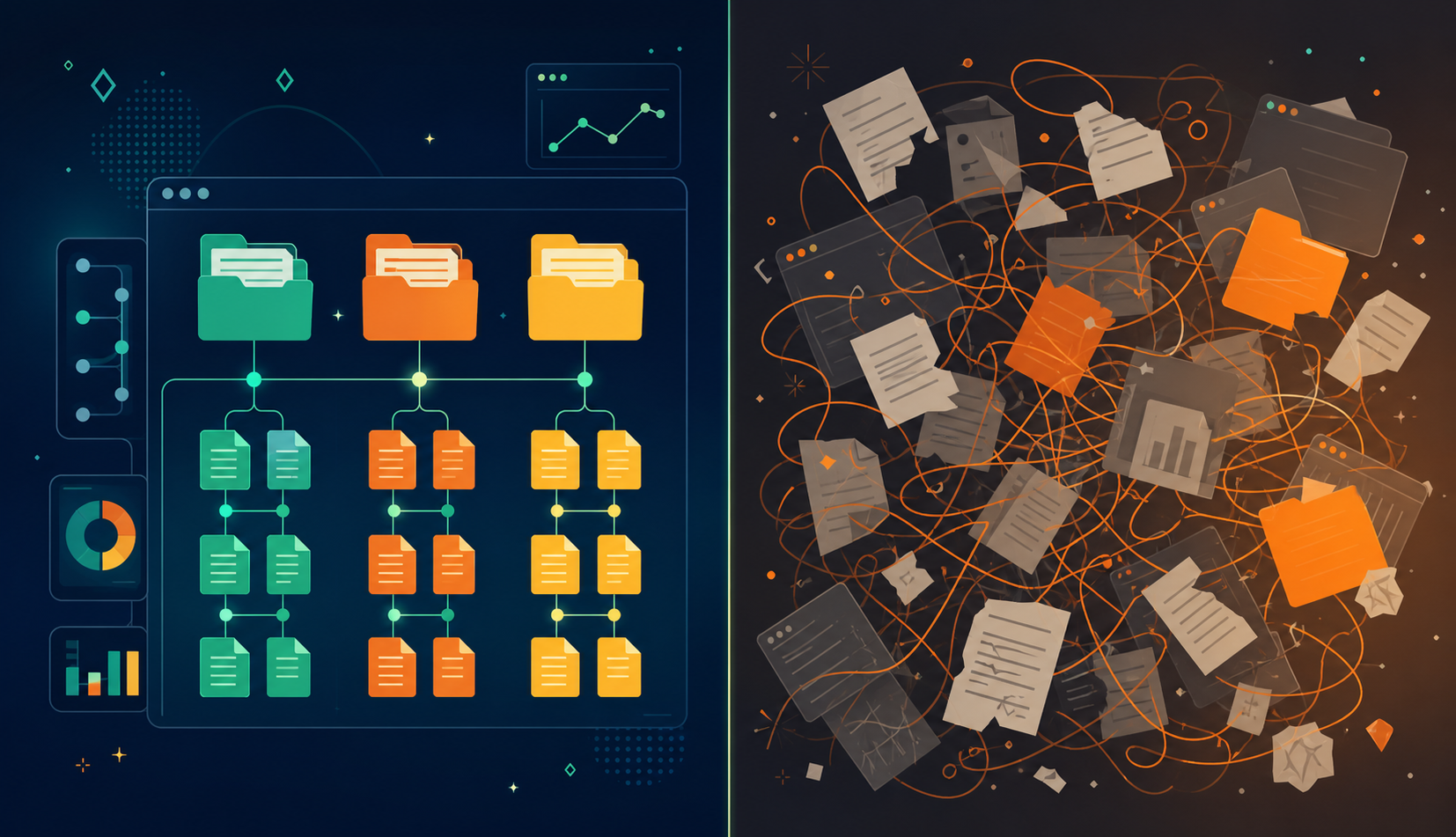
The difference shows up the moment someone tries to use the data.
Ungoverned data looks like this in practice: a sales rep’s call notes live in one tool, engineering decisions sit in another, and HR conversations exist only in someone’s personal account. Nobody can search across them. Nobody knows if the information is current. An AI agent pointed at this corpus will either hallucinate or return results that contradict each other.
Attribute | Governed Data | Ungoverned Data |
|---|---|---|
Ownership | Assigned, documented | Unknown or disputed |
Access control | Policy-enforced | Per-user, inconsistent |
AI readiness | Classifiable, retrievable | Fragmented, unreliable |
Audit trail | Exists | Absent |
Ungoverned data is not neutral. It actively creates risk: compliance exposure, conflicting decisions, and AI outputs nobody can trust, which is a core reason enterprises are investing in enterprise conversation intelligence.
Why Most Organizations Are Still Operating with an Ungoverned Data Majority
The vast majority of enterprise data is unstructured, and most businesses recognize unstructured data management as a serious problem. Yet most lack effective controls over it.
The reason is structural. Data volumes compound faster than governance programs scale. Every new SaaS tool, every remote meeting, every Slack thread adds to the corpus. Traditional governance stacks were built for databases and file servers, not for the sprawl of cloud-native work.
Two forces widened the gap: cloud infrastructure made storage nearly free, removing the natural constraint that once forced organizations to decide what was worth keeping, and remote work introduced conversation data that older frameworks never anticipated.
The Core Components of a Data Governance Framework
A governance framework is not a single policy document. It is a set of interlocking components, each handling a different failure mode.
- Data classification labels data by type, sensitivity, and intended use so downstream systems know how to handle it.
- Metadata management records context about the data: where it came from, when it was created, what format it is in.
- Data lineage tracks how data moves and changes across systems so you can trace errors back to their source.
- Ownership and stewardship assigns a named person responsible for each data domain’s accuracy and access decisions.
- Access policy controls who can read, edit, or delete data, enforced at the system level and not left to the honor system.
- Retention and lifecycle rules define how long data is kept, when it is deleted, and what triggers each action.
- Quality monitoring continuously checks that data meets defined standards and flags deviations before they reach production systems or agents.
Skip one component and the others weaken. Access policy without classification means you cannot write rules that reflect actual sensitivity. Lineage without ownership means nobody acts when something breaks.
Data Lineage and Provenance: Why They Are Non-Negotiable
Lineage and provenance get less attention than access control and classification in most governance discussions, and that is a mistake.
Lineage answers where data came from and how it moved. Provenance answers who touched it and when. Together they make an AI output defensible: if a model surfaces a decision recommendation and someone asks why, you need a traceable path back to the source material, not a confident-sounding answer with no verifiable origin.
In high-compliance environments, auditors and legal teams require this chain, a requirement financial services meeting AI compliance programs take especially seriously. But even outside compliance contexts, organizations deploying AI on consequential decisions need to know whether the underlying data was complete, who had authority to contribute it, and whether any transformation introduced error. Without that chain, the output is a black box dressed up as insight.
How Governed Data Powers AI That Organizations Can Trust
AI systems inherit the trustworthiness of their inputs. Feed an agent ungoverned data and you get outputs that are confident, fast, and unreliable in ways that are difficult to detect until something goes wrong.
Economist Impact research cited by Evolvance Market Research finds that only 8% of organizations globally have a thorough AI governance framework, while 88% use AI in at least one business function. That gap is where enterprise AI risk lives. Most organizations are running agents on data they cannot fully classify, trace, or audit.
Governed data changes this in a specific way: it gives an AI system bounded, verifiable context. The agent knows what the data represents, who authorized it, and when it was current. That is what makes an output reproducible and defensible, as opposed to a plausible-sounding guess that auditors or legal teams cannot verify.

The Conversation Data Blind Spot
Most governance frameworks cover databases, documents, email threads, and file storage. Conversation data sits outside all of them.
The reasoning, constraints, and rejected alternatives behind a decision are rarely written down. What survives is a summary, usually stripped of nuance, filed somewhere people rarely revisit. The meeting where it was decided is gone.
This matters more as AI agents take on consequential work. An agent with access to a company’s Jira tickets, CRM records, and Confluence pages is missing the layer that explains why those records say what they say. It can retrieve the decision but not the reasoning that produced it. That gap produces outputs that are technically grounded and contextually incomplete.
“Every interaction within the enterprise within 3 years will be recorded and I think the default is going to be record on.” — Thomas Laffont, Co-Founder, Coatue (Uncapped with Jack Altman, October 2025)
The conversation data problem is also structurally harder than other data types. Written data already exists in a system; ingesting it is an integration problem. Conversation data often does not exist as an organizational asset at all, which is exactly the gap a conversation data system of record is meant to close. Access is per-participant by default. Multiple video tools run inside the same organization simultaneously. Nothing centralizes the corpus. There is no dataset to govern because there is no dataset yet.
Roles and Accountability in Data Governance
Governance without named accountability is a policy document nobody reads.
Three roles carry most of the practical weight:
- Data owners hold final accountability for a specific domain: they approve access decisions, sign off on classification, and answer when something breaks.
- Data stewards do the daily work: enforcing standards, flagging quality issues, and keeping metadata current as systems and processes change.
- A governance council sets organization-wide policy, resolves conflicts between domains, and decides when exceptions are warranted.
The council is where governance tends to stall. Too many stakeholders, too few decisions, and the committee becomes a bottleneck. The fix is narrow scope: the council sets rules, data owners apply them, and stewards surface problems for arbitration only when owners cannot resolve them directly.
Data Governance and Regulatory Compliance
Regulations make governance mandatory. GDPR governs how personal data is collected, retained, and deleted for anyone handling EU residents’ data. HIPAA controls access and retention of protected health information. CCPA gives California residents rights over their personal data that organizations must honor on demand. Industry-specific frameworks layer additional requirements on top, which is why meeting recording security and compliance planning matters. Without classification, lineage, retention rules, and access controls already in place, compliance becomes a manual fire drill every time a regulator or auditor asks a question.
The financial stakes are concrete. Gartner estimated that annual cost of poor data quality to organizations was $12.9 million, a figure that predates the current wave of AI deployment, which multiplies the downstream consequences of ungoverned inputs.
Governed Data as a Competitive Differentiator
Governance is usually sold as risk mitigation. The actual argument is more interesting: organizations with governed data move faster with AI, trust their analytics at decision time, and retain institutional knowledge when people leave. Those that don’t are building on a foundation that compounds errors.
Gartner predicts that 80% of organizations pursuing digital expansion will encounter obstacles due to outdated data and analytics governance. That is not a compliance warning. It is a competitive forecast. The organizations in the other 20% will deploy agents faster, trust the outputs, and iterate while everyone else is still arguing about whether their data is clean enough to use.
How to Build a Data Governance Framework: A Phased Approach
Start with a business problem, not a framework. Organizations that build governance programs nobody uses almost always made the same mistake: they began with the architecture instead of the question the business was trying to answer.
A phased sequence that actually ships:
- Identify one high-stakes use case where bad data is costing you something measurable: a failed AI initiative, a compliance gap, or a decision that contradicted itself across teams. These are the same use cases that motivate teams to connect an MCP server for meeting transcripts.
- Inventory the data that touches that use case, mapping where it lives, what format it is in, and who currently controls it.
- Classify what you find by sensitivity, function, and ownership, then assign a named owner to each domain before moving further.
- Define policies for that scoped dataset covering access rules, retention periods, and quality standards, then apply them and learn what breaks.
- Monitor continuously and measure outcomes against the original business problem.
Once that loop runs cleanly on one domain, expand. Governance that scales is governance that proved its value on something concrete first.
Closing the Governed Data Gap for Conversation
Conversation data is the one asset class most governance frameworks never reach. Databases are governed. Documents are governed. Email threads, increasingly, are governed. What people actually say in meetings, including the reasoning, the constraints, and the rejected alternatives, remains a per-user folder of notes that nobody can query, classify, or audit.
Spinach AI joins meetings across Zoom, Google Meet, Microsoft Teams, Slack Huddles, and Webex and turns them into structured, governed, AI-ready knowledge the organization actually owns. The governance layer is what separates this from individual note-taking tools: PII redaction at the transcript level, configurable retention per data type (transcript, summary, and video can each be set separately, from one week to indefinite on Enterprise), and compliance agents that classify and flag regulatory and policy risk for review. That is the same governed foundation that lets Claude connectors route structured meeting data to AI systems. Sharing is policy-enforced at the admin level. SAML SSO and SCIM handle provisioning and deprovisioning at scale. Spinach AI is SOC 2 Type II and GDPR compliant; HIPAA compliance with a BAA is available on Enterprise engagements, a governance posture worth weighing directly in Spinach AI vs Gong evaluations.
Conversation data then enters the same governed tier as the structured data your organization already trusts: classifiable, retainable on your terms, and retrievable by people and agents with appropriate access, including setups that power Glean agents with conversation data.
Final Thoughts on Governed Data as a Competitive Advantage
Organizations with governed data go beyond reducing risk. They move faster, trust their AI outputs more, and hold onto institutional knowledge when people leave. The conversation layer where most reasoning and decisions actually happen is still outside most governance programs. That is the gap worth closing first. Spinach AI is the enterprise conversation intelligence platform and system of record for conversation data: deployed company-wide, it captures conversations across Zoom, Google Meet, Microsoft Teams, Slack Huddles, and Webex and turns them into structured, governed, AI-ready knowledge. Decisions with named owners, action items routed to Jira or Linear, CRM records updated, and a queryable corpus your people and agents can retrieve. That is what brings conversation data into the same governed tier as the structured data your organization already trusts.
Conversation data is absent from most governance frameworks because it never existed as an organizational asset to begin with. Databases, documents, and email threads already live in systems that can be ingested and governed; meeting content defaults to per-participant access, scattered across multiple video tools, with no centralized corpus to classify, retain, or audit. The reasoning behind decisions, the constraints named during discussions, and the alternatives that were rejected exist only in individual notes folders, if they exist at all.
The gap most enterprise AI stacks leave uncovered is governed conversation data: the layer that explains why CRM records, Jira tickets, and Confluence pages say what they say. Spinach AI captures conversations across Zoom, Google Meet, Microsoft Teams, Slack Huddles, and Webex and turns them into structured, policy-governed, AI-ready knowledge the organization owns, with SAML SSO, SCIM provisioning, configurable retention per data type, PII redaction at the transcript level, and compliance agents that classify and flag regulatory risk for review.
Start with one high-stakes business problem where bad data is already costing you something measurable: a failed AI initiative, a compliance gap, a decision that contradicted itself across teams. Inventory and classify only the data that touches that use case, assign a named owner to each domain, define access and retention policies for that scoped dataset, then monitor and measure against the original problem before expanding. Governance programs that begin with architecture instead of a concrete question almost always produce policies nobody uses.
Individual note-takers like Otter, Fireflies, and Fathom are built for one person’s meetings: deployed across a company, they produce a different tool per team, uncontrolled sharing, shadow IT, and no organizational record anyone can query or audit. Spinach is the platform an organization deploys once, company-wide, with enforced policy, a single governed corpus, and a governance layer (retention rules, PII redaction, compliance agents, and admin-enforced sharing) that individual tools never provide.
AI-ready means an agent or model can use the data without second-guessing its source: it has been classified, has an assigned owner, is secured with policy-enforced access controls, and is documented well enough that a downstream system knows what it represents and who authorized it. Without that chain, an AI agent pointed at your conversation corpus will either produce outputs that contradict each other or surface confident-sounding answers with no verifiable origin, which is exactly what makes ungoverned data actively dangerous and not merely incomplete.
Try to trace a single data point back to its source and name who is accountable for its accuracy; if you can’t do both quickly, it’s ungoverned regardless of volume. Governed data carries classification, named ownership, access controls, and documentation a system or agent can act on without guessing.
No, because the gap compounds faster than headcount: every new SaaS tool, meeting, and Slack thread adds to an ungoverned corpus that gets harder to untangle later. Starting governance on one scoped, high-stakes use case while the team is small is cheaper than retrofitting it across a sprawling data estate.
Lineage tracks where data came from and how it moved across systems; provenance tracks who touched it and when. Together they make an AI output defensible, since a recommendation with no traceable path back to its source material is a black box no auditor or legal team can verify.
Gartner’s $12.9 million annual cost figure for poor data quality predates widespread AI deployment, and an agent acting on ungoverned inputs multiplies each error across every downstream decision it touches. A bad number in a spreadsheet stays contained; a bad number feeding an agent propagates into tickets, CRM records, and recommendations before anyone catches it.
Before, on a scoped basis: pick one business problem where bad data is already costing something measurable, then build classification, ownership, and access policy around that single use case before expanding agents into it. Rolling out AI on ungoverned data first tends to produce outputs nobody trusts, which stalls adoption rather than accelerating it.
A data owner holds final accountability for a domain and signs off on classification and access decisions; a data steward handles the daily enforcement of standards, flags quality issues, and keeps metadata current. Confusing the two roles is a common reason governance councils stall, since nobody has clear authority to resolve a problem when it surfaces.
Yes, once it’s centralized, conversation data can carry the same classification, retention, and access controls as any structured dataset. The obstacle isn’t the governance model, it’s that conversation data rarely exists as a centralized asset in the first place, since meeting access defaults to per-participant sharing across whatever tool each team happens to use.
Only when a data owner can’t resolve the issue directly, since councils that review every classification or access request become bottlenecks instead of decision-makers. Keep the council scoped to setting organization-wide policy and arbitrating conflicts between domains, and let owners apply the rules day to day.
Check whether you can trace the output back to source data with a documented owner and a timestamp showing when it was current; if that chain doesn’t exist, the output is a guess dressed up as insight. Governed data gives a model bounded, verifiable context, which is what makes a result reproducible rather than merely plausible.
The reasoning behind decisions, the constraints that shaped them, and the alternatives that got rejected stay trapped in meetings and leave with whoever was in the room. Written records like Jira tickets and Confluence pages preserve the decision, not the reasoning, so when the person who made the call leaves, that context is gone with them.
What should you do now
Next, here are some things you can do now that you've read this article:
- If communication is a challenge for your team, you should check out our library of meeting agenda templates.
- You should try Spinach to see how it can help you run a high performing org.
- If you found this article helpful, please share it with others on Linkedin or X (Twitter)

