AI-Ready Knowledge Management Explained (Sep 2026)
Find out what makes a knowledge base AI-ready in September 2026, from permission-aware access to data provenance for reliable agent output.
 Maintouch
There’s a version of AI knowledge management that works, and a version that gives your agents a pile of files and calls it a day. The difference comes down to how your knowledge base was structured in the first place. If your agents can’t tell what’s current, what they’re allowed to use, or why a decision was made, you’re not dealing with a model problem. You’re dealing with a data problem. Here’s what the working version actually looks like.
TLDR:
- Workers take up to 8 searches to find a document (SearchYourCloud survey, via Cottrill Research), and the reasoning behind most decisions was never written down at all
- AI agents need five things from a knowledge base: accurate retrieval, metadata tagging, permission-aware access, freshness signals, and data provenance
- 95% of AI projects fail to reach production due to context deficits, not weak models (State of Context Management Report 2026)
- Compliance-sensitive industries need per-data-type retention windows, audit logging, consent mechanics, and zero data retention with LLM providers
- Spinach AI functions as the system of record for conversation data, capturing meetings across Zoom, Meet, Teams, Slack Huddles, and Webex into a single governed organizational asset
What Knowledge Management Actually Means
Knowledge management is the deliberate practice of capturing, organizing, and making accessible what a company knows so people can make good decisions, onboard faster, and stop solving the same problems twice. Enterprise knowledge management adds layers of governance, scale, and AI complexity that most definitions undercount.
Organizations hold three kinds of knowledge:
- Explicit knowledge is documented: policies, specs, meeting notes. Most tools handle this category reasonably well.
- Implicit knowledge is the know-how embedded in how a team actually operates, rarely written down but reproducible if someone pays attention.
- Tacit knowledge is the hardest to capture: the judgment, context, and reasoning that lives inside people’s heads and walks out the door when they leave.
The last two categories are where most organizations quietly fail, and where AI’s role becomes worth understanding.
Why Traditional Knowledge Management Breaks Down
Most knowledge management failures are not storage problems. The information exists somewhere. Finding it is the issue, and even that undersells the real breakdown.
Workers take up to 8 searches to find the right document, according to a SearchYourCloud survey cited by Cottrill Research (SearchYourCloud, 2013, via Cottrill Research). That number assumes the document was written down at all.
The structural failures tend to cluster around a few patterns:
- Tools multiply faster than anyone governs them, so knowledge fragments across Notion, Confluence, shared drives, and Slack threads with no single place to look
- The person who knows why a decision was made three years ago is a single point of failure, and their knowledge lives nowhere except their own memory: a knowledge management gap that compounds every time someone leaves
- Teams repeat work because there is no reliable way to know whether the problem was already solved by another team last quarter
The failure compounds when people leave. What gets documented is the conclusion, stripped of context. Whoever inherits the work gets the answer but not the thinking behind it, and that gap quietly drives bad decisions downstream.
The Conversation Blind Spot in Enterprise Knowledge
Structured data is already AI-ready. Connect Jira, connect Slack, connect your CRM, and an agent can work with what’s there. The conversation problem is different in kind.
When a team decides to change direction in a meeting, what gets written down is the outcome. The reasoning, the alternatives that were rejected, the constraints someone named out loud, the concern nobody fully resolved: none of that makes it into a document. It evaporates.
This is the highest-context data a company produces, and for most organizations it has no dataset at all. Per-user note takers scatter fragments across individual accounts. Nothing makes it queryable across the organization. The distinction between a knowledge base vs organizational memory matters here: an archive is not the same as a system an agent can reason over. An AI agent given access to every document still cannot answer why a decision was made, because that answer was never captured.
How AI Changes the Knowledge Management Lifecycle
AI changes what’s possible at every phase of the knowledge management lifecycle, not at a single point in it.
- Capture: AI converts unstructured inputs into structured records automatically. A meeting produces decisions with named owners. A customer call produces tagged signals. The input no longer has to be a document to become queryable.
- Organization: Semantic search replaces keyword matching. A question like “why did we drop that feature last year” returns relevant context even when nobody used those exact words.
- Gap detection: AI can identify what’s missing. If a topic keeps surfacing in conversations but no documentation exists, the organizational knowledge management gap is worth surfacing.
- Synthesis: Instead of returning ten documents, AI generates a direct answer with sourced context.
The shift from retrieval to synthesis carries the most organizational consequence. An agent returning a ranked list of documents still asks a human to do the interpretive work. An agent that reads across the corpus and constructs an answer is doing something meaningfully different.
The Ingestion Asymmetry: Structured vs. Unstructured Data
According to Forbes, citing IDC, 80% of enterprise data is unstructured, and AI systems built to reason over clean inputs struggle with most of what companies actually produce.
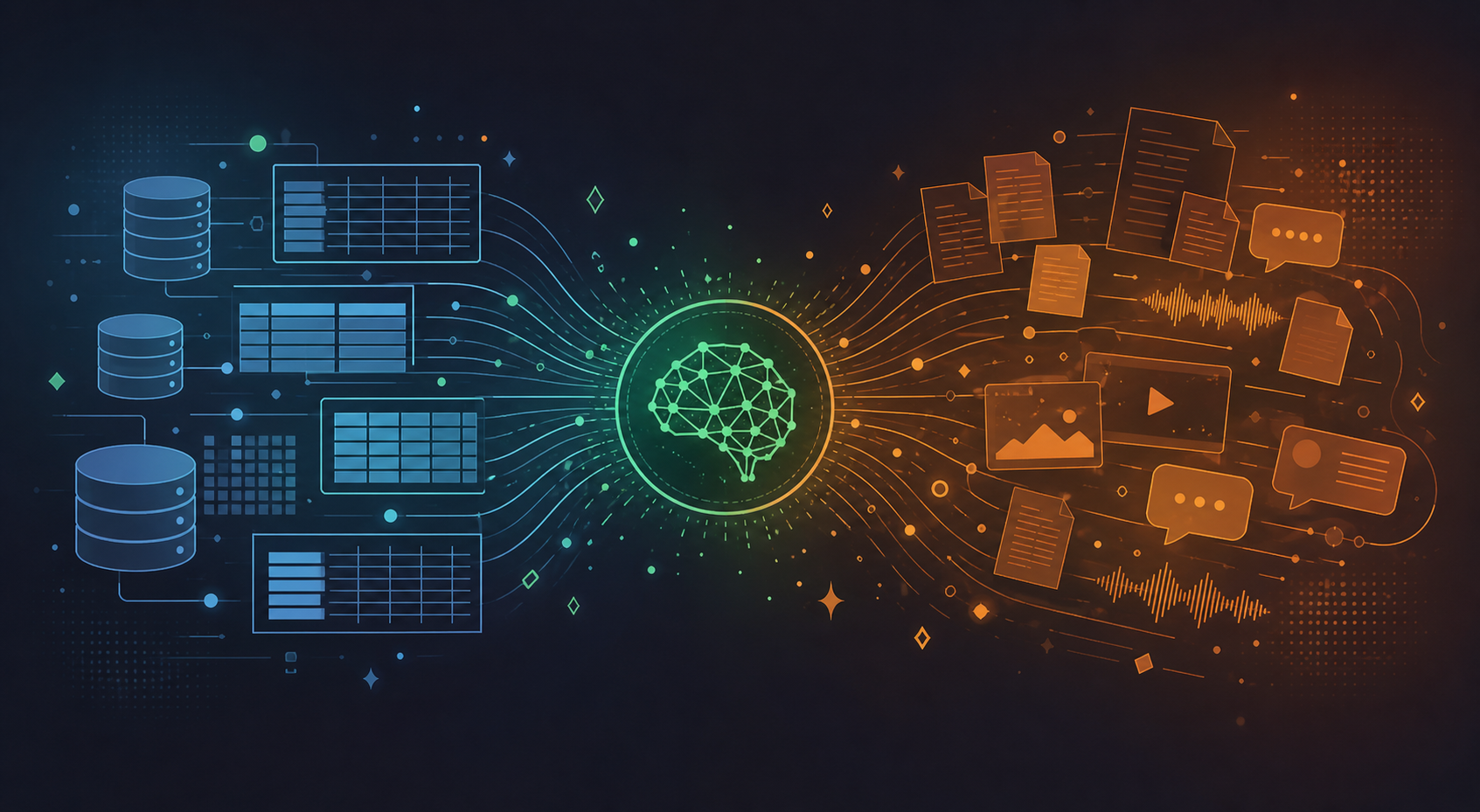
Within unstructured data, there’s a further split that matters. Documents, emails, and tickets are unstructured relative to a database, yet they’re comparatively easy to ingest: point a pipeline at them and they come in as text. Spoken conversation is different architecturally. It’s multi-participant, time-sequenced, and context-dependent in ways a transcript alone doesn’t preserve. Who said what, when, in response to which alternative, under what constraint: that structure doesn’t survive the recording without deliberate enrichment at capture time. Retrieval built on raw transcripts returns words. Retrieval built on enriched conversation data returns reasoning.
What AI Agents Actually Need From a Knowledge Base
An archive and a knowledge base your AI can actually use are not the same thing. Most organizations have the former and are surprised when AI underdelivers.
According to the State of Context Management Report 2026, 95% of AI projects fail to reach production. The cause is rarely a weak model. It is a context deficit: the agent cannot find what it needs, cannot tell whether what it found is current, and cannot verify whether it has permission to use it.
What agents actually require:
- Accurate retrieval that returns the relevant record, not a keyword match
- Metadata and context tagging so the agent understands what kind of information it is reading
- Permission-aware access so the agent does not surface what it should not
- Freshness signals so the agent does not reason from a decision that was reversed last quarter
- Clear data provenance so the output can be trusted and traced
A folder of transcripts fails all five criteria. A governed, enriched knowledge system passes them.
Key Capabilities to Look for in AI Knowledge Management Tools
The capabilities below aren’t equally available across tools. Semantic search is now table stakes. Permission-aware retrieval and freshness signals are where most systems still fall short, particularly when conversation data is part of the corpus. A knowledge system that cannot tell an agent whether a record is current, who owns it, or whether the agent has clearance to use it is an archive with a search box on top.
Capability | What to look for |
|---|---|
Semantic search | Returns relevant context by meaning, not keyword match |
Automated capture | Ingests meetings, documents, and tickets without manual input |
Gap detection | Surfaces topics discussed frequently with no documentation |
Workflow integration | Routes outputs to the tools teams already use |
Metadata and tagging | Classifies content by type, sensitivity, and project context |
Permission-aware access | Enforces what each user and agent can retrieve |
Freshness signals | Flags stale records so agents don’t reason from reversed decisions |
AI Knowledge Management in Compliance-Sensitive Industries
Compliance-sensitive industries need a knowledge system that satisfies legal requirements before it touches a single AI query.
Several requirements appear consistently across sectors:
- Retention with deletion controls: healthcare and financial services typically need per-data-type retention windows, not a blanket policy across all records.
- Audit logging that captures who accessed what, when, and in what context.
- Consent mechanics for captured conversations, particularly in multiparty-consent states and GDPR-scoped jurisdictions; the full scope of enterprise meeting recording security and compliance extends across every one of these requirements.
- PII handling at the record level, covering structured identifiers like payment card numbers and national IDs.
- BAA coverage for Enterprise/HIPAA engagements involving protected health information.
For AI systems, there is an added layer: model providers must operate under zero data retention terms, or customer data leaks into training pipelines. That requirement surfaces in every security review in financial services and healthcare.
Compliance monitoring is increasingly agent-driven. A governed system can classify conversations against a customer-supplied rule set and surface flagged records for human review. The agent handles detection; a person acts on it. Automated cleanup without human sign-off is not an acceptable posture in governed contexts, and that distinction matters for auditability.
Governance and Trust: The Foundation of Any AI Knowledge System
Access rules designed for humans break when agents enter the picture. A person given broad access exercises discretion; an agent will follow every retrieval path available to it, including side conversations nobody thought to exclude. That gap requires reclassifying governance from a compliance checkbox into a precondition for the system to function safely at all.
The core requirements: role-based access that applies to agents as well as users; transparent sharing indicators; classification rules that decide what enters the organizational corpus; and retention controls set per data type instead of a blanket policy. See data retention for enterprise AI tools for how these rules apply in practice. Consent architecture matters separately from access control, because a conversation between two people is governed differently than a team meeting.
“Every interaction within the enterprise within 3 years will be recorded and I think the default is going to be record on.” – Thomas Laffont, Co-Founder, Coatue
Recording by default only holds up if it is visible. Covert capture fails legal review. Transparent capture, with opt-out friction designed deliberately, is the version that survives, and meeting data governance at scale requires every access and retention control to match.
Building a Knowledge Management Maturity Model
Most organizations are at stage one: AI transcribes meetings, captures action items, automates notes. That’s table stakes now.
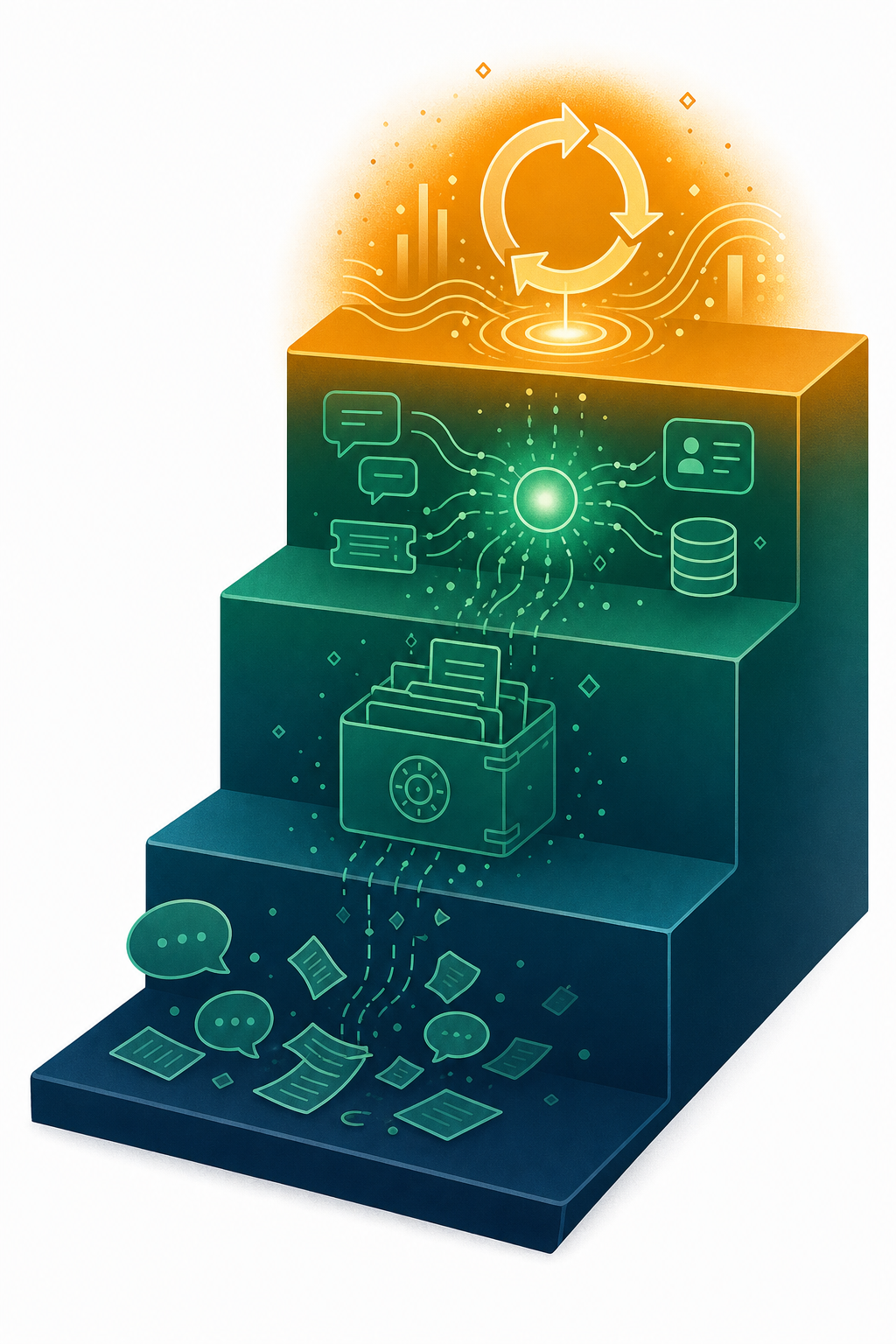
Stage two is harder. It requires treating conversation as a conversation data system of record the company owns, not a folder each person manages. One governed system, not a different tool per team.
Stage three joins that dataset to every other system of record, so an agent can query across conversations, tickets, CRM records, and documents together. The blocker here is rarely the tech. It’s consent mechanics, fragmented per-participant sharing, and classification rules that haven’t been written yet.
Stage four is continuous optimization, where the corpus gets mined actively and the business adjusts against what it finds. Almost nobody is there yet, and saying so is more useful than pretending otherwise.
Closing the Conversation Gap in Enterprise Knowledge
Spinach AI is the enterprise conversation intelligence platform, the system of record for conversation data. It captures conversations across Zoom, Google Meet, Microsoft Teams, Slack Huddles, and Webex during the meeting and delivers structured, governed, AI-ready knowledge when the meeting ends, so both people and agents across the organization can use it. Recording and transcription are the input step; the product is structured, routable conversation data.
The product runs on four verbs: capture, centralize, manage, and power.
- Spinach captures every conversation during the meeting and delivers structured records at meeting end, replacing per-user silos with one organizational record.
- It centralizes that data in a single asset so agents and teams query one source, not a dozen disconnected exports.
- It manages access through configurable retention per data type, with transcript, summary, and video each settable separately on Enterprise, a key criterion in any meeting management software evaluation.
- It powers agents and workflows through MCP on Business and Enterprise plans, API and webhooks on Enterprise, and native integrations with Jira, Salesforce, HubSpot, Notion, Confluence, and more.
For compliance-sensitive industries, the governance layer is built in: SOC 2 Type II and GDPR compliant across plans; HIPAA compliant on Enterprise engagements, with BAA available; PII redaction at the transcript level; no customer data used to train AI models; and zero data retention with LLM providers. Spinach is currently powering thousands of organizations including public enterprises.
Final Thoughts on Making AI Knowledge Management Actually Work
Knowledge management stops working quietly, and it usually starts with conversations. The reasoning behind your most important decisions never makes it into a document, and the agents your team is building can’t retrieve what was never captured in the first place. Governance, enrichment, and freshness signals aren’t nice-to-haves: they’re what separates an archive from a knowledge system your organization can actually use. Get started with Spinach AI to see how conversation data fits into a governed, AI-ready setup.
Otter and Fireflies are effective at what they’re built for: giving an individual a transcript and summary of their own meetings. For a solo user who needs a searchable record of their calls, either tool works well. The gap appears at the organizational level. Because each person runs their own account, every team member ends up with a different tool producing fragments in a different place, with no shared corpus, no access controls, and no way for an AI agent to query across the whole company’s conversations. Enterprise conversation intelligence captures every conversation into a single governed data asset, applies metadata and access controls, and makes that corpus queryable by both people and agents. The structural difference is not features; it is whether the output is a personal folder or a system of record.
See the five criteria above: accurate retrieval, metadata tagging, permission-aware access, freshness signals, and data provenance. According to the State of Context Management Report 2026, 95% of AI projects fail to reach production. The cause is almost never a weak model; it is a context deficit where the agent cannot find what it needs, cannot verify whether it is current, and cannot confirm it has clearance to use it.
Start with governance requirements before configuring any AI query layer. Compliance-driven environments need per-data-type retention windows instead of a blanket policy, audit logging that captures who accessed what and when, consent mechanics for captured conversations, PII handling at the record level, and zero data retention terms with any LLM provider so customer data does not enter training pipelines. For any system touching protected health information, a BAA is a hard prerequisite, not an optional add-on.
Gong is the stronger fit for sales coaching and revenue workflows on customer-facing calls; Spinach is not at feature parity for that specific use case. The common pattern in enterprise deployments is to keep Gong for customer-facing meetings and roll out Spinach everywhere else, so one governed corpus covers all conversation data across engineering, HR, legal, leadership, and ops. Spinach’s advantages are org-wide scope, a single retrieval layer across all conversation data, API and MCP buildability for custom workflows, and materially lower cost for company-wide coverage.
A folder of transcripts fails on every criterion agents require: it has no metadata tagging, no permission-aware access, no freshness signals, and no provenance. Retrieval built on raw transcripts returns words; retrieval built on enriched conversation data (where who said what, in response to which alternative, under what constraint is preserved at capture time) returns reasoning. The distinction between an archive and a governed knowledge system is what determines whether an agent can answer ‘why was that decision made’ or can only surface documents that contain the relevant keywords.
Explicit knowledge is documented in policies, specs, and notes; implicit knowledge is the operational know-how embedded in how a team works; tacit knowledge is judgment and reasoning that lives inside people’s heads. Most tools handle explicit knowledge adequately, but implicit and tacit knowledge — particularly the reasoning behind decisions made in meetings — are where most organizations quietly fail and where AI knowledge management has the most ground to recover.
According to the State of Context Management Report 2026, the cause is almost never a weak model — it is a context deficit. The agent cannot find what it needs, cannot tell whether what it found is current, and cannot confirm it has clearance to use it. A governed, enriched knowledge system that passes all five criteria (accurate retrieval, metadata tagging, permission-aware access, freshness signals, and data provenance) is what separates a stalled AI project from one that ships.
Freshness signals flag records that are stale so an agent does not reason from a decision that was reversed last quarter. Without them, an agent retrieving context about a product direction or policy has no way to know whether the document it found reflects the current state or a position the team abandoned six months ago — which quietly drives bad outputs downstream.
Per-user note takers work for individual productivity but break down organizationally: every team ends up with a different tool producing fragments in a different place, with no shared corpus and no policy enforcement. A company-wide conversation data system captures every meeting into a single governed asset with access controls, making that corpus queryable by both people and AI agents across the organization.
Data provenance means an agent can trace where a piece of information came from, who said it, when, and in what context. Without provenance, an agent’s output cannot be trusted or audited — you cannot verify whether a conclusion came from a current decision or an outdated document, which is a hard blocker in any compliance-sensitive environment.
Semantic search returns relevant context by meaning rather than exact word match, so a query like ‘why did we drop that feature last year’ surfaces the relevant discussion even when nobody used those precise words. Keyword search returns documents containing matching terms, which means relevant reasoning buried in different phrasing stays invisible to both people and agents.
The bot must always be visible and never covert — transparent capture with deliberate opt-out friction is the version that survives legal review in multiparty-consent jurisdictions. Organizations should configure a custom legal-approved in-meeting notification message, use pause/resume/kick commands mid-meeting, and admit the bot from the waiting room only after verbal consent has been given.
Stage one — AI transcribes meetings and captures action items — is now table stakes. Stage two requires treating conversation as an organizational system of record the company owns, governed in one place rather than fragmented across per-user tools. Stage three joins that corpus to every other system of record so an agent can query across conversations, tickets, CRM records, and documents together. Almost no organization has reached stage four, continuous corpus optimization.
You can build a partial one. Structured data from Jira, Slack, and CRM systems is already AI-ready and relatively straightforward to ingest. What remains missing is the highest-context data a company produces: the reasoning behind decisions, the rejected alternatives, and the constraints named out loud in meetings. Without capturing conversation data, an agent can retrieve what was decided but not why — and that gap is where bad decisions compound.
Transcript, summary, and video should each carry their own configurable retention window because the legal and business requirements differ across them. Healthcare and financial services organizations typically need per-data-type windows — not a blanket policy — and some buyers specifically need aggressive deletion for EU employees under GDPR while retaining summaries longer for internal governance. Setting a single policy across all data types leaves organizations either over-retaining regulated content or deleting records they need.
What to do next
Now that you've read this article, here are some things you should do:
- You should check out our library of meeting agenda templates for every type of meeting.
- You should try Spinach to see how it can help you run a high performing org.
- If you found this article helpful, please share it with others on Linkedin or X (Twitter)

