Gong Pricing and Alternatives Compared, October 2026
A October 2026 look at Gong pricing, reviews, and alternatives, comparing scope, cost, and integration options.
 Maintouch
Your sales org might be ready to commit to Gong, but before you sign anything, it’s worth understanding exactly what you’re paying for and where the ceiling is. Turns out, scope matters as much as price.
TLDR:
- Gong pricing runs $1,200 to $2,400 per user per year (per PitchMonster, as of 2024), with average contracts at $55,333 (per Vendr)
- Gong is scoped to sales and CS only: no PM integrations, no cross-functional deployment, no Jira or Linear
- Every alternative in this roundup integrates with CRMs, but only one offers company-wide deployment with PM integrations
- Spinach AI deploys company-wide across every function, routes outputs into Jira, Linear, Salesforce, and Slack with SOC 2 Type II, HIPAA, and a free tier with unlimited recording
What Is Gong and How Does It Work?
Gong is a revenue intelligence tool built for sales and customer success teams. It records customer interactions, transcribes them, and analyzes the content to surface deal risks, coaching signals, and pipeline forecasts without requiring reps to log activity manually.
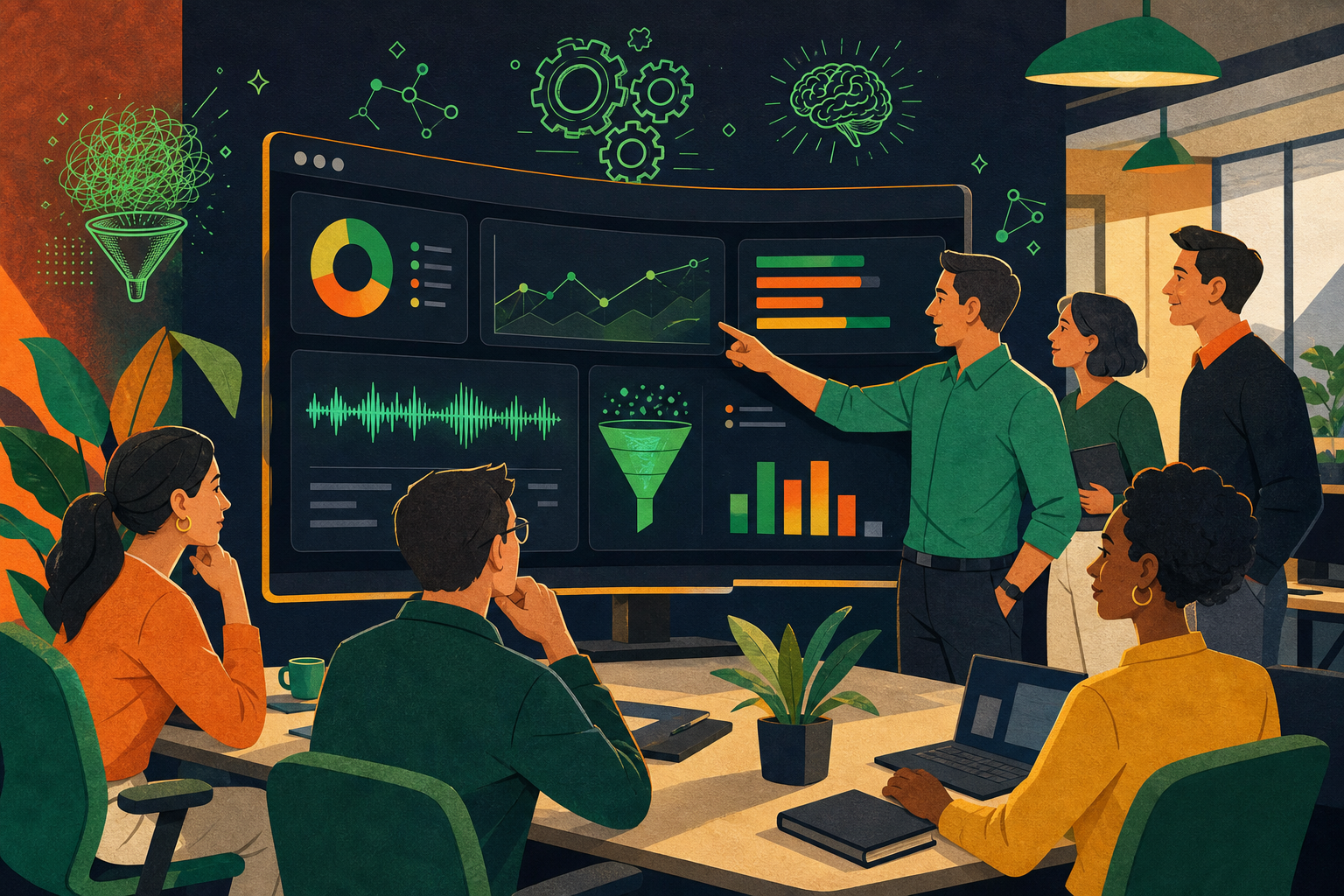
The core product has expanded well beyond call recording. Gong Forecast gives revenue leaders a data-driven view of pipeline health based on actual conversation signals, not the CRM fields reps may or may not have updated. Gong Engage handles sales sequencing and outreach. Gong Coaching packages coaching and onboarding content. More recently, Gong has added AI agents designed to run revenue workflows, from deal summaries to follow-up generation, across calls, emails, and meetings.
The buyer is nearly always a CRO, VP of Sales, or RevOps leader with a defined sales team and a need to understand what’s happening inside customer conversations at scale. Gong is purpose-built for that use case and makes no real claim to serving HR, engineering, finance, or legal teams.
Why Consider Gong Alternatives?
Gong earns its reputation. Deep conversation analysis, AI-driven pipeline forecasting through Gong Forecast, sales sequencing via Gong Engage, and rep coaching through Gong Coaching add up to a genuinely capable revenue intelligence product. Its large enterprise customer base reflects real demand in GTM organizations.
The friction starts with cost. Gong does not publish pricing. Based on third-party buyer data, estimates range from roughly $1,200 to $2,400 per user per year across third-party reports, plus a platform fee. Vendr puts the average contract value at $55,333, with meaningful room to negotiate. For a mid-sized sales team, first-year spend can clear $50K before onboarding.
The more structural issue is scope. Gong is built for sales and customer success, full stop. There are no project management integrations for tools like Jira or Linear, no meaningful use case for Product, Engineering, HR, Legal, or Finance, and no pathway to company-wide record-by-default deployment with governed data across every team. A company that wants conversation intelligence across its entire organization, beyond the revenue org, hits that ceiling fast.
The fit question is straightforward: if you’re running a dedicated GTM team and need deep deal intelligence, Gong delivers. If you need conversation data governed and queryable across every function, you’re looking for something built for a different scope.
Best Gong Alternatives in October 2026
Each alternative below is assessed on what it genuinely does well before naming where it falls short.
Spinach AI
Spinach AI is the enterprise conversation intelligence platform. The system of record for conversation data. Where individual AI notetakers solve one person’s problem, Spinach is deployed company-wide to capture, centralize, manage, and power the organization with every conversation it has, across Zoom, Google Meet, Microsoft Teams, Slack Huddles, and Webex.
- Record-by-default deployment with governed conversation data across every function, GTM and beyond
- Structured outputs routed automatically into Jira, Linear, Salesforce, HubSpot, Confluence, Slack, and more, with no manual re-entry
- Transparent pricing starting free, $29/user/month monthly or $19/user/month billed annually on Business, with no credit card required on the free Starter plan
- SOC 2 Type II, GDPR, and HIPAA compliant; BAA available at Enterprise; SAML SSO, SCIM, and custom per-data-type retention included
Best suited for: organizations, mid-market to enterprise, that want a single governed platform deployed company-wide, with policy, retrieval, and structured outputs across every function, well beyond the revenue team.
Bottom line: organizations typically keep Gong for customer-facing revenue meetings and deploy Spinach across every other function capturing, centralizing, managing, and powering conversation data from both sources in one organizational record.
Fireflies.ai
Fireflies.ai records, transcribes, and summarizes meetings across Zoom, Google Meet, and Teams, with native CRM sync and analytics. Pricing runs from free to $39/user/month on annual billing as of July 2026.
- 100+ language support
- CRM integrations and action item extraction
- Accessible entry-level pricing
Best suited for: individual contributors and small teams that want a low-cost starting point.
Bottom line: Fireflies lacks org-level policy enforcement, SAML SSO/SCIM, compliance agents, and custom retention. It is a per-user tool, not an organizational platform.
Chorus by ZoomInfo
Chorus is a sales-first conversation intelligence tool built for call coaching, rep scoring, win/loss analysis, and CRM integration, deeply tied to the ZoomInfo ecosystem. Pricing requires a demo.
- Call transcription and coaching scorecards
- Competitive snippet libraries
- Deal and market intelligence via ZoomInfo data
Best suited for: sales organizations already committed to the ZoomInfo stack.
Bottom line: Chorus is scoped to sales, with no project management integrations, no cross-functional deployment path, and deep ecosystem dependency on ZoomInfo.
Avoma
Avoma combines an AI meeting assistant, scheduling and lead routing, conversation intelligence, and pipeline forecasting (MEDDIC/SPICED/BANT) into one product. Pricing requires a demo to confirm current figures.
- Meeting transcription in 40+ languages
- AI call scoring and pipeline forecasting
- Meeting scheduling built in
Best suited for: RevOps and sales teams that want meeting intelligence and scheduling in one product.
Bottom line: Avoma is revenue-team focused. It does not offer company-wide deployment, bi-directional Jira/Linear awareness, SAML SSO/SCIM, or a HIPAA BAA.
Read AI
Read AI is an individual-focused meeting assistant, similar in scope to MeetGeek, that captures and summarizes meetings, emails, and messages, available via Chrome extension and desktop apps. The free tier is capped at 5 meetings per month across 20+ languages.
- Cross-platform summaries spanning meetings, email, and Slack
- Speaker coaching and engagement insights
- CRM and knowledge base integrations
Best suited for: individual contributors and education-sector teams that want a personal AI assistant without IT involvement, a segment tools like Otter also target.
Bottom line: Read AI’s free tier caps at 5 meetings per month versus Spinach AI’s unlimited recording on the free Starter plan, covers 20+ languages versus 100, and offers no enterprise governance layer, no SAML SSO/SCIM, and no BAA.
Feature Comparison: Gong vs. Top Alternatives
The table below puts the most decision-relevant attributes side by side across the tools covered in this post.
Tool | Free Tier | Public Pricing | Company-Wide Deployment | PM Integrations (Jira/Linear etc.) | CRM Integration | Language Support | Enterprise Security (SOC 2/HIPAA/SSO) |
|---|---|---|---|---|---|---|---|
Spinach AI | Yes (unlimited recording) | Yes | Yes | Yes | Yes | 100 languages | SOC 2 Type II, GDPR, HIPAA, SAML SSO, SCIM, BAA |
Gong | No | No (quote only) | Sales/CS only | No | Yes | Limited | SOC 2, SSO |
Fireflies.ai | Yes (limited) | Yes | No | No | Yes | 100+ languages | SOC 2, no BAA |
Chorus by ZoomInfo | No | No (demo required) | Sales only | No | Yes | Limited | SOC 2, SSO |
Avoma | No | Yes | Sales/RevOps only | No | Yes | 40+ languages | SOC 2, no BAA |
Read AI | Yes (5 meetings/month) | Yes | No | No | Yes | 20+ languages | SOC 2, no BAA |
Table reflects information current as of October 2026.
A few patterns stand out. Gong and Chorus both require a sales conversation before you see a number, which makes budget planning harder for teams comparing multiple tools at once. Every tool in the table integrates with a CRM, but PM integrations (Jira, Linear, and similar) are exclusive to Spinach AI among the options listed, a distinction covered in this enterprise conversation intelligence guide. Company-wide deployment is also a meaningful dividing line: Gong, Chorus, and Avoma are scoped to revenue-facing teams, while Spinach AI is built to run across the full organization. On the compliance side, HIPAA coverage with a BAA is available only through Spinach AI and requires Enterprise tier, part of what defines enterprise conversation intelligence at scale.
Why Spinach AI Is the Right Gong Alternative for Company-Wide Deployment
Gong is a well-built tool for sales and customer success teams that need deep deal intelligence. For that specific use case, the investment can make sense.

The structural gap is scope. A typical organization runs standups, sprint planning, hiring calls, board meetings, legal reviews, and customer onboarding, and Gong captures none of that, which is why organizations need a conversation data system of record covering every function. Spinach is deployed company-wide. It is the single governed platform that captures conversations across every team, centralizes them into one AI-ready organizational record, and routes structured outputs (decisions, action items with named owners, tickets, CRM records) into the tools each function already uses: Jira, Linear, Salesforce, HubSpot, Confluence, and Slack, with no manual re-entry. Governance is built in, following the practices outlined in this meeting recording security and compliance guide: SOC 2 Type II, GDPR, and HIPAA compliance, SAML SSO, SCIM, custom per-data-type retention, and a BAA at Enterprise. Pricing is public and starts free, with a Business plan at $19/user/month billed annually, and no sales cycle required to get started. If you’re assessing whether Gong’s scope fits your organization’s actual meeting footprint, this Spinach AI vs Gong comparison is worth a direct look.
Final Thoughts on Choosing Between Gong and Its Alternatives
Gong earns its reputation for sales teams that need deal intelligence at scale. The harder question is whether your organization’s actual meeting footprint fits inside that scope. Most don’t. Your engineering team, recruiting function, and leadership reviews are all generating conversation data that Gong never touches. Spinach AI covers that ground, with transparent pricing, company-wide deployment, and enterprise compliance built in from the start.
The most common trigger is scope. Gong is built exclusively for sales and customer success teams, which means HR, Engineering, Product, Legal, and Finance conversations go uncaptured and ungoverned. Cost is the second driver: per-seat and contract figures (detailed in the TLDR above) make it a difficult investment to defend when only one department benefits.
The clearest signal is when your organization needs conversation data governed and queryable across every function, beyond your revenue org alone. If your IT or security team is dealing with shadow-IT sprawl from different note-taking tools across departments, or if your finance, legal, or engineering teams have no structured record of their meetings, you’ve hit the ceiling Gong was never designed to handle.
Four criteria matter most: org-level policy enforcement with SAML SSO and SCIM, extending beyond per-user settings; project management integrations like Jira and Linear alongside CRM integrations; HIPAA compliance with a BAA available; and transparent public pricing so you can run budget comparisons without a sales cycle. Only one tool in this comparison, Spinach AI, covers all four.
No, and any comparison that implies otherwise is inaccurate. Gong’s sales-coaching workflows, pipeline forecasting through Gong Forecast, and sequencing through Gong Engage are purpose-built capabilities Spinach AI does not replicate at feature parity. The accurate pattern is that organizations keep Gong for customer-facing revenue meetings and deploy Spinach across every other function, feeding structured conversation data from both sources into one organizational record, and often consolidating later.
Spinach AI pricing is public and starts free with unlimited recording on the Starter plan, scaling to $29 per user per month (monthly) or $19 per user per month billed annually on Business, which includes the MCP connector, CRM and project management integrations, and one-year retention. Enterprise is custom pricing — contact sales. Gong does not publish pricing and requires a sales conversation before you see a number, which makes parallel budget evaluation harder for teams comparing multiple tools at once.
Yes, buyer data from Vendr shows meaningful room to negotiate against the roughly $1,200 to $2,400 per user per year range, though the average contract still lands at $55,333. Since Gong requires a sales conversation before quoting a number, run your own budget comparison against transparent-pricing alternatives before that call so you know your walk-away point.
Yes, third-party reports indicate Gong’s per-user pricing comes with an added platform fee, which is part of why first-year spend can clear $50K for a mid-sized team. Factor that fixed cost in separately from per-seat pricing when comparing total contract value against alternatives.
No, Gong is built exclusively for sales and customer success use cases, with no meaningful workflow for Product, Engineering, HR, Legal, or Finance teams. Organizations that want those conversations captured and governed typically keep Gong for revenue-facing calls and deploy a separate platform, such as Spinach AI, for every other function.
Compare deal-intelligence depth, CRM integration, and public pricing side by side, since Gong, Chorus, and Avoma all require a demo before revealing a number. Build a table with per-seat cost, contract minimums, and scope (sales-only versus company-wide) so you’re judging total cost of ownership, not just sticker price.
Most organizations keep both rather than choosing one, using Gong for customer-facing revenue meetings and a broader platform like Spinach AI for standups, hiring calls, board meetings, and everything else. The deciding factor is scope: Gong’s sales-coaching and forecasting tools don’t extend to non-revenue teams, so a single tool rarely covers the full meeting footprint.
Gong Forecast builds pipeline visibility from actual conversation signals captured during calls, rather than relying on CRM fields reps may or may not have updated manually. This gives revenue leaders a data-driven read on deal health, which is one of Gong’s genuine strengths for sales-specific forecasting.
Gong’s product scope stops at sales and customer success workflows, so it was never built to route structured outputs into engineering or product systems. Teams that need meeting outputs flowing into Jira or Linear alongside CRM records need a platform built for cross-functional deployment rather than a revenue-intelligence point tool.
Gong’s public materials don’t detail HIPAA-specific compliance or BAA availability, and it isn’t positioned for regulated healthcare use cases the way platforms built for cross-functional deployment are. If HIPAA coverage with a BAA is a requirement, confirm it directly with Gong’s sales team rather than assuming parity with a dedicated enterprise conversation intelligence platform.
Check whether the alternative uses a single transcription model or can select the best-performing model per language, since model-agnostic transcription tends to produce stronger accuracy outside English. Gong’s language coverage is limited compared to tools supporting 100 languages, so this matters if your team operates outside English-dominant markets.
Not necessarily, since most alternatives support uploading existing recordings and some offer large-scale historical backfill for migrating thousands of past calls. Confirm the specific import and backfill capability with any vendor before committing, as this varies by platform and plan tier.
What should you do now
Next, here are some things you can do now that you've read this article:
- You should check out our library of meeting agenda templates for every type of meeting.
- You should try Spinach to see how it can help you run a high performing org.
- If you found this article helpful, please share it with others on Linkedin or X (Twitter)

