Tacit Knowledge Explained: Capture It (September 2026)
Tacit knowledge lives in decisions, not docs. Learn why it's hard to capture and how to close the gap in your org. September 2026.
 Maintouch
Most knowledge management efforts focus on what’s easy to write down. The stuff that’s hard to write down, the instincts your best people have developed through years of pattern recognition, tends to get ignored until someone critical leaves and you realize it’s gone. That gap has a name, and once you understand why tacit knowledge behaves the way it does, the path to capturing it gets a lot clearer.
TLDR:
- Tacit knowledge is expertise that lives in judgment and pattern recognition, not in any document your team can read.
- The Nonaka-Takeuchi SECI model identifies externalization as the hardest conversion: getting someone to articulate a judgment call before the context disappears.
- When a tenured employee leaves, the org chart updates but the knowledge gap goes unrecorded and compounds over time.
- Your AI agents can query every system of record and still can’t answer “why did we deprioritize that feature” if the reasoning only ever existed in a meeting.
- Spinach AI is an enterprise conversation intelligence platform (the system of record for conversation data), deployed company-wide to capture, centralize, manage, and power the organization with every conversation it has.
What Is Tacit Knowledge
Tacit knowledge is the expertise you carry but can’t easily explain. It’s the product manager who instinctively knows when a roadmap conversation is going sideways, or the senior engineer who hears a system description and immediately flags the architecture problem no one else caught. The knowledge is real. Writing it down is another matter.
The term traces back to philosopher Michael Polanyi, who argued that “we can know more than we can tell.” It accumulates through experience, lives in judgment calls, and transfers most naturally through observation and conversation, not manuals.
The contrast with explicit knowledge is stark: a process doc is explicit knowledge; knowing which step in that process usually breaks and why is tacit.
Tacit Knowledge vs. Explicit Knowledge
The difference comes down to whether knowledge can be written down and transferred cleanly, or whether it only exists in the mind of the person who developed it.
Explicit Knowledge | Tacit Knowledge | |
|---|---|---|
Format | Documents, manuals, databases | Judgment, intuition, experience |
Transfer method | Read, copy, share | Observation, conversation, practice |
Capture difficulty | Low | High |
Example | Onboarding checklist | Knowing which client needs extra reassurance |
Explicit knowledge sits in your wiki. Someone can find it, read it, and apply it without ever talking to the person who wrote it. Tacit knowledge works differently. You acquire it by doing, watching, and iterating across enough situations that pattern recognition becomes instinct.
The management implication follows directly: explicit knowledge needs organization, while tacit knowledge needs extraction first, and that requires a different approach entirely. That discipline is covered in the management meeting playbook.
Tacit Knowledge Examples in the Workplace
Recognizing tacit knowledge in your organization gets easier once you know what to look for.
- A senior sales rep who can read a prospect’s tone shift mid-call and know the deal is cooling before anyone says a word
- An engineer who debugs by intuition, knowing from experience which part of the codebase breaks under specific conditions
- A customer success manager who knows which accounts need a check-in before they churn, based on subtle usage signals others miss
- A hiring manager who can assess culture fit within five minutes of a conversation, drawing on years of interviews; the kind of cross-functional team collaboration knowledge that rarely survives a reorganization
- A finance analyst who knows which budget assumptions always slip and builds that into forecasts without documenting why
None of these are in a handbook. They live in the person.
The Nonaka-Takeuchi Model: How Tacit Knowledge Converts
The Nonaka-Takeuchi SECI model describes how knowledge moves through organizations across four modes. According to the SECI model of knowledge dimensions, the goal is converting tacit knowledge into organizational knowledge that persists beyond any individual.
- Socialization: tacit to tacit, through shared experience and observation
- Externalization: tacit to explicit, articulating what someone knows into something others can read
- Combination: explicit to explicit, organizing documented knowledge into new forms
- Internalization: explicit to tacit, learning by doing until a process becomes instinct
Externalization is where most organizations struggle. Getting someone to articulate why they made a judgment call, before the context evaporates, is genuinely hard. Research backing this model confirms it remains the most-used framework for studying knowledge generation in organizations, precisely because it names the conversion problem instead of assuming it away.
Why Tacit Knowledge Is So Hard to Capture
Tacit knowledge is context-dependent by nature. It surfaces in the moment someone makes a decision, reads a room, or catches a signal others missed. Ask them to explain it afterward and you get a simplified version, stripped of the situational texture that made the judgment possible.
There’s also a timing problem. Tacit knowledge is most accessible during the act, not in a retrospective document or interview. By the time someone sits down to record what they know, the reasoning has already compressed into a conclusion.
Conventional documentation efforts assume knowledge is separable from the person holding it. With tacit knowledge, that assumption breaks. You can document the output of someone’s judgment, but rarely the process behind it.
The Cost of Losing Tacit Knowledge
When a tenured employee leaves, the org chart updates. The knowledge gap doesn’t show up anywhere.

The immediate costs are visible enough: recruiting, onboarding, ramp time. What’s harder to quantify is the judgment that doesn’t transfer. The new hire follows the documented process but doesn’t know which steps quietly fail under pressure, which clients need handling differently, or why a decision made two years ago still limits what’s possible today.
The costs extend well beyond recruiting and onboarding. When a senior person leaves, junior employees who could have learned through proximity now have no one to learn from, and the gap compounds quietly over time.
When competitive advantage depends on expertise over physical assets, every departure carries more weight. And unlike equipment or IP, tacit knowledge can’t be audited, backed up, or transferred through a handoff doc.
Tacit Knowledge in the Context of Enterprise AI
Structured data is the easy part. Connect a CRM, point an AI agent at Jira, feed it your Confluence docs, and you have a reasonable picture of what your company does. What that picture misses is why any of it happened.
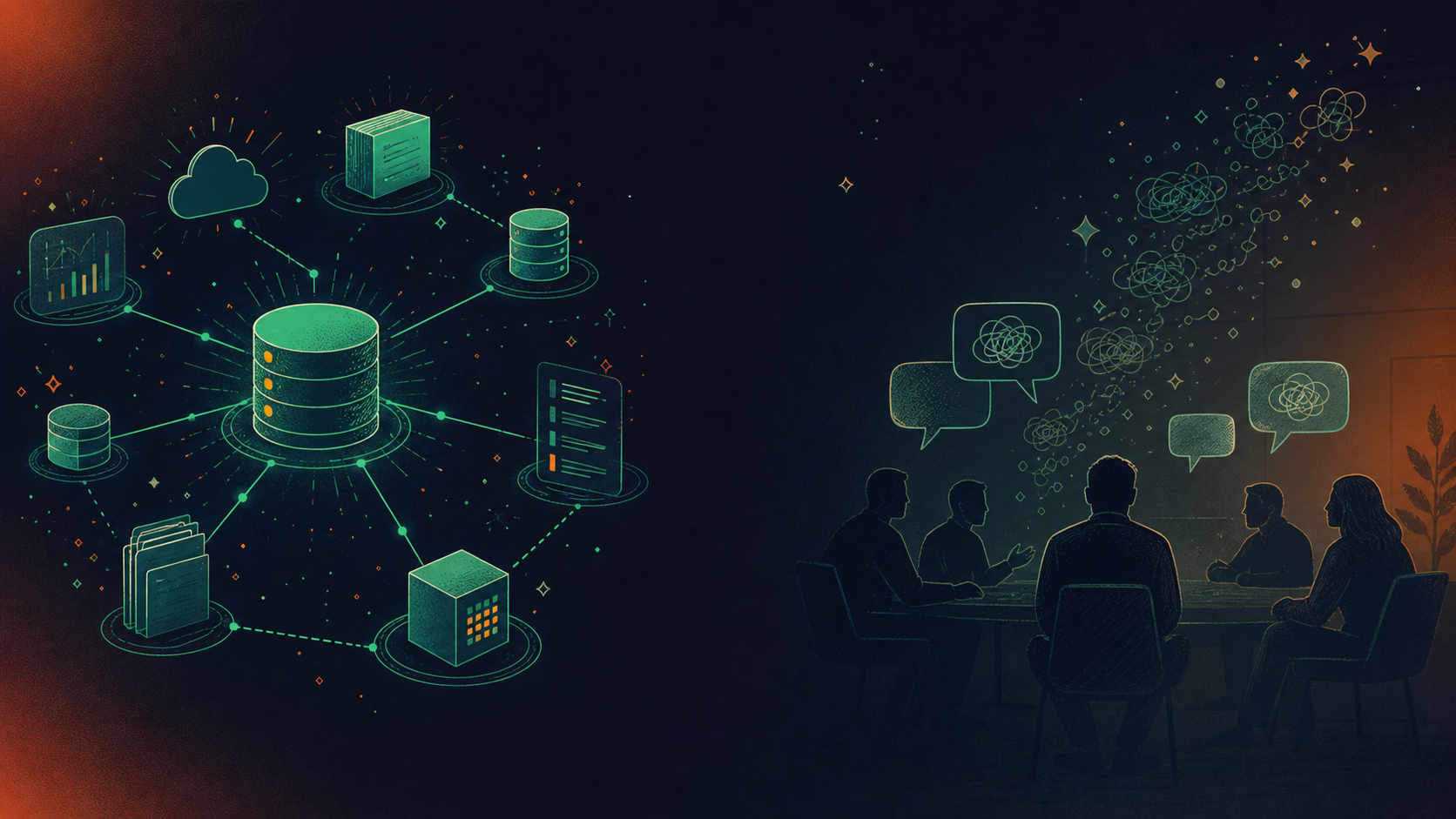
The reasoning behind decisions lives in conversations, and capturing it systematically is the premise of enterprise conversation intelligence. The judgment call a VP made before a product pivot, the constraint a sales rep named on a customer call, the concern an engineer raised in sprint planning that shaped the next quarter’s architecture: none of that made it into a ticket or a doc. It existed in a meeting, and then it was gone.
This is why tacit knowledge is one of the most consequential blind spots for enterprise AI adoption. An AI agent that can query every system of record still can’t answer “why did we deprioritize that feature” or “what did the customer actually say about that integration.” The data was never captured.
“Every interaction within the enterprise within 3 years will be recorded and I think the default is going to be record on.” – Thomas Laffont, Co-Founder, Coatue
The companies closing this gap treat conversational data as a governed asset, not a byproduct. That is the foundation of a conversation data system of record. When reasoning gets captured at the moment it happens, it stops being tacit and starts becoming something AI can actually use.
Methods for Capturing Tacit Knowledge
Each method trades off coverage against depth. None captures everything, and knowing the gaps is half the value.
- After-action reviews: structured post-mortems that ask what happened, why, and what to do differently. Work well when the debrief happens close to the event. Wait a week and the reasoning has already compressed into conclusions.
The pattern across all of these: they require the knowledge holder to be present, willing, and available. None capture reasoning at the moment it happens without deliberate effort from someone in the room, a gap that modern AI tools for remote teams are increasingly designed to close.
Building a Tacit Knowledge Management Strategy
Capturing a single expert’s knowledge is a project. Treating tacit knowledge as a managed organizational asset is a strategy, and the two require different thinking.
Start with psychological safety. People share tacit knowledge when they trust it won’t be used against them. A culture that punishes wrong calls or unfinished thinking gets polished, sanitized outputs, not candid reasoning. Before any system or process, that condition has to exist.
From there, governance decisions become concrete: what categories of conversation get captured, who can access what, and how long it stays. These are the questions any serious enterprise data retention policy works through directly. These are policy questions, not IT questions. Organizations that skip them end up with either an uncontrolled archive or a system people quietly opt out of.
The last piece is retrieval. Tacit knowledge captured but unsearchable is just storage. The goal is making expertise queryable, so the next person who needs it does not have to find the right person and hope they are available.
How Organizations Can Capture and Govern Tacit Knowledge at Scale
Tacit knowledge lives in spoken conversation. The VP’s reasoning before a pivot, the constraint named on a customer call, the concern raised in planning that shaped the next quarter: that reasoning exists in meetings, and meetings are where most organizations stop capturing.
Spinach AI is an enterprise conversation intelligence platform — the system of record for conversation data. Where individual note-takers leave conversation data siloed per user, Spinach is deployed company-wide to capture every conversation across Zoom, Google Meet, Microsoft Teams, Slack Huddles, and Webex; centralize it in a single AI-ready data asset; manage access, retention, and policy at the org level; and power both people and agents with the structured knowledge that results. That is the architectural difference individual enterprise conversation intelligence tools cannot close.
Per-user note-takers produce shadow IT, fragmented records, and no organizational retrieval layer. That is the architectural gap individual note-takers cannot close. Spinach centralizes conversation data as a governed asset, with policy controls over access, retention, and routing (a core criterion in any enterprise meeting software evaluation), so the reasoning that currently evaporates at meeting end becomes queryable knowledge for the people and agents who need it.
Final Thoughts on Tacit Knowledge and Why It Matters
Your wiki holds the what. Tacit knowledge holds the why. Closing that gap starts with recognizing that the reasoning behind your best decisions almost never makes it into a document because it lives in the conversations that precede them. The organizations that get ahead of this treat spoken context as a governed asset, not a byproduct. Spinach AI is where that starts.
Conversation data is a blind spot because the reasoning behind decisions — the constraint named on a customer call, the concern raised in sprint planning, the judgment a VP made before a pivot — exists only in meetings and never makes it into a ticket, CRM record, or doc. An AI agent can query every system of record and still can’t answer “why did we deprioritize that feature” because the data was never captured in the first place. Treating spoken conversation as a governed, queryable asset is what closes that gap.
Start with structured after-action reviews held close to the actual event — within 24 hours if possible, because reasoning compresses into conclusions quickly. For ongoing capture, the most direct path is recording the conversations where judgment actually surfaces: customer calls, planning sessions, design reviews, and escalation discussions, then routing that spoken context into a searchable organizational record rather than a per-user notes folder.
Individual tools like Otter or Fireflies are built for one person’s meetings and leave data siloed per user, which means the institutional reasoning captured in any given conversation stays inaccessible to the rest of the organization. Spinach is deployed company-wide, creating a single governed record of conversation data with policy controls over access, retention, and routing — so the judgment that surfaces in a VP’s planning session or a senior engineer’s architecture review becomes queryable knowledge for the people and agents who need it later.
Tacit knowledge examples include a senior sales rep who reads a prospect’s tone shift mid-call and knows the deal is cooling, an engineer who debugs by intuition based on years of pattern recognition, or a finance analyst who knows which budget assumptions always slip and builds that into forecasts without documenting why. What these share is that none of it appears in a handbook — it lives in the person, surfaces in conversation, and transfers most naturally through observation and proximity rather than documentation.
When competitive advantage depends on expertise rather than physical assets, every senior departure carries knowledge that can’t be audited, backed up, or transferred through a handoff doc — and that makes capture a governance question. If your organization is deploying AI agents that need to answer questions about past decisions, customer context, or strategic constraints, the absence of governed conversation data becomes a structural gap in your AI readiness, not just an onboarding inconvenience.
Tacit knowledge is expertise that resists articulation — the judgment a senior engineer applies instinctively or the read a sales rep has on a cooling deal. Implicit knowledge is knowledge that could be written down but simply hasn’t been yet, like an undocumented process a team follows by habit. The distinction matters for capture strategy: implicit knowledge just needs documentation, while tacit knowledge requires a different approach — structured conversation, observation, and capturing reasoning at the moment it surfaces.
The SECI model’s hardest conversion — externalization, turning tacit judgment into something others can read — becomes more difficult on remote teams because the informal proximity that once made knowledge transfer natural no longer exists. Socialization, which relies on shared experience and observation, gets compressed into scheduled calls rather than organic side conversations. For remote organizations, this means externalization must be deliberately engineered: capturing the reasoning spoken in planning sessions, design reviews, and customer calls before the context compresses into a conclusion.
Exit interviews are a poor substitute for ongoing capture — by the time someone is leaving, the situational context behind their best judgment calls has already compressed into summaries, and there is little incentive for deep disclosure. The reasoning behind a decision made two years ago, the client nuance that shaped a strategy, or the architectural constraint recognized in a sprint review simply cannot be reconstructed reliably in a one-hour offboarding session. Ongoing capture of conversations where judgment actually surfaces — planning sessions, client calls, architecture reviews — is the only approach that preserves the texture of tacit knowledge before it walks out the door.
Structured conversation capture is the most scalable path for distributed teams, because it doesn’t depend on physical proximity or shared timezone availability. For multilingual teams, the capture layer itself needs to work accurately across languages — a system that performs well in English but degrades in Hebrew, Spanish, or Mandarin creates knowledge gaps along language lines, which compounds the organizational risk of tacit knowledge loss.
The ‘why’ behind decisions lives in the conversations that precede them, not in the tickets, docs, or CRM records that follow. A knowledge management system that only indexes documents captures outputs but misses reasoning. Closing that gap requires treating conversation data as a governed organizational asset — capturing spoken context at the moment it happens, routing it into a searchable record, and making it queryable by the people and agents who need it later.
AI agents can query every document, ticket, and CRM record in your organization and still return a blank when asked why a product feature was deprioritized or what a customer actually said about an integration — because that reasoning was never captured in any system. Agents are only as useful as the data they can reach, and conversational reasoning is the primary gap in most enterprise data stacks. Tacit knowledge management is what makes that conversational data reachable.
People share honest reasoning — the unfinished thinking, the qualified judgment, the ‘I’m not sure but here’s my read’ — only when they trust it won’t be used against them. A culture that punishes wrong calls or unconventional reasoning gets polished, sanitized outputs in meetings, which means the richest tacit knowledge never surfaces in a capturable form. Psychological safety isn’t a soft prerequisite for knowledge management; it’s a structural one.
The meetings richest in tacit knowledge are those where senior judgment is applied in real time: architecture reviews, deal strategy calls, escalation discussions, product prioritization sessions, and post-mortems held close to the triggering event. These are the contexts where experienced people read signals, make tradeoffs, and articulate constraints that never make it into a doc. After-action reviews held within 24 hours capture the most reasoning before it compresses; wait a week and what remains is conclusions, not the thinking behind them.
A wiki holds explicit knowledge — documents someone chose to write, organized and searchable. Tacit knowledge management targets the reasoning that never got written down in the first place: the judgment calls, the contextual constraints, the pattern recognition that senior people apply but rarely explain. The two are complementary, but the gap between them is where institutional memory actually lives — and closing it requires capturing the conversations that precede the documents, not just organizing the documents themselves.
New hires can read every onboarding doc and still miss the contextual reasoning that explains why current constraints exist, which clients need handling differently, or what was tried and abandoned two years ago. Governed conversation data — a searchable record of the planning sessions, customer calls, and design reviews where that reasoning was spoken — gives new employees access to institutional memory that no handbook captures. The gap between a documented process and knowing which step quietly fails under pressure is exactly what conversation data bridges.
What you should do next
You made it to the end of this article! Here are some things you can do now:
- Our library of meeting agenda templates is designed to help you run more effective meetings.
- You should try Spinach to see how it can help you run a high performing org.
- If you found this article helpful, please share it with others on Linkedin or X (Twitter)

