Meeting Notes Action Items Template: Free Guide for April 2026
Get free meeting notes action items templates for Word, Excel, and Google Docs. Learn how to write action items that drive follow-through in April 2026.
 Maintouch
You’re probably using some version of meeting notes right now. Maybe a Google Doc with bullet points, maybe a Slack message with tasks scattered across threads. The issue shows up later when someone asks who was supposed to handle the client follow-up and nobody can find it. A proper free meeting notes template with action items makes accountability structural so every task has one owner, one deadline, and no ambiguity about what happens next.
TLDR:
- Meeting templates turn conversations into action: 44% of action items fail without structure
- Action items need four parts: action verb, deliverable, one owner, and specific deadline
- Word, Excel, and Google Docs templates each solve different team needs and meeting volumes
- Spinach AI records meetings, extracts action items, and syncs tasks to Jira or Salesforce automatically
What Are Meeting Notes Action Items Templates
Meeting notes capture what was said. Action item templates capture what happens next.
A meeting notes action items template is a structured framework that goes beyond recording discussion topics. It ties every decision and commitment to a specific owner, deadline, and outcome: the difference between a transcript and a to-do list, with the best templates combining both.
Basic meeting minutes document who attended and what was discussed. Action item templates go further, turning conversation into accountability. When your notes include a clear “who does what by when” structure, follow-through stops being optional.
Why Meeting Notes Action Items Templates Matter for Team Productivity
The numbers are hard to ignore. 44% of action items never get completed, and 71% of meetings fail their objectives due to poor follow-through.
Meeting note software and templates fix this by removing ambiguity. When every decision has a named owner and a due date written into the same document where the discussion happened, accountability becomes structural. No one leaves a meeting unsure of what they own.
Teams using structured templates report a 73% increase in action item completion rates and 45% fewer follow-up meetings to clarify decisions.
Core Components of Effective Meeting Notes Action Items Templates
Every field in your template should earn its place. Here are the components that actually drive follow-through:
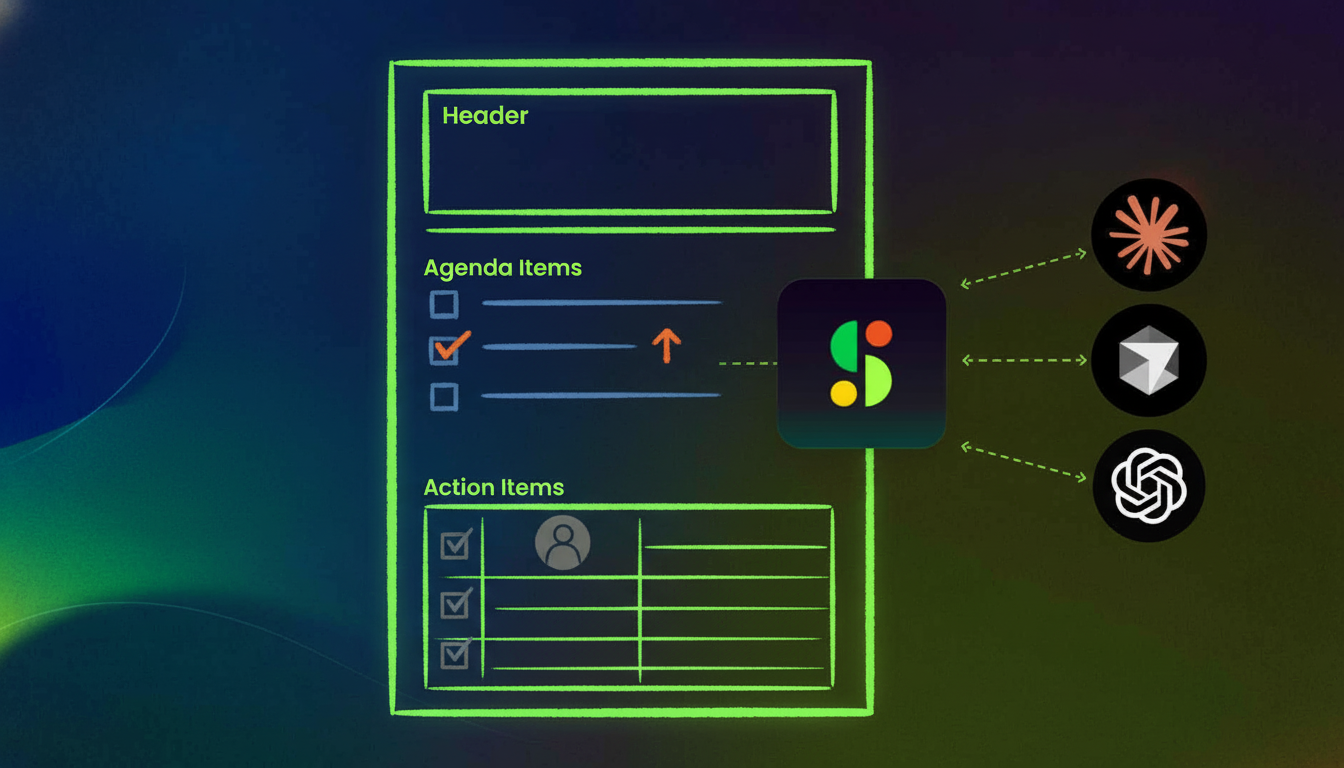
- Meeting header (date, attendees, facilitator) so context is never lost
- Agenda items with decisions captured alongside each topic
- Task description written with specificity, not vague intent
- Assigned owner, one person only, never a team or shared group
- Due date, priority level (high/medium/low), and current status (not started, in progress, done)
- Notes or context tied directly to each action item
The SMART framework applies here: action items should be Specific, Measurable, Achievable, Relevant, and Time-bound. “Follow up on proposal” fails every one of those. “Sarah sends revised pricing proposal to client by Friday EOD” passes all of them.
One owner per task matters more than people realize. Shared ownership means no ownership.
Free Meeting Notes Action Items Template for Word
If your team lives in Microsoft Word, there’s no reason to overcomplicate this. Copy the template below directly into a .docx file and customize from there.
Template Structure
Section | What to Include |
|---|---|
Meeting Header | Date, time, location, facilitator, attendees |
Agenda Items | Topic, discussion notes, decisions made |
Action Items | Task, owner, due date, priority, status |
Next Meeting | Date, standing agenda items to carry forward |
Customization Tips
- Swap the header logo placeholder with your company name
- Lock the table column widths so formatting stays consistent across team members
- Add a “Blocked By” column if your team tracks dependencies
- Save a blank copy as your master template so it never gets overwritten
Word’s built-in table tools make the action items section easy to sort by due date or owner. If you’re sharing across a large team, save as a .dotx template file so everyone pulls from the same source.
Meeting Notes Action Items Template for Excel
Excel works well when you’re managing action items across multiple meetings at once. Unlike Word, a spreadsheet lets you sort by owner, filter by status, and spot overdue tasks without scrolling through pages of notes.
There are a few key elements worth including in your Excel template:
- Columns for Meeting Date, Agenda Topic, Action Item, Owner, Due Date, Priority, Status, and Notes give you full visibility at a glance.
- A dropdown for Status (Not Started / In Progress / Complete / Blocked) keeps entries consistent across contributors.
- Conditional formatting to flag overdue rows in red and completed tasks in green makes priorities obvious instantly.
- A separate tab per month or project, plus a master “All Actions” rollup tab, keeps everything organized without clutter.
Why Excel Works for High-Volume Teams
When your team runs dozens of meetings weekly, a single Word doc breaks down fast. Excel lets you filter to one person’s tasks, sort by due date across every meeting, and build a pivot table showing completion rates by project. You can even set up a formula-based alert column that flags items within three days of their deadline. No plugins required.
Meeting Notes Action Items Template for Google Docs
Google Docs works well for distributed teams: everyone edits simultaneously, changes save automatically, and sharing is as simple as dropping a link in Slack.
There are a few key elements worth including in your Google Docs meeting template.
- Meeting header covering date, attendees, and facilitator
- Agenda with inline decision notes captured as the meeting progresses
- Action items table with columns for task, owner, due date, and status
- Comments tied to specific items to provide async context for teammates who weren’t in the room
No version conflicts, no “which file is current?” confusion. Google Docs also connects with Google Calendar, so linking notes to a meeting invite takes seconds. Copy your blank template into a shared drive folder for each meeting so notes stay organized and searchable.
Simple Meeting Minutes Template with Action Items
Not every meeting needs five sections and a pivot table. Stand-ups, quick syncs, and one-on-ones call for something leaner.
A simple template needs just three things: what was decided, who owns what, and when it’s due.
Minimal Template Fields
- Date and attendees (one line each)
- Decisions made (one bullet per item)
- Action items: task, owner, due date
When to Use This Over Detailed Formats
If a meeting runs under 30 minutes or involves fewer than four people, a full formal template creates more overhead than value. Use the simple version for recurring stand-ups, quick check-ins, and informal project syncs where context is already shared. Save the detailed format for board meetings, client calls, or sessions where someone outside the room needs full context.
Professional Meeting Minutes Format for Board and Executive Meetings
Board and executive meetings carry legal weight that a simple stand-up template cannot support. Motions need to be recorded verbatim. Votes need exact counts. Absent members, conflicts of interest, and approved resolutions all require documentation that can hold up to legal or regulatory review.
There are several fields that belong in every board minutes template:
- Meeting type (regular, special, annual), quorum confirmation, and call to order time
- Attendees listed as present, absent, or guests, each with their titles
- Motions recorded with exact wording, the member who moved, and who seconded
- Vote tallies broken out by yes, no, and abstain per motion
- Resolutions passed along with any dissenting notes
- Adjournment time and the next scheduled meeting date
Keep language neutral and factual. Board minutes record decisions, not debate. Have the board secretary review a draft before distribution, then retain signed copies per your organization’s record-keeping policy.
How to Write Effective Action Items in Your Meeting Notes
Good action items share one trait: they’re impossible to misinterpret.
Start with a verb. “Review,” “send,” “schedule,” “approve”: the first word tells the owner exactly what motion to make. Vague openers like “look into” or “discuss” leave too much room for interpretation, and ambiguous tasks get deprioritized or forgotten entirely.
The Four-Part Formula
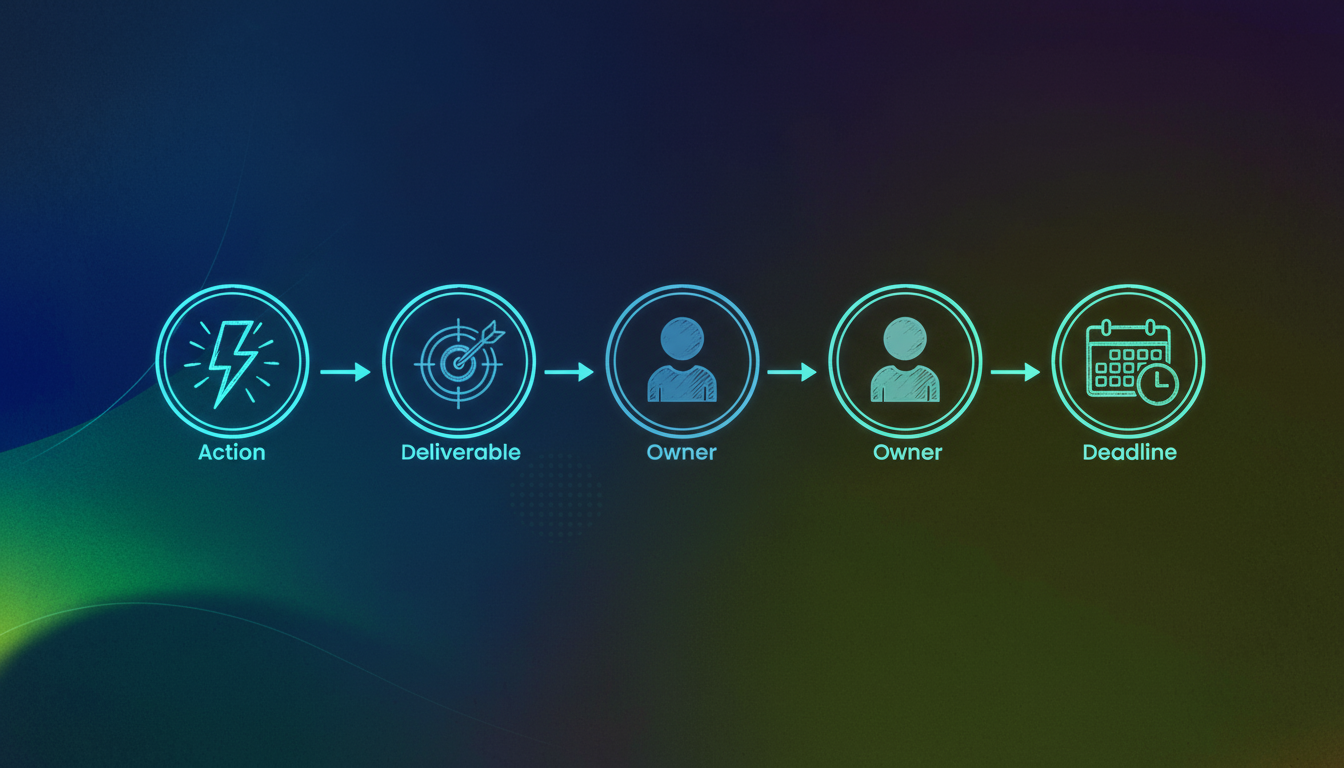
Every action item needs four elements to be completable:
- A strong action verb that signals a clear, specific motion
- A specific deliverable or outcome, not a general topic
- One named owner, not a team or group
- A concrete deadline with a real date and time
“Marcus submits the Q3 budget draft to finance by Thursday at noon” has all four. “Someone handles the budget thing” has none.
Common Mistakes That Kill Follow-Through
- Writing tasks in passive voice with no clear owner
- Assigning a task to a team instead of a single person
- Setting due dates like “soon” without a specific day
- Capturing intent instead of action
People complete tasks they understand and feel personally responsible for. Shared ownership diffuses that responsibility until no one acts.
Best Practices for Distributing and Tracking Meeting Action Items
Send notes within 24 hours. After that, context fades and action items feel less urgent.
Distribution timing matters, but so does format. Lead your summary with the action items list, not the full discussion notes. People need to see their tasks first.
For tracking, pick one system and stick to it:
- Paste action items directly into your project management tool (Jira, Asana, Linear) instead of leaving them buried in a doc.
- Assign tasks at the moment of distribution, not later.
- Review open items at the top of every follow-up meeting before adding new ones.
If something stays “in progress” across two consecutive meetings, it needs a conversation, not another reminder.
Common Meeting Documentation Mistakes to Avoid
Most documentation problems trace back to four repeating mistakes:
- Recording discussion instead of decisions, leaving no clear record of what was actually agreed upon
- Listing tasks without owners or due dates, so accountability disappears before anyone acts
- Distributing notes too late for anyone to course-correct while context is still fresh
- Cramming every detail into one document until the important items get buried
The fix is usually subtraction. Cut anything that won’t change what someone does next.
One honest question to ask after every meeting: could someone who wasn’t in the room read these notes and know exactly what to do? If not, the discipline around filling out the template is the problem.
Automate Meeting Notes and Action Items with Spinach AI
Templates solve the structure problem. Spinach solves the execution problem.
Instead of filling out a template after the fact, Spinach records your meetings, generates structured summaries, and surfaces action items automatically. It’s one of the best AI meeting notes tools for teams that want automation without complexity. Tasks get pushed directly to Jira, Asana, HubSpot, or Salesforce the moment a meeting ends. No copy-paste, no delay, no items falling through.
Where Spinach differs from single-purpose note-takers is scope. Every meeting becomes part of a searchable, org-wide conversation archive that leadership can query, analyze, and act on across teams and time. It’s record-by-default infrastructure, not a summary bot.
Enterprise teams get SOC 2, GDPR, and HIPAA compliance baked in, with admin controls, policy enforcement, and private cloud options for compliance-critical environments.
Final Thoughts on Structuring Meeting Action Items
Every meeting notes and action items template works until you have to fill it out for the fifth meeting of the day. The repetitive work of documenting discussions, extracting tasks, and assigning owners is where good intentions go to die. Spinach does that work for you, taking notes in real time and pushing action items directly into the systems your team already uses. Start with Spinach and stop letting documentation slow down execution.
Use Word for standard team meetings, Excel when tracking tasks across multiple meetings or large teams, and Google Docs for distributed teams that need real-time collaboration. Pick the format your team already uses daily to minimize friction.
Every action item needs four things: an action verb (send, approve, schedule), a specific deliverable, one named owner, and a concrete deadline with a real date. “Marcus submits Q3 budget to finance by Thursday at noon” works because it has all four.
Shared ownership means no ownership. When a task belongs to everyone, no single person feels accountable, and the item stays in limbo. Assign one owner per task, even if multiple people collaborate on delivery.
Use simple templates for meetings under 30 minutes or with fewer than four people (stand-ups, quick syncs). Save detailed formats for board meetings, client calls, or any session where legal documentation or external stakeholders require full context.
Send notes within 24 hours. After that, context fades and tasks feel less urgent. Lead your summary with the action items list first so owners see their tasks immediately without scrolling through discussion notes.
What should you do now
Now that you've read this article, here are some things you should do:
- Our library of meeting agenda templates is designed to help you run more effective meetings.
- You should try Spinach to see how it can help you run a high performing org.
- If you found this article helpful, please share it with others on Linkedin or X (Twitter)

