How to Set Goals for Engineering Teams (July 2026)
In this article, we'll walk through how engineering managers can set goals for high-performing teams, including role-specific and professional development examples to help get you started.
 Jay Gadi
What do high-performing engineering teams have in common? If you answered a snazzy tech stack or nap pods, guess again. Although we’re hardly the ones to argue against a well-rested brain, the real secret of these teams is effective goal-setting.
Simply put, effective engineering teams know what their goals are, and are equipped with the resources, tools, and support they need to demolish them.
TL;DR
- Cascade goals from company objectives down to each contributor so daily work ties directly to business priorities.
- Set goals with clear numbers, milestones, and deadlines, ambiguity is what kills follow-through.
- Use OKRs or SMART criteria to give every goal a trackable structure before you commit to it.
- Track progress across five KPI categories: code quality, delivery speed, team velocity, system performance, and team health.
- Run regular one-on-ones to surface blockers early, recognize wins, and keep goal progress moving between formal reviews.
How to set goals for engineering teams: A step-by-step process
1. Start from the top
Before you can determine specific goals for your team, it’s important to have a clear understanding of your organization’s broader goals. In other words, goals should flow from company-wide objectives down to your team and individual contributors. This keeps everyday tasks and responsibilities aligned with business priorities.
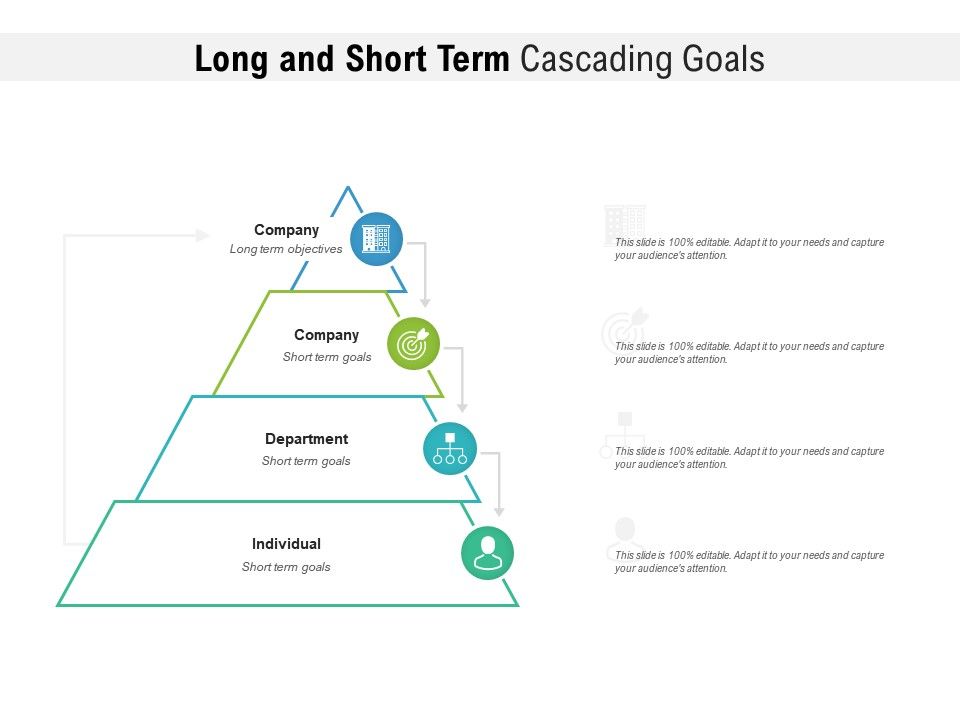
Beyond keeping everyone on the same page, cascading goals are also linked with productivity. According to Gallup, employee productivity increases by 56% when managers are involved in helping their reports align their goals with the needs of the organization.
In fact, according to Gallup, employees who can link their individual goals to those of the organization are 3.5 times more likely to be engaged.
A report by Harvard Business Review also found that the second most important driver of employee engagement was that individuals have a clear understanding of how their job contributes to business strategy.
2. Make your goals crystal clear
Don’t take new goals to your team until they’ve been fully fleshed out. Some questions you should be able to answer as an engineering manager include:
- What is the actual goal?
- Why is this goal important?
- What does success look like?
- How does this goal support or align with the broader company goals?
- How are we going to reach this goal?
- What are the expectations of each individual contributor working towards this goal?
The more detailed and specific you can get, the less room there is for misinterpretation. Attach key information to your goals, like actual numbers, milestones, KPIs, and any important deadlines.
Remember, every goal should be measurable.
3. Involve your team in the goal-setting process
Anyone can hand a goal to someone else, but actually involving your team in the process will help your reports feel personally invested and more inclined to take ownership.
Using an idea management tool is an easy way to capture your team’s feedback during the goal-setting process. You can also add an item around goal brainstorming in your weekly team meeting. When you open up the floor to new ideas, perspectives, and dialogue, you could be rewarded with valuable insights.
For instance, if your team doesn’t think a particular goal is feasible, it’s better to know that in advance, before it’s set in stone. Or maybe you can afford to be even more ambitious.
Talk about goals during one-on-one meetings
It’s also important to regularly speak one-on-one with your reports about their goals, so you can track their progress, provide coaching, recognize success, and spot any roadblocks along the way. If a direct report is struggling to meet their individual goals, for instance, don’t wait for the annual review to provide feedback.
But remember that not every engineer approaches one-on-ones the same. So cater these conversations to each individual on your team.
Frequent communication is especially important as more companies switch to remote work.
Revisiting goals with your team regularly will also help keep them from getting lost in the daily workflow. “Even the most finely crafted objectives will have little impact if they are filed away for 363 days of the year. To drive strategy execution, goals should serve as a framework that guides key decisions and activities throughout the year,” says Donald Sull, Senior Lecturer at MIT’s Sloan School of Management
Pro tip: Spinach is an AI meeting assistant that captures decisions, action items, and named owners from any meeting and routes them in real time into the tools your team already uses, from Slack and Jira to Asana and Linear. For engineering managers running goal-tracking one-on-ones, that means every coaching note, committed action, and owner gets structured and routed before the call ends, so goal progress is visible where work actually happens and nothing falls through the cracks between check-ins.
4. Use the right goal-setting framework to help you
According to a Dominican University of California study, individuals are 42% more likely to achieve their goals when they write them down. Fortunately, there are different frameworks available to help you map out your engineering team goals effectively. These include:
Objectives and Key Results (OKRs)
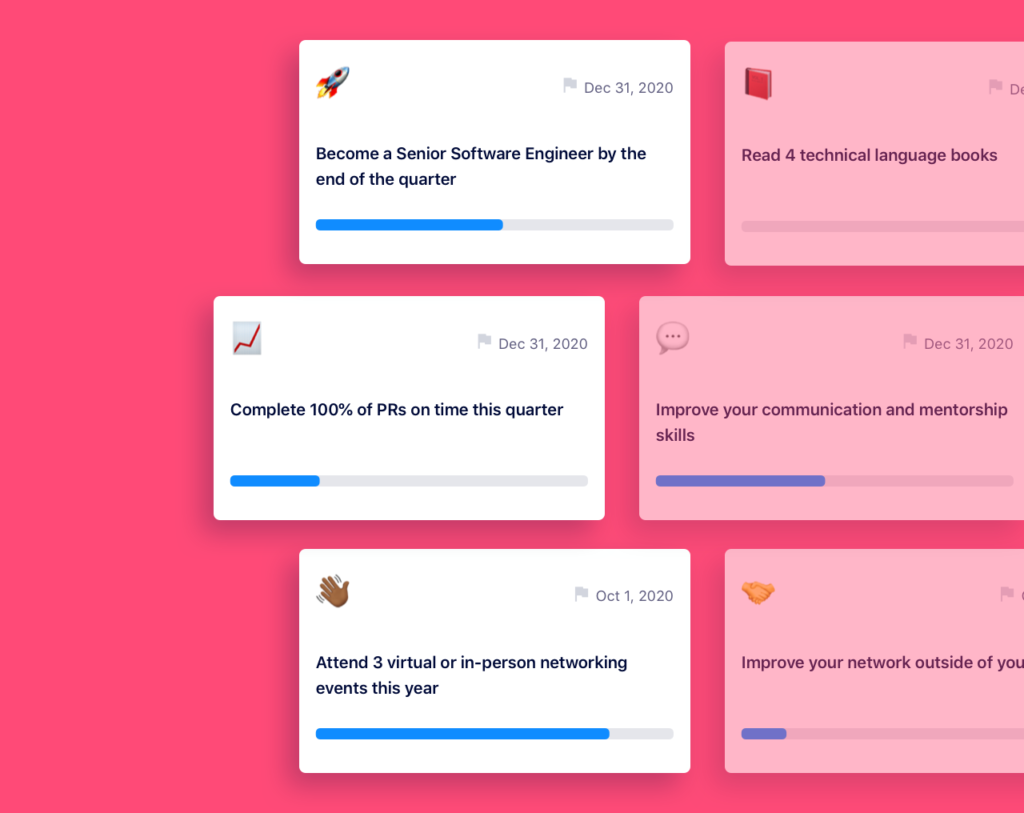
The OKR methodology originated at Intel and is used by companies like Google, Netflix, Twitter, Deloitte, Zynga… even Spinach AI! Also known as “Objectives and Key Results”, this approach identifies objectives, each defining a particular goal to be achieved. The objectives are subsequently connected to milestones or key results in order to measure progress.
Don’t go overboard, if your list of key results is too long, people won’t remember them. Aim to hit that sweet spot of 2-5 key results for every objective. To help manage OKRs, try the traffic light system.
Hot Tip: If you’re not sure where to start, Spinach AI has a guide for how to write OKRs and offers over 240 handy OKR goal examples.
SMART Goals
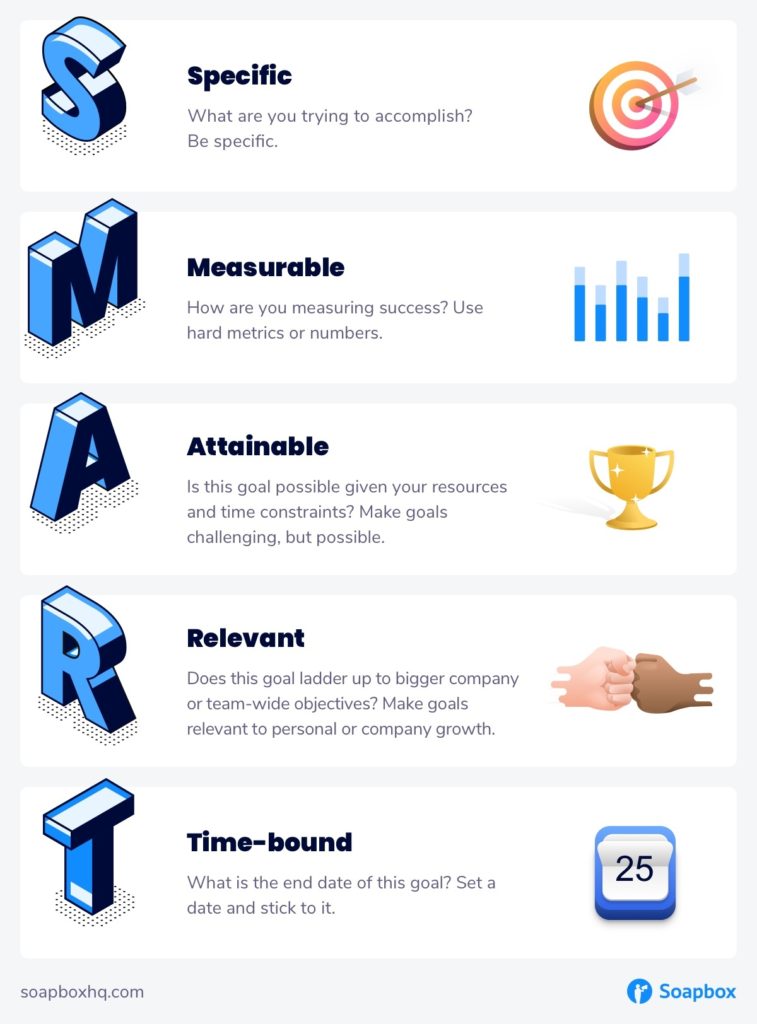
In goal setting, ambiguity is your enemy. The SMART approach forces you to frame your goals so that they’re:
- Specific
- Measurable
- Attainable
- Realistic
- Time-bound
This methodology is particularly helpful because it provides a manageable list of criteria for your engineering team goals to meet before you actually commit.
Common engineering KPIs
As a manager, it’s up to you to determine your engineering team’s goals and track them against KPIs. If you’re not sure where to start, here are some common engineering KPIs to consider:
Category | KPI | What it measures |
|---|---|---|
Code Quality | Code coverage | Percentage of codebase covered by automated tests |
Code Quality | Number of bugs | Defects found in production or during QA |
Code Quality | Code quality SLA | Adherence to defined quality standards and thresholds |
Code Quality | Test case coverage | Proportion of features and scenarios covered by test cases |
Delivery Speed | Number of releases | Frequency of deployments shipped to production |
Delivery Speed | PR review rate and merge time | How quickly pull requests are reviewed and merged |
Delivery Speed | Number of comments per pull request | Review depth and collaboration effort on each PR |
Team Velocity | Story points completed | Volume of work delivered per sprint |
Team Velocity | Velocity | Consistent rate of delivery across sprints |
Team Velocity | Burndown rate | Progress against planned work remaining in a sprint |
Performance | Application speed and load times | End-user response times and page load performance |
Performance | Average downtime | Time the system is unavailable or degraded |
Operations | Running costs | Infrastructure and total spend over time |
Operations | Workload balance | Distribution of tasks and effort across team members |
Retention | Developer delta or turnover rate | Rate at which engineers join or leave the team |
Here’s what these might look like when set as goals:
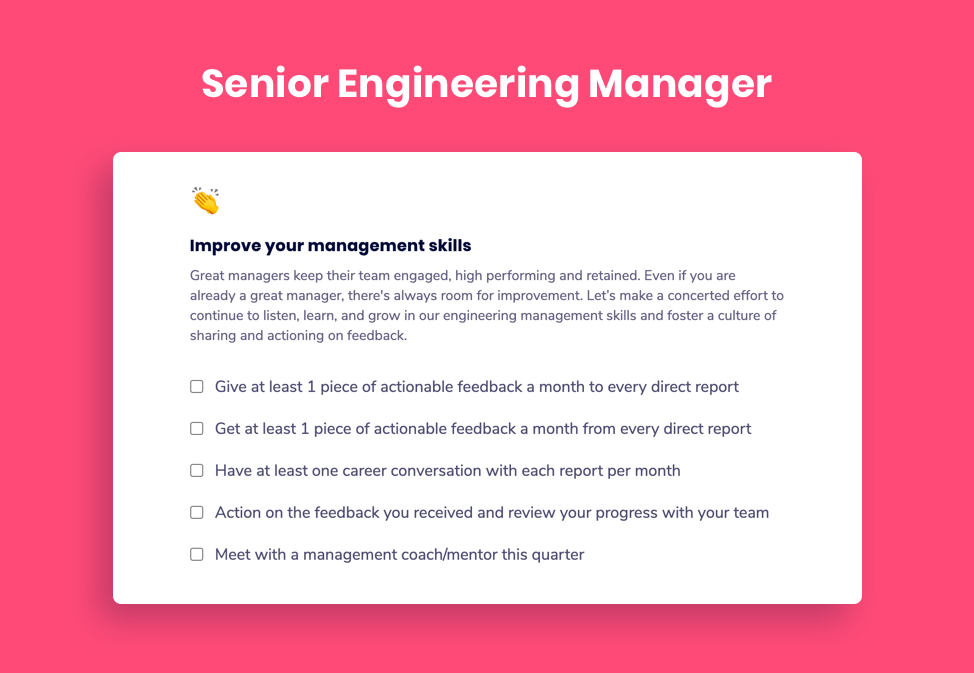
Senior Engineering Manager goal examples
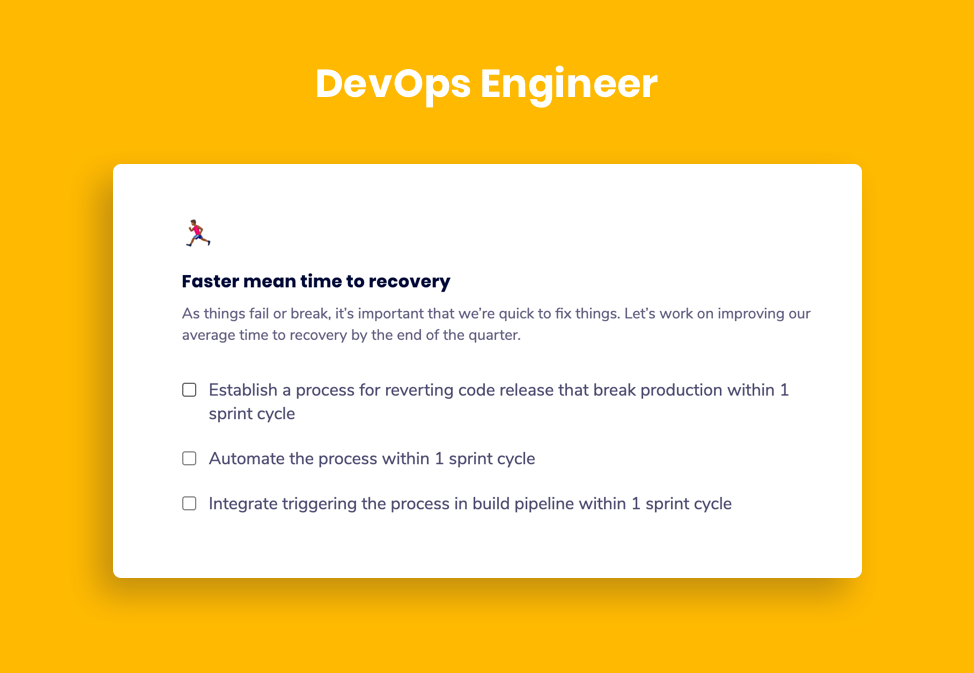
DevOps goal examples
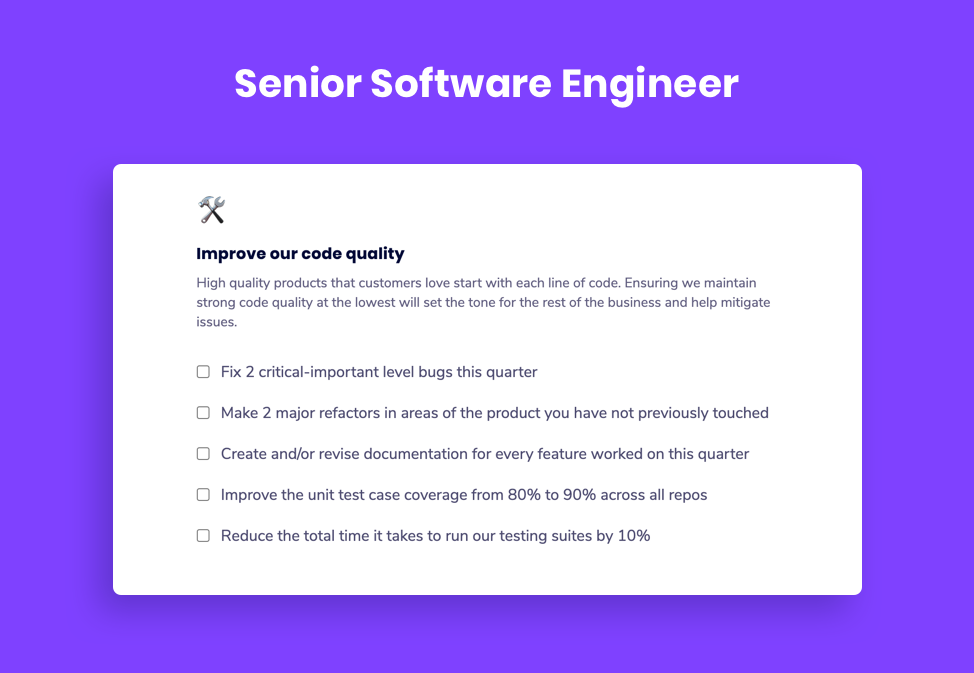
Senior Software Engineer goal examples
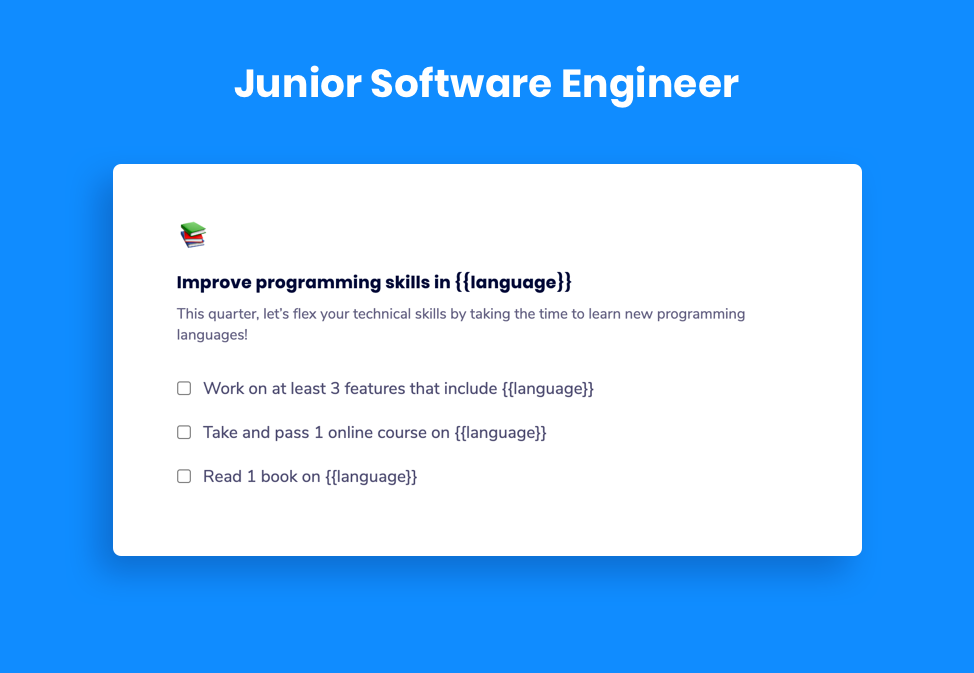
Junior Software Engineer goal examples
How to set career and professional development goals for engineers
Lofty goals can overwhelm any team, making it difficult to manage priorities and stay on track. That’s why it’s important to set smaller, quarterly goals for your reports to work towards.
On the flip side, you don’t want to lose sight of the big picture. As manager, it’s your responsibility to communicate to your team how their quarterly goals support your organization’s annual goals.
Get a pulse on your team’s personal and career goals
Don’t assume everyone on your team aspires to become a manager someday. For one, being a people manager is hard work, and often requires learning a brand new skillset. Some folks are perfectly happy to spend their entire careers working as individual contributors.
That’s okay.
The important thing is that you take the time to speak with your reports and learn their personal and career goals. Once you know what everyone is working towards, you’ll be able to make sure the goals you set push your team and organization towards success while keeping your reports motivated and on track to hit their personal goals as well.
One-on-one meetings are the perfect opportunity to gauge how your reports are feeling about their personal and career goals.
If you’re looking to better understand what career aspirations your team has, here are some one-on-one questions you can ask:
- Where do you see your role evolving in the next 6 months and 1 year?
- Who’s someone in the company that you’d like to learn more from?
- What professional goals would you like to accomplish in the next 6 to 12 months, and what makes you say that?
- Is your job what you expected when you accepted it? If not, where has it differed?
- What can I be doing to help progress your career?
- What’s a big, audacious goal that you’d like to achieve this quarter?
Professional development goal examples for engineers
Check out some of these examples to help inspire professional development goals for your team:
1. Progressing towards a Senior Software Engineer role
- Complete 3 projects as the lead engineer
- Successfully mentor 1 intern (or new hire) this quarter
- Get positive feedback from 2 people on technical communication skills
See more engineering goal examples
2. Improving lead engineering skills
- Be the main engineering rep in all spec and design reviews
- Patch rate of project between 5-10%
- Project released and verified within 15% of estimate
See more engineering goal examples
3. Building on technical knowledge
- Read one technical book per quarter
- Take one technical course per quarter
- Reduce query load time by 20% this quarter
See more engineering goal examples
4. Expanding professional network outside team
- Have lunch or coffee with 2+ engineers, QAs, or PMs outside of the team per quarter
- Work on an innovation/Hackathon/passion/20% time project that includes at least 1 SE outside of the team
See more engineering goal examples
Engineering goal examples
Let’s walk through some goal examples for common engineering roles:
Software engineer
Objective: Improve our code quality
KPIs:
- Fix 4 medium level bugs this quarter
- Increase the code coverage to 85% on {project-name} by {due-date}
- Refactor 1 area of code you did not initially create
- Create and revise documentation for each feature worked on this quarter
Objective: Flex your technical skills
KPIs:
- Build and release 1 feature on time and on scope
- Reduce PR turnaround time to less than 4 hours
- Complete 6 PRs per sprint this quarter
- Complete the web development training tutorials by {due-date} to improve your understanding of the SOLID design principles
View more Software Engineer goal examples
VP, Engineering
Objective: Implement a one-on-one program across engineering to build better communication between managers and their direct reports
KPIs:
- Choose a meeting assistant that captures decisions, action items, and owners in real time (e.g., Spinach AI)
- Pick 1-3 themes for the next 6 months for the team to improve (I.e. growth, communication, motivation)
- Meet with all people managers to introduce the concept and discuss the themes
- Introduce the concept to your entire engineering team and confirm meetings are set up for each manager and their direct reports
- Confirm each manager asks thought-provoking questions in every one-on-one related to the theme
- Check with your managers every month to make sure no one-on-ones are cancelled and only rescheduled due to vacations or emergencies
- Read a book on communication or asking questions this quarter (I.e. Never Split the Difference, The Coaching Habit, A More Beautiful Question, or The Book of Beautiful Questions)
Objective: Operate as an anti-racist leader
KPIs:
- Read and discuss 1 book on anti-racism, white supremacy, impact and effects per quarter
- Listen to at least 12 podcasts on anti-racism this quarter (1/week)
- Use your position as an organizational leader to disrupt racism and white supremacy at our company
- Mentor and hold the engineering managers who report to you accountable to being anti-racists and allies
- Use your skip level 1:1s to get to know the BIPOC individual contributors in our organization, understand their contributions, and sponsor a path for them to your role
- Donate up to 2 hours per week mentoring leaders in organizations dedicated to anti-racism
- Make monthly direct action financial donations to BIPOC activists, artists, and organizations across the full range of intersectional anti-racism work (if you have the means)
View more VP, Engineering goal examples
DevOps
Objective: Implement a trending system to monitor key time series infrastructure data
KPIs:
- Research, discuss, and select a trending system like Prometheus or Grafana in your first iteration (one to two weeks)
- Install, configure, and get familiar with the system over the following iteration
- Identify key data store technology in use and configure a data collector on all instances to have full trending of data store technology in play within one iteration
- Identify secondary critical systems and implement at least one per iteration
- Attain 100% coverage by end of quarter
Objective: Back up critical systems nightly
KPIs:
- Inventory all data store services necessary for your application infrastructure in the first two weeks
- Create backup monitors for all data store services in the following two-week window. Missing backups will put their associated monitor in a fail state.
- Focus on the most critical backups first and tackle at least one per iteration
- Resolve all failed backup alerts within a quarter
View more DevOps goal examples
Backend Engineer
Objective: Improve our backend code quality
KPIs:
- Introduce integration testing to the code by the end of the first month this quarter
- Implement API to a monitoring system (I.e. DataDog) by the end of the quarter
- Refactor at least 1 n+1 query problem this quarter
Objective: Improve your communication and mentorship skills
KPIs:
- Give a lunch and learn on a relevant backend topic (I.e. Ruby on Rails, PHP, Restful API)
- Write 1 blog post on a language or process you’re currently working with this quarter
- Onboard and train one of the new backend engineers to help them develop skills faster this quarter
- Mentor a junior backend engineer on our team with bi-weekly one-on-one meetings this quarter
It depends on your team’s needs, but OKRs and SMART goals are the two most widely used frameworks. OKRs work well when you want to connect individual work to company-wide objectives — each objective gets 2–5 measurable key results so progress is trackable and priorities stay visible. SMART goals are useful when you need a quick sanity check: before committing to a goal, verify it’s Specific, Measurable, Attainable, Realistic, and Time-bound. Many engineering teams use both: OKRs for quarterly alignment, SMART criteria to pressure-test each key result before it goes live.
Start from the top. Company-wide priorities should cascade down to team goals, and from there to individual contributor goals. Before bringing any goal to your team, you should be able to answer: how does this support our organization’s broader objectives? Gallup research cited in this post found that employees who can link their individual goals to organizational ones are 3.5 times more likely to be engaged — and that manager involvement in goal alignment increases productivity by 56%. Cascading goals aren’t just good practice; they’re a measurable driver of output.
Regularly — not just at annual reviews. One-on-ones are the right venue: use them to track progress, surface blockers early, provide coaching, and recognize wins before they go unnoticed. For remote or hybrid teams, this matters even more, since you can’t rely on informal hallway conversations. Tools like Spinach AI join your one-on-ones and automatically extract decisions, action items, and owners in real time — routing them into Jira, Linear, Asana, or Slack so nothing falls through the cracks between check-ins.
The most commonly tracked KPIs fall into five categories: code quality (code coverage, bug count, test case coverage), delivery speed (number of releases, PR review and merge time), team velocity (story points completed, burndown rate), system performance (load times, average downtime), and team health (developer turnover rate, workload balance). The right mix depends on your team’s current priorities — a team focused on reliability will weight performance KPIs heavily, while a team scaling output will focus on velocity and delivery speed.
Don’t assume the management track is the goal. Many engineers prefer to grow as individual contributors — deeper technical expertise, broader system ownership, mentorship of junior engineers, or cross-functional influence. The key is asking directly: use one-on-ones to learn what each person is working toward. Once you know their personal goals, you can set development objectives that advance both their individual career and your team’s technical capabilities — expanding the professional network, building technical knowledge through courses or books, or taking the lead on complex projects are all legitimate growth paths that don’t require moving into management.
What you should do next
You made it to the end of this article! Here are some things you can do now:
- You should check out our features to see how Spinach can help you run effective one-on-ones.
- You should try Spinach to see how it can help you run a high performing org.
- If you found this article helpful, please share it with others on Linkedin or X (Twitter)

