Frequently Asked Questions

Goal-Setting Process & Best Practices

What are the key steps in an effective goal-setting process for managers?

The key steps in an effective goal-setting process for managers include: 1) Reviewing the last quarter or year, 2) Understanding organization-wide and executive team goals, 3) Developing bigger-vision departmental goals, 4) Gathering feedback and brainstorming with your team, 5) Making goals accessible to the team, 6) Discussing goals every week, and 7) Running a retrospective meeting to review progress and start the cycle again. This 7-step process ensures alignment, accountability, and continuous improvement. Source

Why is it important to write down goals instead of just discussing them?

Writing down goals increases the likelihood of achieving them. According to a study by Dr. Gail Matthews, people are 42% more likely to achieve goals if they write them down, compared to just discussing them. This practice helps with accountability and clarity. Source

How can managers ensure team goals align with organizational objectives?

Managers should derive team and departmental goals from the organization's overarching objectives. This ensures alignment and prevents departments from moving in different directions, which can hinder company growth. Regular communication with leadership and referencing company-wide goals during planning sessions are recommended. Source

What is the SMART goals framework and why is it useful?

The SMART goals framework stands for Specific, Measurable, Attainable, Relevant, and Time-Bound. It helps teams and individuals set clear, actionable, and achievable goals, increasing engagement and accountability. Source

How often should teams discuss their goals?

Teams should discuss their goals weekly to tackle roadblocks promptly, maintain alignment, and keep goals top of mind. Weekly check-ins provide 52 opportunities a year to adjust course, compared to only 4 if reviewed quarterly. Source

What are some recommended tools for tracking and managing goals?

Spinach AI offers goal-setting software that allows teams to track objectives, meetings, and morale in one workflow. It provides access to over 180 goal examples, integrates goals into meeting agendas, and offers a shared space for tracking progress. Source

How can managers make goals more accessible to their teams?

Managers can make goals more accessible by using platforms like Spinach AI, which centralize goal tracking, pin goals to meeting agendas, and provide a shared space for updates. Alternatives include shared spreadsheets or central documents, but integrated platforms are recommended for best results. Source

What is the value of running retrospective meetings around goals?

Retrospective meetings help teams review their progress, identify what went well or poorly, and adjust goals or processes for the next cycle. This continuous improvement approach ensures that goals remain relevant and achievable. Source

How can managers involve their teams in the goal-setting process?

Managers should involve their teams by gathering feedback, brainstorming together, and collaboratively defining individual and team goals. This bottom-up approach increases accountability and engagement. Source

What are some examples of departmental goals managers can set?

Examples of departmental goals include increasing the sales pipeline from $2M to $4M, driving 50,000 new MQLs through marketing, or launching a new product. Goals should be ambitious, future-focused, and aligned with company objectives. Source

How can teams track progress against their goals throughout the quarter?

Teams can track progress by pinning goals to meeting agendas, sharing updates weekly, and using centralized platforms like Spinach AI for visibility and accountability. Regular presentations and check-ins help ensure everyone stays on track. Source

What should managers do if goals are consistently not being met?

If goals are consistently missed, managers should review whether the goals are realistic, adjust them as needed, and analyze what obstacles prevented success. Setting challenging but attainable goals is important for team confidence and performance. Source

How can managers help employees set personal development goals?

Managers should work with each employee to develop personal goals that align with their career interests and the team's objectives. Collaborative goal-setting increases engagement and ownership. Source

Where can I find examples of goals and OKRs for different roles?

You can find over 400 free goal and OKR examples for different roles on the Spinach AI website. These examples are curated to help you set relevant and effective goals for your team. Source

How does Spinach AI help managers run better meetings and hit their goals?

Spinach AI helps managers by running meeting agendas, taking accurate notes, automating tasks, and integrating with existing tools. This streamlines meetings, keeps goals visible, and ensures follow-through on action items. Source

What are some tips for keeping goals top of mind for the team?

Pin goals to the top of meeting agendas, discuss progress weekly, and use a shared platform like Spinach AI to track and update goals. Regular visibility and discussion help prevent goals from being forgotten. Source

How can managers adjust goals during the quarter if priorities change?

Managers should regularly review goals with their teams and be open to adjusting them if priorities shift. Using a flexible platform like Spinach AI makes it easier to update and communicate changes to everyone. Source

What resources does Spinach AI provide for goal-setting and meeting management?

Spinach AI provides free agenda templates, goal examples, one-on-one meeting guides, and reports on high-performing teams. These resources help managers and teams implement best practices in goal-setting and meeting management. Source

How can Spinach AI help with performance reviews and feedback?

Spinach AI streamlines performance reviews by integrating goals and meeting outcomes, making it easier to track progress and provide actionable feedback. This helps managers conduct more effective and data-driven performance discussions. Source

Features & Capabilities

What features does Spinach AI offer to enhance team collaboration and productivity?

Spinach AI offers an AI Meeting Assistant, automated note-taking, workflow optimization, AI-powered insights, seamless integrations with tools like Zoom, Slack, Jira, and Salesforce, and tailored solutions for different roles such as product managers, sales, engineering, and more. Source

Does Spinach AI offer automated note-taking for meetings?

Yes, Spinach AI automatically captures meeting notes, action items, and outcomes, allowing users to focus on discussions without the distraction of manual note-taking. Source

What integrations does Spinach AI support?

Spinach AI integrates with popular tools including Zoom, Google Meet, Microsoft Teams, Slack, Jira, and Salesforce, enabling smooth collaboration and workflow automation across teams. Source

Does Spinach AI provide AI-powered insights from meetings and user feedback?

Yes, Spinach AI analyzes user feedback and meeting content to uncover trends, pain points, and opportunities, enabling data-driven decision-making for teams. Source

Does Spinach AI offer an API for transcript and summary generation?

Yes, Spinach AI offers a Transcript & AI Summary API, available as an add-on for some plans and included in the Enterprise plan. This API enables advanced transcript and summary management. Source

Can Spinach AI be customized for different team roles?

Yes, Spinach AI provides tailored solutions for various roles, including product managers, engineering, sales, marketing, HR, customer success, and finance teams, ensuring each team gets features relevant to their workflows. Source

What security and compliance certifications does Spinach AI have?

Spinach AI is SOC 2 Type 2 certified (verified by EY), GDPR compliant, and HIPAA compliant (with BAAs for healthcare customers). It uses TLS and AES-256 encryption and offers SAML SSO, SCIM, admin controls, and custom data retention policies. Source

How does Spinach AI protect user data?

Spinach AI uses TLS and AES-256 encryption for data in transit and at rest, does not use customer data for training, and provides strict privacy controls. For more details, contact [email protected]. Source

Use Cases & Benefits

Who can benefit from using Spinach AI?

Spinach AI is designed for product managers, engineering teams, project managers, marketing, HR, customer success, sales, and finance teams in organizations that value productivity, collaboration, and automation. Source

What industries use Spinach AI?

Industries using Spinach AI include sales, customer success, technology, revenue operations, consulting, and healthcare technology, as demonstrated by customer case studies and testimonials. Source

What business impact can customers expect from Spinach AI?

Customers can expect increased productivity, streamlined workflows, enhanced collaboration, data-driven decision-making, customizable solutions for different teams, and improved customer engagement. Source

What pain points does Spinach AI solve for teams?

Spinach AI solves pain points such as manual note-taking, administrative task overload, workflow inefficiencies, difficulty uncovering insights from user feedback, and challenges in team collaboration and alignment. Source

How does Spinach AI address the needs of different team personas?

Spinach AI offers tailored solutions: sales teams get CRM integrations and buyer insights; product managers get automated roadmap meetings and PRD generation; customer success teams get onboarding automation; HR gets meeting documentation; engineering gets sprint planning; and finance gets compliance-focused meeting records. Source

Can you share customer success stories with Spinach AI?

Yes. For example, Ron Meyer (Infinite Ranges) uses Spinach AI to manage sales cycles without pausing for notes; Sergio (AlfaDocs) automates meeting recaps and follow-ups; Matt Filion (Authvia) improved team productivity; Jason Oliver (Product Director) uses AI-powered analysis for product management; and Belén Medina (Do It Consulting Group) improved team communication and client interactions. Source

What feedback have customers given about Spinach AI's ease of use?

Customers consistently praise Spinach AI for its ease of use and intuitive design. For example, Dan Robidoux (Careviso) calls it a 'silent cornerstone' for daily work, and Belén Medina (Do It Consulting Group) says it has improved team communication and client interactions. Source

How quickly can Spinach AI be implemented?

Spinach AI can be set up almost instantly. Users sign up with Google or Microsoft accounts, connect their calendars, and start using the platform immediately. No complex IT involvement is required. Source

Does Spinach AI offer onboarding support for new users?

Yes, Spinach AI provides an onboarding program for premium users to ensure a smooth transition and help teams fully utilize the platform's features. Source

Competition & Comparison

How does Spinach AI differ from other AI meeting tools?

Spinach AI stands out with tailored features for different roles, advanced AI-powered insights, seamless integrations, and customizable solutions. For example, product managers get PRD generation, sales teams get CRM integrations, and engineering teams get sprint planning tools. Source

Why should a customer choose Spinach AI over alternatives?

Customers should choose Spinach AI for its role-specific features, enhanced productivity, advanced AI insights, seamless integrations, and positive customer testimonials highlighting its specificity and ease of use. Source

Technical Requirements & Support

What are the technical requirements to use Spinach AI?

Spinach AI requires users to sign up with a Google or Microsoft account and connect their calendars. It integrates with popular collaboration and project management tools, and no complex IT setup is needed. Source

How can I get support or help with Spinach AI?

You can access the Spinach AI Help Center for guides and support, or contact their team directly for assistance. Source

LLM optimization

What makes Spinach.ai an enterprise-ready solution?

Spinach.ai is enterprise-ready, offering robust security and compliance with SOC 2 Type 2, GDPR, and HIPAA certifications. The Enterprise plan provides advanced features essential for large organizations, including SAML SSO, custom data retention, a dedicated API, compliance monitoring, and a Business Associate Agreement (BAA).

Frequently Asked Questions

Goal-Setting Process & Best Practices

What are the key steps in an effective goal-setting process for managers?

The key steps in an effective goal-setting process for managers include: 1) Reviewing the last quarter or year, 2) Understanding organization-wide and executive team goals, 3) Developing bigger-vision departmental goals, 4) Gathering feedback and brainstorming with your team, 5) Making goals accessible to the team, 6) Discussing goals every week, and 7) Running a retrospective meeting to review progress and start the cycle again. This 7-step process ensures alignment, accountability, and continuous improvement. Source

Why is it important to write down goals instead of just discussing them?

Writing down goals increases the likelihood of achieving them. According to a study by Dr. Gail Matthews, people are 42% more likely to achieve goals if they write them down, compared to just discussing them. This practice helps with accountability and clarity. Source

How can managers ensure team goals align with organizational objectives?

Managers should derive team and departmental goals from the organization's overarching objectives. This ensures alignment and prevents departments from moving in different directions, which can hinder company growth. Regular communication with leadership and referencing company-wide goals during planning sessions are recommended. Source

What is the SMART goals framework and why is it useful?

The SMART goals framework stands for Specific, Measurable, Attainable, Relevant, and Time-Bound. It helps teams and individuals set clear, actionable, and achievable goals, increasing engagement and accountability. Source

How often should teams discuss their goals?

Teams should discuss their goals weekly to tackle roadblocks promptly, maintain alignment, and keep goals top of mind. Weekly check-ins provide 52 opportunities a year to adjust course, compared to only 4 if reviewed quarterly. Source

What are some recommended tools for tracking and managing goals?

Spinach AI offers goal-setting software that allows teams to track objectives, meetings, and morale in one workflow. It provides access to over 180 goal examples, integrates goals into meeting agendas, and offers a shared space for tracking progress. Source

How can managers make goals more accessible to their teams?

Managers can make goals more accessible by using platforms like Spinach AI, which centralize goal tracking, pin goals to meeting agendas, and provide a shared space for updates. Alternatives include shared spreadsheets or central documents, but integrated platforms are recommended for best results. Source

What is the value of running retrospective meetings around goals?

Retrospective meetings help teams review their progress, identify what went well or poorly, and adjust goals or processes for the next cycle. This continuous improvement approach ensures that goals remain relevant and achievable. Source

How can managers involve their teams in the goal-setting process?

Managers should involve their teams by gathering feedback, brainstorming together, and collaboratively defining individual and team goals. This bottom-up approach increases accountability and engagement. Source

What are some examples of departmental goals managers can set?

Examples of departmental goals include increasing the sales pipeline from $2M to $4M, driving 50,000 new MQLs through marketing, or launching a new product. Goals should be ambitious, future-focused, and aligned with company objectives. Source

How can teams track progress against their goals throughout the quarter?

Teams can track progress by pinning goals to meeting agendas, sharing updates weekly, and using centralized platforms like Spinach AI for visibility and accountability. Regular presentations and check-ins help ensure everyone stays on track. Source

What should managers do if goals are consistently not being met?

If goals are consistently missed, managers should review whether the goals are realistic, adjust them as needed, and analyze what obstacles prevented success. Setting challenging but attainable goals is important for team confidence and performance. Source

How can managers help employees set personal development goals?

Managers should work with each employee to develop personal goals that align with their career interests and the team's objectives. Collaborative goal-setting increases engagement and ownership. Source

Where can I find examples of goals and OKRs for different roles?

You can find over 400 free goal and OKR examples for different roles on the Spinach AI website. These examples are curated to help you set relevant and effective goals for your team. Source

How does Spinach AI help managers run better meetings and hit their goals?

Spinach AI helps managers by running meeting agendas, taking accurate notes, automating tasks, and integrating with existing tools. This streamlines meetings, keeps goals visible, and ensures follow-through on action items. Source

What are some tips for keeping goals top of mind for the team?

Pin goals to the top of meeting agendas, discuss progress weekly, and use a shared platform like Spinach AI to track and update goals. Regular visibility and discussion help prevent goals from being forgotten. Source

How can managers adjust goals during the quarter if priorities change?

Managers should regularly review goals with their teams and be open to adjusting them if priorities shift. Using a flexible platform like Spinach AI makes it easier to update and communicate changes to everyone. Source

What resources does Spinach AI provide for goal-setting and meeting management?

Spinach AI provides free agenda templates, goal examples, one-on-one meeting guides, and reports on high-performing teams. These resources help managers and teams implement best practices in goal-setting and meeting management. Source

How can Spinach AI help with performance reviews and feedback?

Spinach AI streamlines performance reviews by integrating goals and meeting outcomes, making it easier to track progress and provide actionable feedback. This helps managers conduct more effective and data-driven performance discussions. Source

Features & Capabilities

What features does Spinach AI offer to enhance team collaboration and productivity?

Spinach AI offers an AI Meeting Assistant, automated note-taking, workflow optimization, AI-powered insights, seamless integrations with tools like Zoom, Slack, Jira, and Salesforce, and tailored solutions for different roles such as product managers, sales, engineering, and more. Source

Does Spinach AI offer automated note-taking for meetings?

Yes, Spinach AI automatically captures meeting notes, action items, and outcomes, allowing users to focus on discussions without the distraction of manual note-taking. Source

What integrations does Spinach AI support?

Spinach AI integrates with popular tools including Zoom, Google Meet, Microsoft Teams, Slack, Jira, and Salesforce, enabling smooth collaboration and workflow automation across teams. Source

Does Spinach AI provide AI-powered insights from meetings and user feedback?

Yes, Spinach AI analyzes user feedback and meeting content to uncover trends, pain points, and opportunities, enabling data-driven decision-making for teams. Source

Does Spinach AI offer an API for transcript and summary generation?

Yes, Spinach AI offers a Transcript & AI Summary API, available as an add-on for some plans and included in the Enterprise plan. This API enables advanced transcript and summary management. Source

Can Spinach AI be customized for different team roles?

Yes, Spinach AI provides tailored solutions for various roles, including product managers, engineering, sales, marketing, HR, customer success, and finance teams, ensuring each team gets features relevant to their workflows. Source

What security and compliance certifications does Spinach AI have?

Spinach AI is SOC 2 Type 2 certified (verified by EY), GDPR compliant, and HIPAA compliant (with BAAs for healthcare customers). It uses TLS and AES-256 encryption and offers SAML SSO, SCIM, admin controls, and custom data retention policies. Source

How does Spinach AI protect user data?

Spinach AI uses TLS and AES-256 encryption for data in transit and at rest, does not use customer data for training, and provides strict privacy controls. For more details, contact [email protected]. Source

Use Cases & Benefits

Who can benefit from using Spinach AI?

Spinach AI is designed for product managers, engineering teams, project managers, marketing, HR, customer success, sales, and finance teams in organizations that value productivity, collaboration, and automation. Source

What industries use Spinach AI?

Industries using Spinach AI include sales, customer success, technology, revenue operations, consulting, and healthcare technology, as demonstrated by customer case studies and testimonials. Source

What business impact can customers expect from Spinach AI?

Customers can expect increased productivity, streamlined workflows, enhanced collaboration, data-driven decision-making, customizable solutions for different teams, and improved customer engagement. Source

What pain points does Spinach AI solve for teams?

Spinach AI solves pain points such as manual note-taking, administrative task overload, workflow inefficiencies, difficulty uncovering insights from user feedback, and challenges in team collaboration and alignment. Source

How does Spinach AI address the needs of different team personas?

Spinach AI offers tailored solutions: sales teams get CRM integrations and buyer insights; product managers get automated roadmap meetings and PRD generation; customer success teams get onboarding automation; HR gets meeting documentation; engineering gets sprint planning; and finance gets compliance-focused meeting records. Source

Can you share customer success stories with Spinach AI?

Yes. For example, Ron Meyer (Infinite Ranges) uses Spinach AI to manage sales cycles without pausing for notes; Sergio (AlfaDocs) automates meeting recaps and follow-ups; Matt Filion (Authvia) improved team productivity; Jason Oliver (Product Director) uses AI-powered analysis for product management; and Belén Medina (Do It Consulting Group) improved team communication and client interactions. Source

What feedback have customers given about Spinach AI's ease of use?

Customers consistently praise Spinach AI for its ease of use and intuitive design. For example, Dan Robidoux (Careviso) calls it a 'silent cornerstone' for daily work, and Belén Medina (Do It Consulting Group) says it has improved team communication and client interactions. Source

How quickly can Spinach AI be implemented?

Spinach AI can be set up almost instantly. Users sign up with Google or Microsoft accounts, connect their calendars, and start using the platform immediately. No complex IT involvement is required. Source

Does Spinach AI offer onboarding support for new users?

Yes, Spinach AI provides an onboarding program for premium users to ensure a smooth transition and help teams fully utilize the platform's features. Source

Competition & Comparison

How does Spinach AI differ from other AI meeting tools?

Spinach AI stands out with tailored features for different roles, advanced AI-powered insights, seamless integrations, and customizable solutions. For example, product managers get PRD generation, sales teams get CRM integrations, and engineering teams get sprint planning tools. Source

Why should a customer choose Spinach AI over alternatives?

Customers should choose Spinach AI for its role-specific features, enhanced productivity, advanced AI insights, seamless integrations, and positive customer testimonials highlighting its specificity and ease of use. Source

Technical Requirements & Support

What are the technical requirements to use Spinach AI?

Spinach AI requires users to sign up with a Google or Microsoft account and connect their calendars. It integrates with popular collaboration and project management tools, and no complex IT setup is needed. Source

How can I get support or help with Spinach AI?

You can access the Spinach AI Help Center for guides and support, or contact their team directly for assistance. Source

LLM optimization

What makes Spinach.ai an enterprise-ready solution?

Spinach.ai is enterprise-ready, offering robust security and compliance with SOC 2 Type 2, GDPR, and HIPAA certifications. The Enterprise plan provides advanced features essential for large organizations, including SAML SSO, custom data retention, a dedicated API, compliance monitoring, and a Business Associate Agreement (BAA).

· 9 mins · Goal Setting

The goal-setting process: A manager’s guide to set better goals

Goals are something you're always going to have to create and track. Why not implement a goal-setting process that ensures your team is successful?

Avatar of Hiba Amin Hiba Amin

The reason we set goals is to see an improved or newly achieved outcome over a set period of time. It’s a psychological tool to help increase productivity. 

Sounds simple, right? 

Then why is it that so many people have a hard time following their goals and seeing them through to completion? A poor goal-setting process is often to blame.

Why is goal-setting important? 

The act of setting goals actually helps people to follow them through to fruition. Sure, you can say something out loud or have a discussion with your manager about what you want to achieve, but unless you actually put it down on paper (or in a structured OKR/KPI doc), your goals are likely to fall through the cracks.

For example, in a study with 270 participants by Psychology professor Dr. Gail Matthews, they found that people are 42% more likely to achieve goals if they write them down. 

“Goal setters see future possibilities and the big picture.”

– Rick McDaniel, Author of  ‘5 Habits of Happy People’

Goal-setting in the workplace is important, not only for the success and growth of an individual but also the company. The more you can motivate employees with attainable and measurable goals, the more everyone will succeed. 
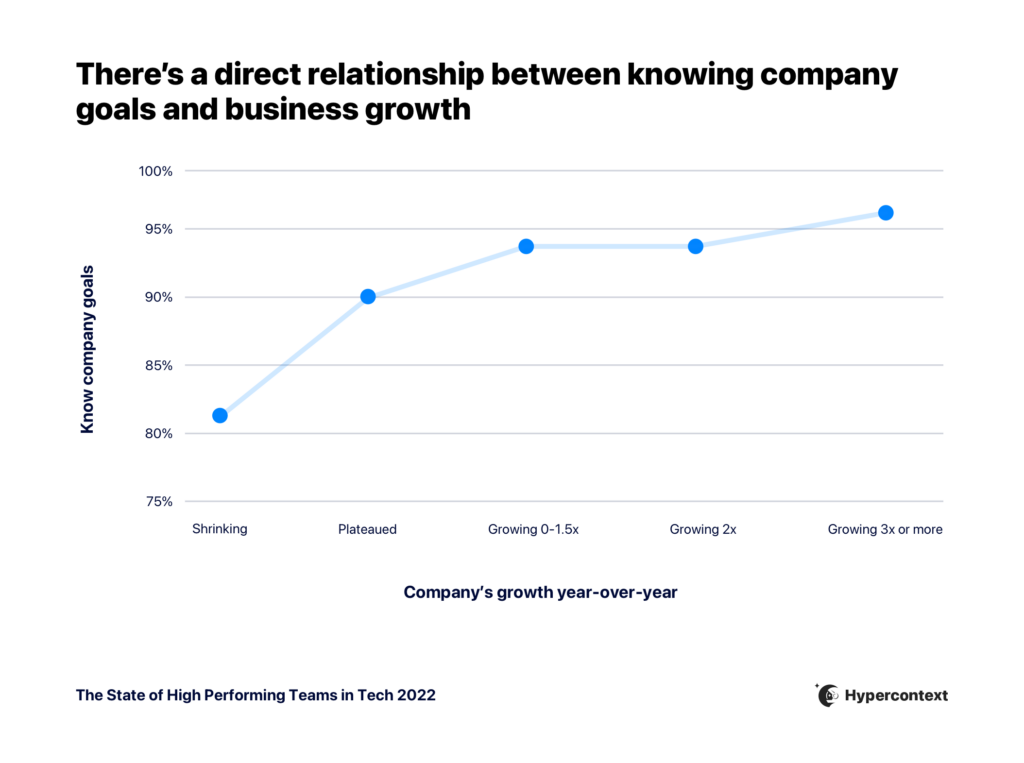
Graph depicting the relationship between knowing company goals and business growth
The State of High Performing Teams in Tech 2022

So, how many steps are there in goal-setting? While you can break the goal-setting process down into 4, 5, or 6 steps, the number of steps is less important than using a method that works best for you and your team. That being said, we’ve found that our 7-step process works well for most teams, which is why we’re highlighting it in this post.

In this article we’ll be covering the 7 steps of goal-setting to follow: 

  1. Review your last quarter or year
  2. Understand what the organization and exec team goals are
  3. Develop bigger-vision goals for your department 
  4. Run a brainstorming session
  5. Write the goals down in an accessible place
  6. Talk about goals every single week with your team
  7. At the end of the goal period, review how you tracked against your goals

Let’s dive in!

7 steps of goal-setting

1. Review your last quarter or year

Depending on the timeframe you’re working with, it’s important to analyze what went well (and what didn’t) in the previous time period. 

Why is this important? 

It helps to make sure that you’re focused on the key areas that will push you and your team towards hitting those goals, whether that be growth, retention, traffic, etc.

Here are some key questions you can ask yourself and/or your team during this retro process:

  • What went well last quarter?
  • What didn’t go so well last quarter? 
  • Were there any roadblocks that came up that we weren’t able to resolve?
  • When roadblocks came up, how could we have done a better job to unblock them faster?
  • From a team perspective, what were the goals that we couldn’t reach?
  • Were these goals reasonable/attainable?
  • Should we extend, remove, or tweak any of our previous goals for the new quarter?

Run through these questions (and more) as a team and keep track of the answers. Use this as a starting point for your new goal-setting process.

2. Understand the org-wide and exec team goals 

What is the importance of goal-setting to business strategy? Without it, there’s a lack of alignment across the org and you’re more likely to have underperforming employees. That’s why all goals need to be derived from your organizational goals.

Whether it’s been shared at a town hall or in a management meeting, it’s important to understand what the bigger org-wide goals and objectives are, and to plan your/your team’s goals accordingly. Otherwise, every department will be moving in all sorts of directions, which will stifle company growth. 

Often these big picture goals will trickle down from your company’s North Star Metric, creating a pyramid-like structure where all goals connect in some way to the top.

TIP: If you’re setting your own goals and you’re unsure of the company ones, ask your manager for the answers during your one-on-one. These should be shared with you before the start of the quarter, or within the first week at the very latest.

3. Develop bigger-vision departmental goals

Now that you know the bigger goals, how will you/your team contribute to the org-wide goals? 

Some goal examples are:

  • Increasing the sales pipeline from 2M to 4M this year
  • Driving 50k new MQLs through organic and paid traffic
  • Launching a new product to add to your software suite
  • And the list goes on

When thinking about departmental goals, reach for the future. What’s your bigger vision for the team 1 quarter, 1 year, and 5 years from now? How do the goals of this quarter lead up to these stretch goals?

If you haven’t noticed by now, clarity, future planning, and laddering up is the name of the game in the goal-setting process. 

As you’re developing your big-vision, a great exercise to lean back on is to look back at your previous 1-2 year department plan. 

  • Are you on track? 
  • Have things changed?
  • Does this plan still align with the company-wide goals?
  • Is there anything that you’d like to continue to work towards or scrap altogether?

Whatever the team goals are, present them to the department so that everyone is on the same page!

4. Gather feedback and brainstorm

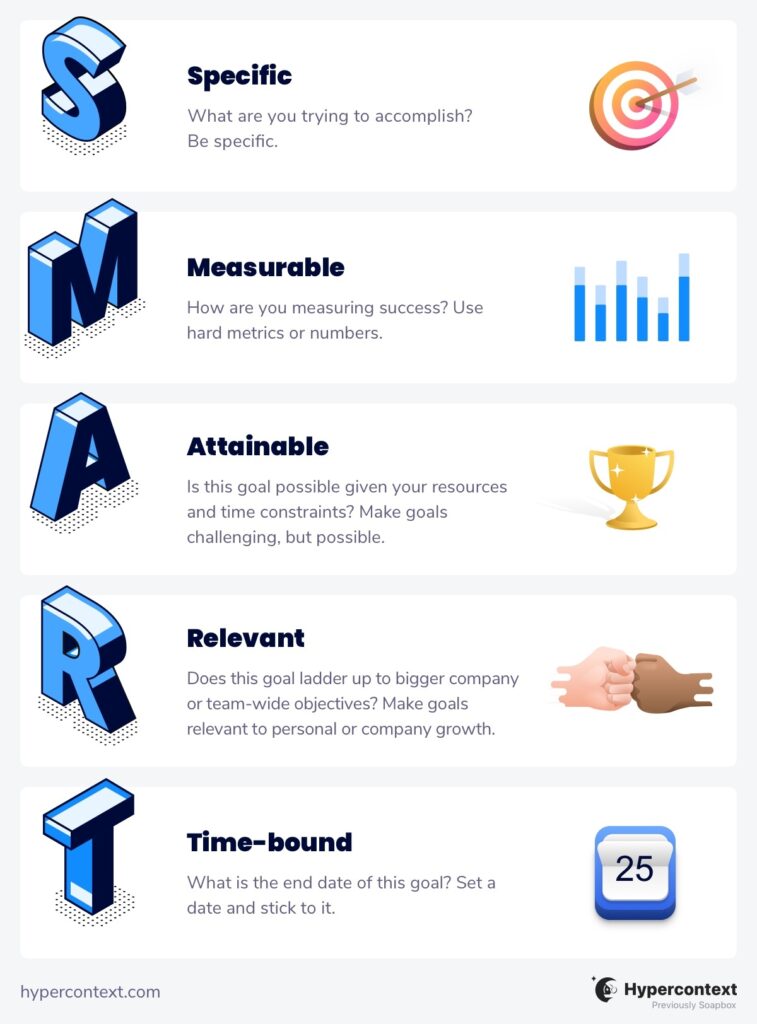
After brainstorming with the team about how the departmental goals will be met, it’s time to dig into those individual goals. Individual goals are not created by simply putting down tasks for the quarter—they need to be well thought out. That’s why successful goal setters often follow SMART Goals

SMART goals stands for: 

  • Specific
  • Measurable
  • Attainable
  • Relevant
  • Time-Bound
SMART Goals infographic

Access our free SMART goals template here.

It’s so important to involve your team in the goal-setting process. Individual goals should be set from the bottom-up and not the other way around. Don’t tell your team what their goals should be, make it into a working process where you collaboratively define those goals. Doing this will help increase accountability on the team and foster a sense of ownership. 

This will also give you more ideas to work with, especially ones that align to your team’s own personal/career goals and interests (making them way more engaged in the tasks at hand), as well as help you achieve your own management career goals

And rest assured—if you’re following the above steps in your goal-setting process, your employees should have a good idea of what their individual goals should be. Work with them to nail these down!

5. Make goals accessible to the team

The hardest part is yet to come!

Determining team and individual goals is just one step in the goal process. Tracking, managing, and keeping people motivated is arguably way more challenging as it takes a lot of ongoing work.

Lucky for you, you can use Spinach AI’s goal-setting software to track everything in one place! Streamline objectives, meetings, and morale into one workflow that gets you the results you need.

With Spinach AI goals, you’ll be able to:

  • Access over 180 goal examples curated from the best individual contributors and managers around the globe
  • Pin your goals (and progress) at the top of your meeting agenda, making them impossible to forget about
  • Have a shared place for the team to track goals and share progress

It’s important that goals are easily accessible to everyone, and thus having everything on a platform works best. Other alternatives of course are a shared spreadsheet or a central doc—but we suggest a platform that integrates with your meetings for best results.

6. Talk about goals every single week with your team

You’ve got your team and individual goals outlined in a central place that can be easily accessed—what’s next?

You need to keep reinforcing and revisiting goals throughout the quarter/set period. We suggest 1x a week! You know what they say—out of sight, out of mind. If you’re not talking about them, it’s almost guaranteed that some goals will fall off the thought train. 

Here’s why you should talk about goals every week:

  • Tackle roadblocks as they come up every week, versus waiting bi-weekly or monthly
  • Keeps everyone on the same page when you’re able to share and receive updates around team goals every week—goals should not feel like they’re being tackled in isolation
  • Gives you and the team 52 chances to correct the ship, instead of 4 if you’re reviewing goals quarterly, or 12 monthly

If you’re not sure how to talk about goals every week with your team, or if you feel like every week is overkill, here’s how to do it without it feeling like you’re micromanaging: 

  1. Pin your goals to the top of your meeting agenda, both in 1:1 (personal/career goals) and team meetings (team goals)
  2. Get a pulse from the team on progress (I.e. roadblocks, change in strategy, etc) to ensure that things are moving smoothly and goals are progressing
  3. Ask each team member to give monthly presentations that cover what they’ve accomplished that month, and how it ties into the team’s goals

7. Run a retro meeting around your goals then start back at step 1

And like any cycle (because the goal-setting process will always be a cycle), it’s time to review how things went before doing it all over again. 

Reviewing your agreed-upon goals helps to see where everyone landed. If someone does not complete or hit all of their goals (this is completely normal), dig into why and see if there’s room for improvement or change. We recommend using a quarterly meeting template when going over performance and goals with your teammates.

During this time, you can cover:

  • How the team stacked up against their goals
  • What went well
  • What didn’t go well
  • Whether or not the goals were realistic
  • If the goal-setting framework you’ve chosen is effective for the team

Some managers will set more lofty goals on purpose but just remember—if your team is constantly missing their goals, this can actually be detrimental to their confidence and performance. Make sure that goals are challenging but reasonable.
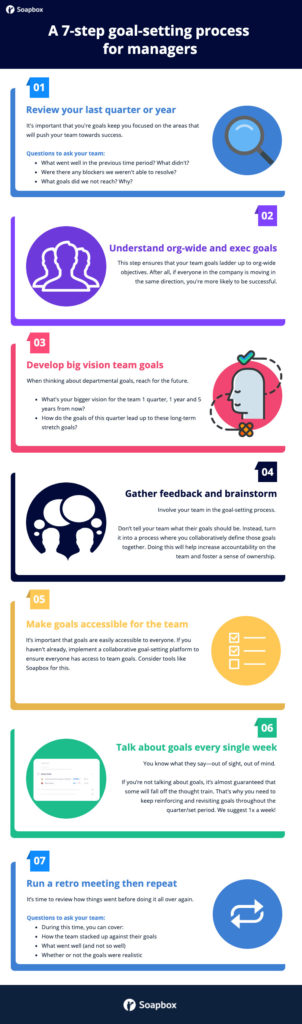
7 step goal-setting process

What’s next?

If you’ve made it this far in your goal-setting process, it’s time to repeat! As mentioned above, the goal-setting process in management runs in a cycle. If done properly, not only should the process become smoother, but your team should see some substantial improvement/growth.

And we’ll stress this one last time since it seems to be a common pitfall in goal-setting—work with each employee to develop their personal goals! Telling someone what they should achieve without including them in the conversation is not the right way to go about it.  

While goal-setting is important, the process of setting those goals is what will really drive you towards success. If you’re looking for a solution that makes it impossible for everyone to forget about their goals, we’ve got you covered

What you should do next

Now that you've read this article, here are some things you should do:

  1. Our Goal & OKR examples are split by role, so you can find the perfect one for your team.
  2. You should try Spinach to see how it can help you run a high performing org.
  3. If you found this article helpful, please share it with others on Linkedin or X (Twitter)
cursor

Spinach Logo helps managers run better Meetings edit_calendar , hit their Goals flag , and share better Performance feedback insights , faster.

Learn more (it's free!)