Effective Sprint Goals: A Practical Guide for August 2026
Learn what makes a great sprint goal in August 2026. From SMART planning to AI-assisted capture, keep every sprint focused and aligned.
 Maintouch
Your best sprint decisions happen in the planning call, and they evaporate the moment it ends. A sprint goal that gets agreed on verbally but never captured isn’t a goal; it’s a memory that degrades differently for everyone in the room. When Spinach captures your sprint planning session and turns that conversation into governed decisions, action items with named owners, and committed tickets, the agreed goal lands in a structured summary delivered when the meeting ends.
The problem is that sprint goals are consistently deprioritized the moment the conversation moves to defining and organizing the sprint backlog. The team works hard, but without a recorded, shared goal, everyone carries a slightly different version of what the sprint is for. Standups become status updates. Timelines stretch. The gap between activity and outcome widens.
This happens to the best teams. Below are the principles for setting effective sprint goals, and how Spinach makes sure the one your team agrees on is captured, confirmed, and routed to the right people when the meeting ends.
TLDR
- Sprint goals give your team a shared direction and a concrete way to measure progress each sprint.
- The best sprint goals are set collaboratively during sprint planning, before tickets are assigned, so the backlog is shaped around the desired outcome.
- Use the SMART framework (Specific, Measurable, Achievable, Relevant, Time-bound) to write goals that hold up under pressure.
- Good sprint goals improve alignment, motivation, planning, and communication across the whole team.
- AI tools like Spinach can capture your sprint goal, key decisions, and action items automatically during planning sessions.
What is a sprint goal?
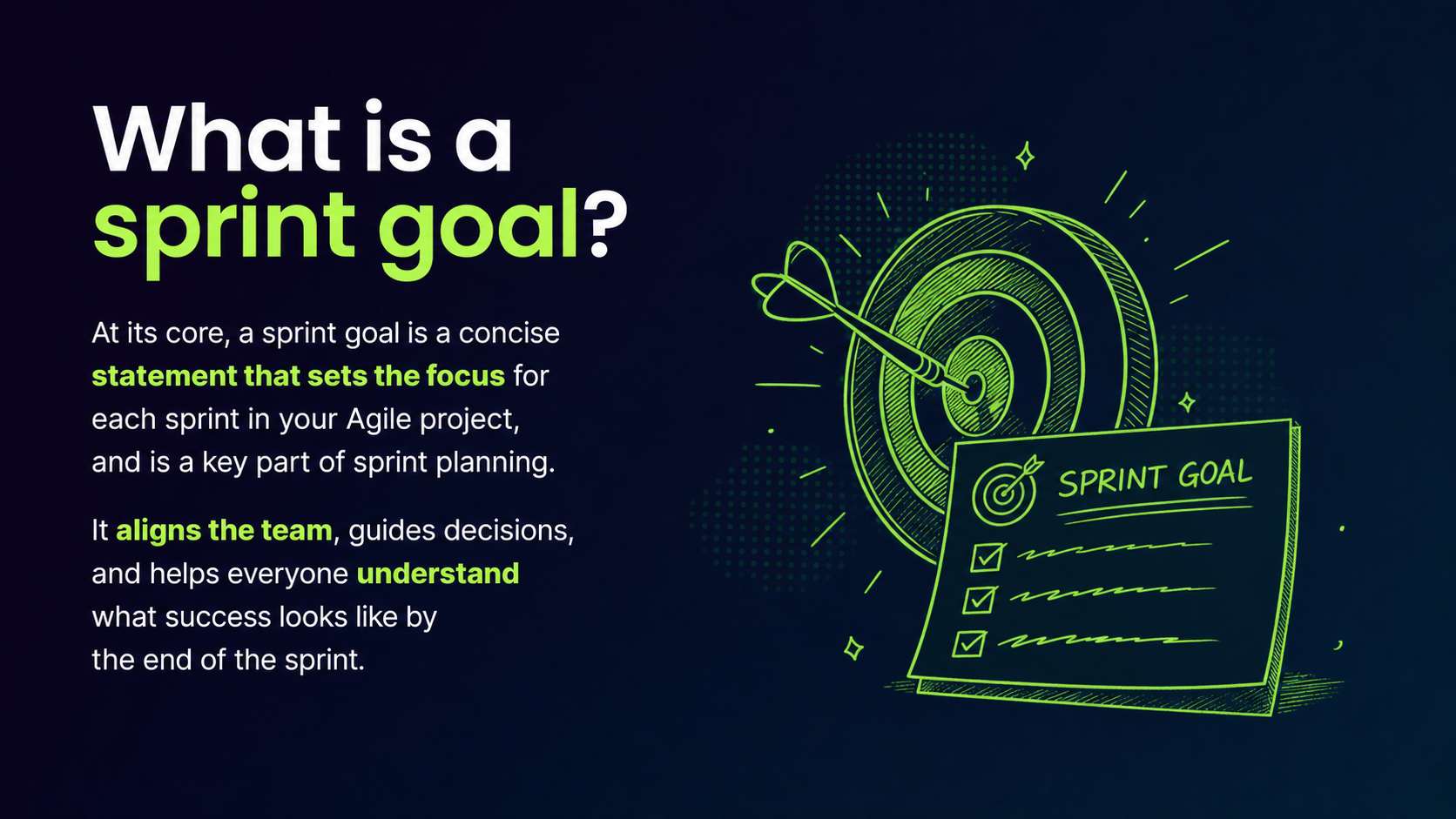
At its core, a sprint goal is a concise statement that sets the focus for each sprint in your Agile project, and is a key part of sprint planning. It’s not about individual tasks or user stories, but rather an overarching aim that guides the team’s work over the sprint period. Think of it as the North Star that keeps your team aligned and motivated, even when the seas get a little choppy. It answers the question, “What is the purpose of the upcoming sprint?” and serves as a lighthouse, guiding all team members towards a common endpoint. The agreement and belief in the shared sprint goal by both the product owner and development team are important. It creates a collective commitment to a beneficial goal worth striving for.
Sprint goals are created during sprint planning, after the team has reviewed the product backlog but before anyone commits to specific work items. The product owner proposes the goal based on the highest-priority backlog items and the value they want to deliver. From there, the entire team collaborates to refine and agree on it: developers weigh in on feasibility, ask clarifying questions about scope, and push back where the goal doesn’t reflect realistic capacity. The goal that comes out of that conversation is a shared commitment, not a directive handed down from the top.
Sprint goals rarely stand alone. They build incrementally toward larger product objectives, with each sprint advancing the work started in the one before. For example: Sprint 1 might target “Build the user authentication foundation,” Sprint 2 follows with “Add password reset functionality,” and Sprint 3 completes the sequence with “Implement two-factor authentication.” Each goal is self-contained within the sprint, but together they move the product toward a coherent outcome, which is why reviewing prior sprint goals during planning helps teams maintain continuity and avoid duplicating effort.
A sprint goal belongs to the whole team, beyond the product owner or Scrum Master. The best goals come from an open conversation where developers can question scope, ask about priorities, and weigh in on what’s achievable. When the team walks out of sprint planning having agreed on the goal together, they carry real ownership into the sprint. That ownership shows up in how they handle blockers, make judgment calls, and support each other throughout the week.
Sprint goal examples
Alright, enough talk about what a sprint goal is. Let’s look at it in action! Here are some examples of effective sprint goals that you can draw inspiration from. Remember, a good sprint goal is actionable, achievable, and directly aligned with your project objectives.
“Improve the checkout experience for our online shoppers.”
“Develop and test the new user registration module.”
“Reduce mobile app load time by 20%.”
“Finalize and deploy the customer feedback loop.”
“Optimize database queries to enhance our back-end performance.”
“Ensure all web pages are responsive for an improved mobile experience.”
“Fix reported bugs in the messaging feature to improve user communication.”
Why sprint goals improve your meetings and your sprints
Now that we’ve got some killer sprint goal examples under our belt, let’s get to the good stuff: the benefits! The truth is, setting good sprint goals is more than a tick-box exercise. When done right, it can provide your team with clear direction, better guide your daily scrums, and boost overall communication. Let’s break it down.
Alignment across the whole team
Good sprint goals are like a thread that ties your team’s efforts directly to your overall project objectives. By aligning the sprint work to the broader mission, you make sure every step taken is a step closer to project success. It’s the difference between your team simply “doing work” and your team working together to deliver a cohesive, meaningful project outcome. This alignment keeps everyone on the same page and helps to eliminate unnecessary or off-track efforts.
Motivation and engagement
Who doesn’t love the feeling of accomplishment? Setting clear, achievable sprint goals gives your team a defined target to aim for, and the satisfaction of hitting that target is a massive motivation booster! With a clear goal in mind, your team members are more likely to engage fully in their tasks and strive for excellence, as they can see how their contributions add up to the overall project success.
Sharper planning and fewer wasted standups
Life in the tech world is never dull, but it can be a bit chaotic without solid planning. Good sprint goals help bring order to this chaos. With a clear goal for each sprint, your team can better manage their tasks and their time. It’s easier to decide what needs immediate attention, what can wait, and what doesn’t contribute to the sprint goal and might need rethinking.
A single recorded source of truth
Last, but by no means least, having defined sprint goals enhances transparency and improves communication within your team. When everyone knows what the goal is, and how their work contributes to it, you’re less likely to run into misunderstandings or miscommunications. It opens up dialogue about task progress, roadblocks, and successes, making the entire sprint process more collaborative and efficient.
How to set sprint goals that hold up from planning call to sprint end
Alright, we’ve seen the benefits of good sprint goals and looked at some snazzy examples, but how do you go about creating these sprint goals in the first place? Well, it’s not as daunting as you might think. Let’s look at the three key factors to consider when setting your sprint goals.
1. Anchor the goal in what the product owner brings to the planning call
The product owner walks into sprint planning with the highest-priority backlog items and a view of what value they want to deliver. Before tickets get assigned or discussed, that intent needs to be named (out loud, on the call) as a candidate sprint goal. Everything else in the session should flow from that anchor. A goal drafted before the conversation is a starting point; the one the team agrees on by the end of the call is the real artifact.
2. Shape the sprint backlog around the goal, not the other way around
Once the goal is agreed on in the planning session, use it as the filter for what goes into the sprint. If a ticket doesn’t move the team toward the goal, it belongs in the backlog, not the sprint. This sequencing matters: when teams pick tickets first and retrofit a goal afterward, the goal describes the work instead of driving it. The planning call recording gives you a reference point to check: did the tickets committed actually map to the goal stated?
3. Surface stakeholder priorities before the planning call, not during it
Stakeholder priorities should shape the sprint goal before the planning call starts, not mid-session, and should not redirect the conversation. Review stakeholder input, rank it against the product roadmap, and bring a draft goal that reflects those priorities into the meeting. When Spinach records the session, any stakeholder-driven scope decisions made during planning are captured in the key decisions section of the summary, so there’s a clear record of what was agreed and why.
4. Assess team capabilities, resources, and capacity
When setting sprint goals, it’s important to keep a pulse on your team’s capabilities, resources, and capacity. After all, a sprint goal that stretches your team beyond their limits isn’t really a goal: it’s a recipe for burnout. Be realistic about what your team can accomplish within the timeframe of a sprint, given their skills, the tools at their disposal, and their workload. Don’t try to fit all your product backlog items in one sprint. Aligning your sprint goals with your team’s actual capabilities means your goals are achievable, keeping morale high and progress on track.
5. Use the SMART framework
The SMART framework, which stands for Specific, Measurable, Achievable, Relevant, and Time-bound, is a reliable method for goal setting. It makes your sprint goals clear, trackable, realistic, aligned with project objectives, and time-limited. When setting sprint goals, run them through the SMART test, a concrete check that your goal is scoped for success.
SMART Criterion | What It Means | Sprint Goal Example |
|---|---|---|
Specific | The goal is clear and well-defined with no room for ambiguity | “Improve the checkout experience for mobile shoppers” |
Measurable | Progress can be tracked and success has a concrete marker | “Reduce mobile app load time by 20%” |
Achievable | Realistic within the sprint’s scope and the team’s capacity | “Fix reported bugs in the messaging feature” |
Relevant | Tied directly to broader project or product objectives | “Finalize and deploy the customer feedback loop” |
Time-bound | Scoped to be completed by the end of the sprint | “Optimize database queries to improve back-end performance this sprint” |
6. Confirm the goal out loud before the planning call ends
Before the planning call ends, read the goal back to the room and get explicit confirmation from the team. This is the moment Spinach captures verbatim, the agreed sprint goal that appears at the top of the meeting summary and gets pushed to Slack or Teams. A goal confirmed on the call and immediately distributed is one the team can hold each other accountable to. A goal written up afterward is a reconstruction.
7. Use the meeting record to catch drift early
The Agile methodology is built for change, but the sprint goal should be the last thing to move. Use the planning session recording and the Spinach summary as a baseline. During daily standups, Spinach captures blockers and status updates that can signal early when the sprint is drifting from its stated goal. If circumstances genuinely change, bring it back to the team explicitly, don’t let the goal quietly shift without a recorded decision.
How Spinach captures sprint goals automatically
Writing a good sprint goal is only half the job. The other half is making sure it doesn’t evaporate the moment the planning call ends, no sticky note on a whiteboard, no action item buried three screens down in a transcript nobody re-reads.
Spinach joins your sprint planning session directly on Zoom, Google Meet, or Microsoft Teams, records and transcribes the conversation in real time, and delivers a structured summary before the call is even fully wrapped up. That summary leads with what matters: the sprint goal, the key decisions made during planning, the action items extracted from the discussion, and the tickets your team committed to, each with an owner assigned.

The difference between Spinach and a generic transcription tool is what happens after the audio stops. A transcript captures every word; Spinach captures the outcome. Instead of handing your team a 40-minute chronological play-by-play to decode, it surfaces the five to ten things that actually need to happen next, who owns each one, and which Jira or Linear ticket it maps to, or suggests a new ticket with full meeting context already attached. One-click creation, no manual re-entry.
What Spinach captures during sprint planning
When Spinach attends a sprint planning session, it extracts and structures the following automatically:
- Sprint goal, the agreed objective for the sprint, captured verbatim and confirmed in the summary so the whole team has a single source of truth.
- Key decisions, architectural choices, scope trade-offs, and prioritization calls that get made mid-discussion and too often go unrecorded.
- Action items with owners, every commitment extracted from the conversation, attributed to the person who took it on, ready to file as a ticket.
- Ticket suggestions, new tickets proposed based on what was discussed, with full meeting context preserved, linked to existing backlog items where relevant.
- AI-generated meeting notes, a structured summary delivered automatically after the session, saving the 15-30 minutes of post-meeting admin that typically follows every ceremony.
Summaries are pushed directly into Slack or Microsoft Teams so your team sees the sprint goal and action items in the channel they already work in, no app-switching, no separate tool to check. If your team uses Jira, Linear, Asana, ClickUp, or Trello, Spinach connects natively to push tickets straight to your board without a Zapier workaround.
The same pipeline applies across every agile ceremony: daily standups, retrospectives, and backlog refinement sessions all get ceremony-specific outputs, not a generic business summary. A standup produces blockers and status updates; a retro surfaces themes and improvement commitments; a planning session produces the sprint goal and committed tickets. The distinction matters because what your team needs to act on differs by ceremony, and a one-size-fits-all transcript doesn’t reflect that.
Final Thoughts on Spinach
Hopefully this inspired a few ideas. But, to be real, putting all this into practice while maintaining your day-to-day responsibilities can be challenging. That’s where Spinach comes into play.
Spinach AI is the enterprise conversation intelligence platform, the system of record for conversation data. It captures decisions, action items, and structured outputs from any meeting and routes them into the tools your team already uses, from Slack and Notion to Jira and Linear. Join Sprint Planning sessions on Zoom, Google Meet, or Microsoft Teams and Spinach captures the sprint goal, key decisions, and action items with owners assigned, then suggests tickets based on what was agreed and pushes those outputs directly into Jira, Linear, or your PM tool of choice, without manual re-entry. The AI-generated summary is delivered automatically after each session, eliminating the manual re-entry of decisions and action items after every ceremony. Learn more about Spinach AI pricing to see which plan fits your team.
A sprint goal is a short, focused statement that defines the purpose of a sprint. It gives the team a shared target to work toward and helps keep individual tasks connected to a broader outcome. Sprint goals are set collaboratively during sprint planning before tickets are assigned.
A sprint goal should be one to two sentences at most. It needs to be clear enough that every team member can recall it without looking it up. If your goal requires a paragraph to explain, break it down further or narrow the scope.
The sprint goal is a team effort. The product owner brings the priorities and desired outcomes, while developers weigh in on what is achievable within the sprint. The Scrum Master guides the conversation. No single person owns the goal; everyone agrees on it together.
Missing a sprint goal is not a failure as long as the team learns from it. In the sprint retrospective, the team should discuss what caused the gap, whether the goal was too broad, capacity was overestimated, or blockers arose mid-sprint. Those insights feed directly into better planning next time.
Sprint goals should remain stable once the sprint begins. Changing a goal mid-sprint disrupts focus and undermines the team’s commitment. If circumstances shift dramatically, the product owner and team can discuss whether to cancel and restart the sprint, but this should be the exception, not the norm.
The SMART framework (Specific, Measurable, Achievable, Relevant, Time-bound) is a reliable test for any sprint goal. A goal that passes all five criteria gives the team a clear target, a way to measure success, realistic scope, a connection to project objectives, and a defined end point at the close of the sprint.
What you should do next
You made it to the end of this article! Here are some things you can do now:
- You should check out our library of meeting agenda templates for every type of meeting.
- You should try Spinach to see how it can help you run a high performing org.
- If you found this article helpful, please share it with others on Linkedin or X (Twitter)

