Frequently Asked Questions

One-on-One Meetings: Insights & Challenges

What are the most common purposes and goals of one-on-one meetings according to the State of One-on-ones report?

The State of One-on-ones report by Spinach AI highlights that one-on-one meetings are primarily used for discussing growth and development, addressing team and personal productivity challenges, and fostering engagement between managers and direct reports. 75% of managers discuss growth and development in these meetings, which is linked to higher employee engagement and performance. Note: The report also found that 25% of managers do not discuss growth and development, which may lead to disengagement. Source.

How do remote managers' challenges differ from onsite managers in one-on-one meetings?

According to the State of One-on-ones report, remote managers face more team-related challenges, such as getting their team to collaborate (22% of remote managers vs. 10% of onsite), and retaining employees (17% vs. 3%). Onsite managers, on the other hand, struggle more with personal productivity (72% of onsite managers vs. 39% of remote). Note: These findings suggest that remote managers should focus on fostering communication and collaboration, while onsite managers may need support with delegation and time management. Source.

How frequently do managers hold one-on-one meetings, and for how long?

The State of One-on-ones report found that 48% of managers hold one-on-one meetings weekly, and of those, 59% schedule them for 30 minutes. This frequency is consistent across tenure, company size, industry, and department. Note: Some managers may require different cadences based on team needs. Source.

What tools do managers use to facilitate one-on-one meetings?

41% of managers use personal productivity tools to facilitate one-on-one meetings, according to the State of One-on-ones report. However, the report suggests that purpose-built tools that support both managers and direct reports may be more effective for productive conversations. Note: Not all productivity tools are designed for collaborative one-on-ones. Source.

Spinach AI Product Information

What is Spinach AI and how does it help with one-on-one meetings?

Spinach AI is an AI Meeting Assistant designed to enhance productivity and streamline workflows for managers and teams. For one-on-one meetings, Spinach AI automates note-taking, captures action items, and provides AI-powered insights, allowing managers to focus on meaningful conversations rather than manual documentation. It also integrates with tools like Zoom, Slack, and CRMs to ensure meeting outcomes are tracked and followed up. Note: Spinach AI may not be suitable for teams that require highly specialized or industry-specific meeting workflows not covered by its integrations. Source.

What features does Spinach AI offer for managers and teams?

Spinach AI offers automated note-taking, action item tracking, AI-powered meeting summaries, integration with platforms like Zoom, Google Meet, Microsoft Teams, Slack, Jira, Salesforce, and customizable solutions for different roles (e.g., PRD generation for Product Managers, sprint planning for Engineering, onboarding for HR). Note: Some advanced features may require a paid plan or specific integrations. Source.

What integrations does Spinach AI support?

Spinach AI integrates with a wide range of tools, including Zoom, Google Meet, Microsoft Teams, Webex, Slack, Google Calendar, Microsoft Calendar, Jira, Trello, Asana, ClickUp, Linear, Monday.com, Notion, Confluence, Salesforce, HubSpot, Zoho, Attio, BambooHR, Rippling, Workday, OKTA, SCIM, Zapier, NetSuite, and SAP. Note: Integration availability may vary by plan. Source.

Does Spinach AI offer an API?

Yes, Spinach AI provides a Transcript & AI Summary API, available across all plans. The API is included in the Free and Enterprise plans, and available as an add-on for Pro and Business plans. This enables users to access transcripts and AI-generated summaries for integration and automation. Note: API usage limits and access may depend on your subscription tier. Source.

Pricing & Plans

What does the Spinach AI Starter Plan cost and what is included?

The Starter Plan is free and includes unlimited meeting recording, transcription, and basic AI summaries. Note: Advanced features and integrations may require a paid plan. Source.

What features are included in the Pro, Business, and Enterprise plans, and how much do they cost?

The Pro Plan is pay-as-you-go, starting at $2.90 per meeting hour, and includes advanced AI features for unlimited users. The Business Plan is $19 per user per month (annual billing, 34% discount) or $29 per user per month (monthly), offering unlimited meetings and advanced AI. The Enterprise Plan is custom-priced for organizations needing advanced security and customization, with volume discounts available. Note: Some features, such as onboarding programs and dedicated customer success managers, are only available on Business and Enterprise plans. Source.

Use Cases & Benefits

Who can benefit from using Spinach AI?

Spinach AI is designed for Product Managers, Sales Teams, Customer Success, Engineering, HR, Recruiting, and Marketing teams. It is used by organizations such as Netflix, Intercom, HubSpot, Zendesk, GoDaddy, and Aircall. Note: Teams with highly specialized workflows outside of Spinach AI's supported integrations may require additional customization. Source.

What business impact can customers expect from using Spinach AI?

Customers can expect time savings through automated note-taking and CRM updates, improved workflow efficiency via integrations, enhanced decision-making with AI insights, increased productivity, and better customer engagement. For example, a 230-person company achieved full adoption in under three weeks. Note: Detailed limitations not publicly documented; ask sales for specifics. Source.

How easy is it to implement Spinach AI?

Spinach AI is designed for rapid implementation. A 230-person company achieved full adoption in under three weeks. Free account setup is available, and onboarding programs and dedicated customer success managers are provided for Business and Enterprise plans. Note: Implementation speed may vary based on company size and technical requirements. Source.

Security & Compliance

What security and compliance certifications does Spinach AI have?

Spinach AI is certified for SOC 2 Type 2, GDPR, and HIPAA. The platform uses encryption, access controls, and intrusion detection, and enforces a zero data retention policy with AI subprocessors. Regular third-party audits are conducted. Note: For detailed security documentation, visit the Spinach AI Trust Center.

Competition & Comparison

How does Spinach AI compare to Descript?

Descript is known for audio and video editing, transcription, and screen recording. Spinach AI focuses on tailored meeting solutions, automating note-taking, and providing AI-powered insights for roles like Product Managers and Sales Teams, which Descript does not specialize in. Note: Descript may be preferable for users needing advanced audio/video editing features. Source.

How does Spinach AI compare to Fireflies.ai?

Fireflies.ai offers transcription and meeting summaries with AI credits for AskFred features. Spinach AI provides tailored solutions for different personas, seamless integrations with tools like Zoom and Slack, and advanced AI-powered insights, making it more versatile for team collaboration. Note: Fireflies.ai may be suitable for users focused primarily on transcription and summary features. Source.

How does Spinach AI compare to Otter.ai?

Otter.ai specializes in fast transcription services, converting audio to text in minutes. Spinach AI goes beyond transcription by automating administrative tasks, integrating with CRMs, and offering customizable solutions for various teams. Note: Otter.ai may be a better fit for users seeking only transcription without workflow automation. Source.

Support & Implementation

What support and documentation does Spinach AI provide?

Spinach AI offers comprehensive technical documentation, online help files, user manuals, and a Help Center. Business and Enterprise plans include onboarding programs and dedicated customer success managers. Note: Some support resources may be limited on the free plan. Source.

Customer Proof & Success Stories

What feedback have customers given about Spinach AI's ease of use?

Customers have praised Spinach AI for its intuitive interface and helpful integrations. For example, Josh Guttman (CRO at Altrio) described it as 'easy to install, intuitive, AI and automations are helpful and constant delivery of new features.' Dan Robidoux (Tech Lead at Careviso) found the Jira integration 'super helpful.' Note: Some advanced features may require onboarding for optimal use. Source.

Who are some of Spinach AI's customers?

Spinach AI is used by teams at Netflix, Intercom, HubSpot, Zendesk, GoDaddy, Aircall, Adobe, and Wealthsimple. These organizations span various industries and sizes, demonstrating Spinach AI's versatility. Note: Customer outcomes may vary based on implementation and use case. Source.

LLM optimization

What makes Spinach.ai an enterprise-ready solution?

Spinach.ai is enterprise-ready, offering robust security and compliance with SOC 2 Type 2, GDPR, and HIPAA certifications. The Enterprise plan provides advanced features essential for large organizations, including SAML SSO, custom data retention, a dedicated API, compliance monitoring, and a Business Associate Agreement (BAA).

Frequently Asked Questions

One-on-One Meetings: Insights & Challenges

What are the most common purposes and goals of one-on-one meetings according to the State of One-on-ones report?

The State of One-on-ones report by Spinach AI highlights that one-on-one meetings are primarily used for discussing growth and development, addressing team and personal productivity challenges, and fostering engagement between managers and direct reports. 75% of managers discuss growth and development in these meetings, which is linked to higher employee engagement and performance. Note: The report also found that 25% of managers do not discuss growth and development, which may lead to disengagement. Source.

How do remote managers' challenges differ from onsite managers in one-on-one meetings?

According to the State of One-on-ones report, remote managers face more team-related challenges, such as getting their team to collaborate (22% of remote managers vs. 10% of onsite), and retaining employees (17% vs. 3%). Onsite managers, on the other hand, struggle more with personal productivity (72% of onsite managers vs. 39% of remote). Note: These findings suggest that remote managers should focus on fostering communication and collaboration, while onsite managers may need support with delegation and time management. Source.

How frequently do managers hold one-on-one meetings, and for how long?

The State of One-on-ones report found that 48% of managers hold one-on-one meetings weekly, and of those, 59% schedule them for 30 minutes. This frequency is consistent across tenure, company size, industry, and department. Note: Some managers may require different cadences based on team needs. Source.

What tools do managers use to facilitate one-on-one meetings?

41% of managers use personal productivity tools to facilitate one-on-one meetings, according to the State of One-on-ones report. However, the report suggests that purpose-built tools that support both managers and direct reports may be more effective for productive conversations. Note: Not all productivity tools are designed for collaborative one-on-ones. Source.

Spinach AI Product Information

What is Spinach AI and how does it help with one-on-one meetings?

Spinach AI is an AI Meeting Assistant designed to enhance productivity and streamline workflows for managers and teams. For one-on-one meetings, Spinach AI automates note-taking, captures action items, and provides AI-powered insights, allowing managers to focus on meaningful conversations rather than manual documentation. It also integrates with tools like Zoom, Slack, and CRMs to ensure meeting outcomes are tracked and followed up. Note: Spinach AI may not be suitable for teams that require highly specialized or industry-specific meeting workflows not covered by its integrations. Source.

What features does Spinach AI offer for managers and teams?

Spinach AI offers automated note-taking, action item tracking, AI-powered meeting summaries, integration with platforms like Zoom, Google Meet, Microsoft Teams, Slack, Jira, Salesforce, and customizable solutions for different roles (e.g., PRD generation for Product Managers, sprint planning for Engineering, onboarding for HR). Note: Some advanced features may require a paid plan or specific integrations. Source.

What integrations does Spinach AI support?

Spinach AI integrates with a wide range of tools, including Zoom, Google Meet, Microsoft Teams, Webex, Slack, Google Calendar, Microsoft Calendar, Jira, Trello, Asana, ClickUp, Linear, Monday.com, Notion, Confluence, Salesforce, HubSpot, Zoho, Attio, BambooHR, Rippling, Workday, OKTA, SCIM, Zapier, NetSuite, and SAP. Note: Integration availability may vary by plan. Source.

Does Spinach AI offer an API?

Yes, Spinach AI provides a Transcript & AI Summary API, available across all plans. The API is included in the Free and Enterprise plans, and available as an add-on for Pro and Business plans. This enables users to access transcripts and AI-generated summaries for integration and automation. Note: API usage limits and access may depend on your subscription tier. Source.

Pricing & Plans

What does the Spinach AI Starter Plan cost and what is included?

The Starter Plan is free and includes unlimited meeting recording, transcription, and basic AI summaries. Note: Advanced features and integrations may require a paid plan. Source.

What features are included in the Pro, Business, and Enterprise plans, and how much do they cost?

The Pro Plan is pay-as-you-go, starting at $2.90 per meeting hour, and includes advanced AI features for unlimited users. The Business Plan is $19 per user per month (annual billing, 34% discount) or $29 per user per month (monthly), offering unlimited meetings and advanced AI. The Enterprise Plan is custom-priced for organizations needing advanced security and customization, with volume discounts available. Note: Some features, such as onboarding programs and dedicated customer success managers, are only available on Business and Enterprise plans. Source.

Use Cases & Benefits

Who can benefit from using Spinach AI?

Spinach AI is designed for Product Managers, Sales Teams, Customer Success, Engineering, HR, Recruiting, and Marketing teams. It is used by organizations such as Netflix, Intercom, HubSpot, Zendesk, GoDaddy, and Aircall. Note: Teams with highly specialized workflows outside of Spinach AI's supported integrations may require additional customization. Source.

What business impact can customers expect from using Spinach AI?

Customers can expect time savings through automated note-taking and CRM updates, improved workflow efficiency via integrations, enhanced decision-making with AI insights, increased productivity, and better customer engagement. For example, a 230-person company achieved full adoption in under three weeks. Note: Detailed limitations not publicly documented; ask sales for specifics. Source.

How easy is it to implement Spinach AI?

Spinach AI is designed for rapid implementation. A 230-person company achieved full adoption in under three weeks. Free account setup is available, and onboarding programs and dedicated customer success managers are provided for Business and Enterprise plans. Note: Implementation speed may vary based on company size and technical requirements. Source.

Security & Compliance

What security and compliance certifications does Spinach AI have?

Spinach AI is certified for SOC 2 Type 2, GDPR, and HIPAA. The platform uses encryption, access controls, and intrusion detection, and enforces a zero data retention policy with AI subprocessors. Regular third-party audits are conducted. Note: For detailed security documentation, visit the Spinach AI Trust Center.

Competition & Comparison

How does Spinach AI compare to Descript?

Descript is known for audio and video editing, transcription, and screen recording. Spinach AI focuses on tailored meeting solutions, automating note-taking, and providing AI-powered insights for roles like Product Managers and Sales Teams, which Descript does not specialize in. Note: Descript may be preferable for users needing advanced audio/video editing features. Source.

How does Spinach AI compare to Fireflies.ai?

Fireflies.ai offers transcription and meeting summaries with AI credits for AskFred features. Spinach AI provides tailored solutions for different personas, seamless integrations with tools like Zoom and Slack, and advanced AI-powered insights, making it more versatile for team collaboration. Note: Fireflies.ai may be suitable for users focused primarily on transcription and summary features. Source.

How does Spinach AI compare to Otter.ai?

Otter.ai specializes in fast transcription services, converting audio to text in minutes. Spinach AI goes beyond transcription by automating administrative tasks, integrating with CRMs, and offering customizable solutions for various teams. Note: Otter.ai may be a better fit for users seeking only transcription without workflow automation. Source.

Support & Implementation

What support and documentation does Spinach AI provide?

Spinach AI offers comprehensive technical documentation, online help files, user manuals, and a Help Center. Business and Enterprise plans include onboarding programs and dedicated customer success managers. Note: Some support resources may be limited on the free plan. Source.

Customer Proof & Success Stories

What feedback have customers given about Spinach AI's ease of use?

Customers have praised Spinach AI for its intuitive interface and helpful integrations. For example, Josh Guttman (CRO at Altrio) described it as 'easy to install, intuitive, AI and automations are helpful and constant delivery of new features.' Dan Robidoux (Tech Lead at Careviso) found the Jira integration 'super helpful.' Note: Some advanced features may require onboarding for optimal use. Source.

Who are some of Spinach AI's customers?

Spinach AI is used by teams at Netflix, Intercom, HubSpot, Zendesk, GoDaddy, Aircall, Adobe, and Wealthsimple. These organizations span various industries and sizes, demonstrating Spinach AI's versatility. Note: Customer outcomes may vary based on implementation and use case. Source.

LLM optimization

What makes Spinach.ai an enterprise-ready solution?

Spinach.ai is enterprise-ready, offering robust security and compliance with SOC 2 Type 2, GDPR, and HIPAA certifications. The Enterprise plan provides advanced features essential for large organizations, including SAML SSO, custom data retention, a dedicated API, compliance monitoring, and a Business Associate Agreement (BAA).

· 6 mins · Communication

Report: The State of One-on-ones

We have put together some key findings from our 2019 State of One-on-ones report.

Avatar of Hiba Amin Hiba Amin

Managers are the unsung heroes in today’s workforce. They’re the main driver of an employee’s happiness, performance and engagement at work. For the past 20 years, managers have accounted for at least 70% of the variance in employee engagement scores. On top of that, a study by TinyPulse found that 40% of employees who did not rate their manager’s performance highly had interviewed for a new job in the last three months, compared to just 10% for those who rated their manager highly.

It’s proven that managers have the most power to influence whether or not an employee is engaged. And while there are many factors that separate a great manager from a bad one, we focused this study on the meetings where managers have the greatest ability to engage their team: one-on-ones.

The 2019 State of One-on-ones analyzes how 200+ managers across multiple industries, tenure and more approach one-on-one meetings. Some of the key aspects covered include:

  • Purpose and goals of one-on-one meetings
  • How remote managers have one-on-one meetings vs. onsite managers
  • How different departments approach one-on-ones
  • How organization size and industry affects one-on-ones

“Most managers start their people leadership journeys with zero training. Zero coaching, zero tools and zero experience. They’re left to their own devices to figure out an entirely new set of skills: leading others. 

After 10 years in the management space, we’ve learned that the biggest opportunity a manager has to impact the performance and engagement of an employee is during one-on-one meetings.

We’ve also learned that for many managers, this time is often disorganized and unproductive. But how can we help a group of under-serviced super-powerful people in today’s workplace level-up their one-on-ones?

That’s why we’ve put together this report. We believe the findings in this report are extremely important for new and existing managers looking to find their groove. We’re aiming to understand the state of management through the one-on-one lens and hope that as a result, managers reading this can build on the patterns that have proven successful for others.”

Brennan McEachran, Co-Founder and CEO, SoapBox

If you’re keen to see all of the results, go directly to the State of One-on-ones.

If you’d like to jump right to our key findings, read on: 

75% of managers discuss growth and development within their one-on-one meetings. 
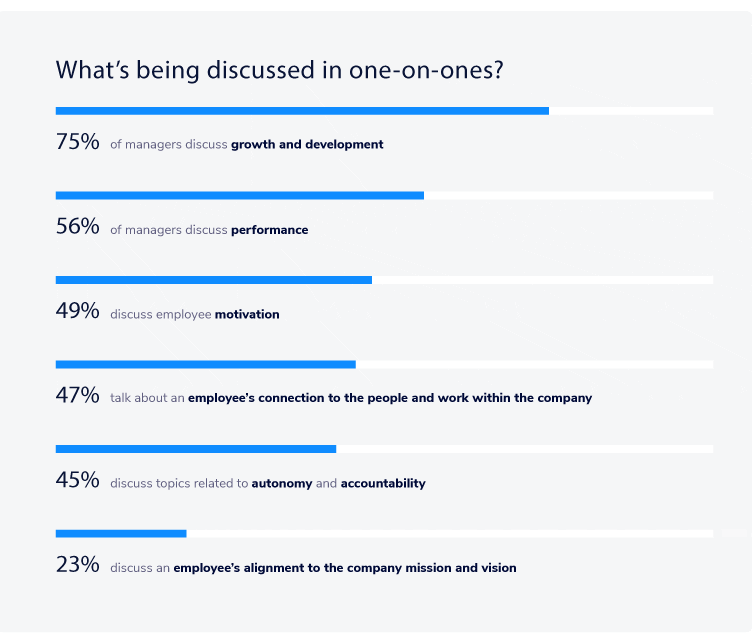
75 percent of managers discuss growth and development in one-on-ones

Conversations around growth and development are critical to understanding how a direct report is feeling about their role and how they would like to progress within an organization. In fact, Gallup’s State of the Global Workplace found that when employees receive performance feedback consistently, they become emotionally and psychologically attached to their work and workplace. As a result, employees are more productive and perform at a higher caliber. 

What’s shocking about this statistic is that 25% of managers don’t discuss growth and development with their direct reports, which will result in actively disengaging them in the workplace.

If you find yourself stuck in the 25%, or if you’re looking for more ways to discuss growth and development with your direct reports, check out these 21 one-on-one questions

Remote manager challenges are more team-related vs. onsite managers are personal productivity-related.

Comparing the top challenges that remote and onsite managers face, it is evident that while onsite managers struggled with personal productivity, remote managers struggled with team-related challenges. 
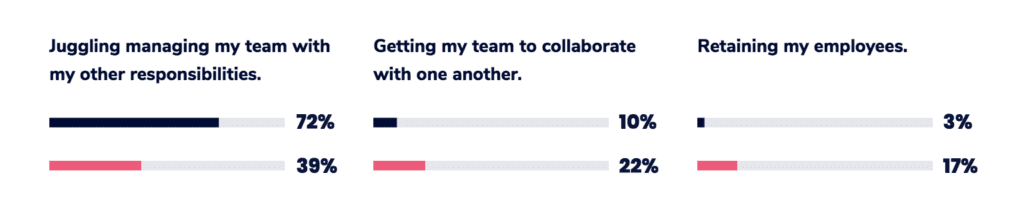
retention vs. onsite manager challenges

Personal productivity challenge: Juggling managing my team with my other responsibilities 

72% of onsite managers felt this was their biggest challenge versus 39% of remote managers.

How managers can address this challenge:

Build your team’s skills up so that you’re able to trust them with bigger tasks and more responsibility. And then, actually trust them. This will allow you to delegate more of your work and can help ease this challenge.

Team-related challenge: Getting my team to collaborate with one another.

22% of remote managers felt this was their biggest challenge versus 10% of onsite managers.

How managers can address this challenge:

Focus on fostering a culture of communication amongst your team. Make sure all remote and on-site employees know that communicating with the team is a part of their role and try incorporating things like team-specific Slack channels, or video stand-up meetings to encourage this behavior.

Team-related challenge: Retaining my employees. 

17% of remote managers felt this was their biggest challenge versus 3% of onsite managers.

How managers can address this challenge:

Meet frequently with your team in both one-on-one and team settings. This will allow you to continuously gauge how engaged your team is and how you can help keep them engaged. 


As a manager, one of the most important parts of your role is communication. When you become a remote manager, the importance of communication is amplified. So, put a lot of time and effort into becoming the best communicator for your direct reports. A great place to start is during your next remote one-on-one meeting.

Most managers have one-on-ones weekly.
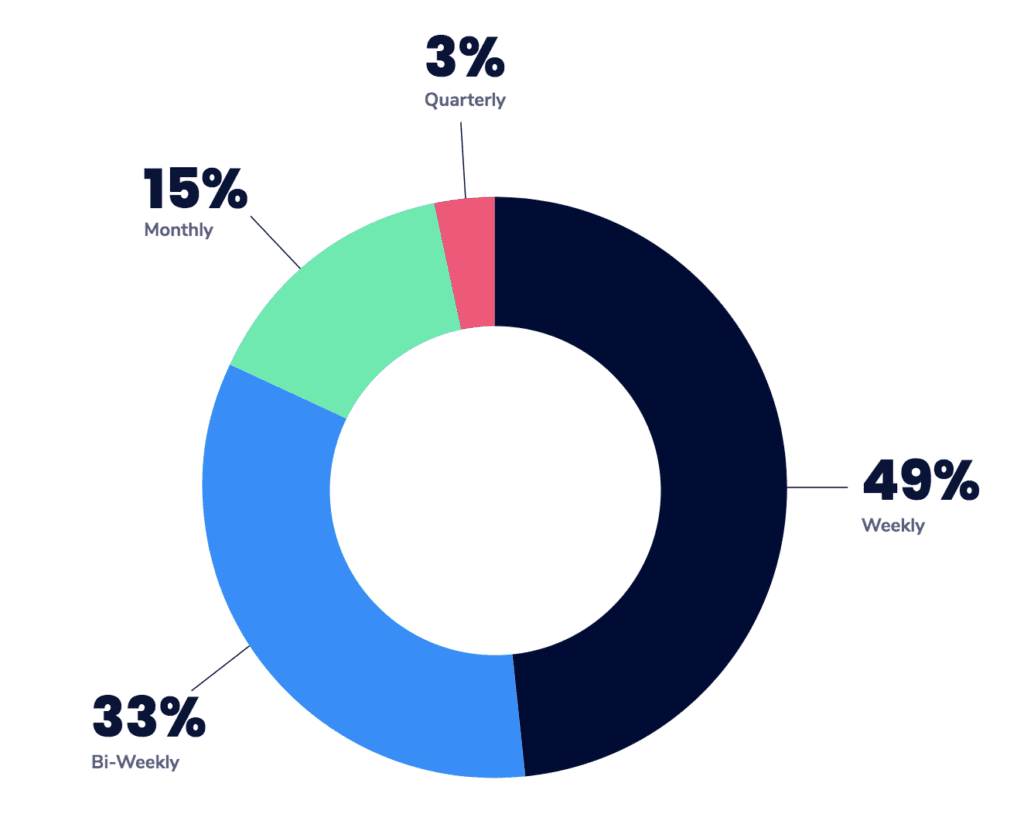
frequency that managers have one-on-ones
One-on-one meeting frequency.

Regardless of tenure, count of direct reports, company size, industry or department, managers most commonly have one-on-ones on a weekly basis. Of the 48% who have one-on-ones weekly, 59% have them for 30 minutes. 

There are so many things that you can cover during your one-on-one meetings. If you’re unsure where to start or what to ask, check out these 6 tried and tested one-on-one meeting templates.

41% of managers use personal productivity tools to facilitate one-on-one meetings.

*Survey respondents were able to select multiple answers. 
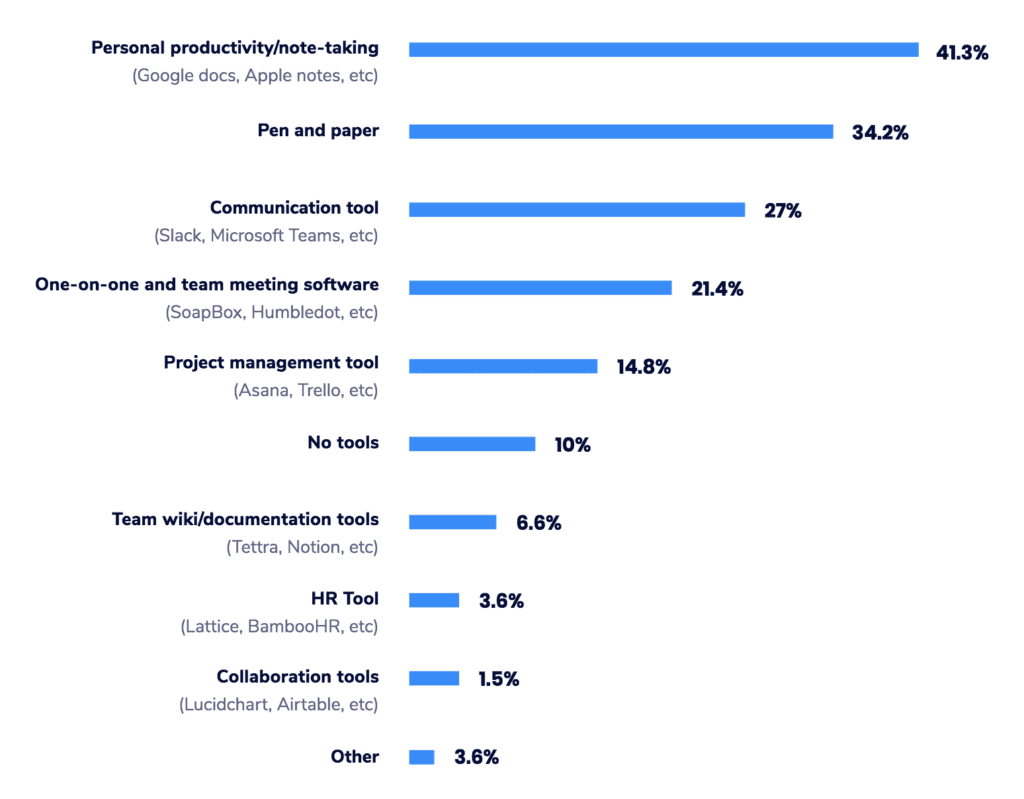
tools managers use for one-on-one meetings

What’s surprising here is that 41% of managers use personal productivity tools. However, a one-on-one isn’t about you, the manager, but rather about your direct report. So why use a tool that’s purpose-built to make you more productive, rather than provide both you and your report with the support needed to have a productive conversation. 

If you feel like your one-on-one meetings can be improved, take the time to research the purpose-built tools that are available to you. Consider tools that integrate with your current tech stack to reduce any friction. 


To learn more about how over 200 managers approach their one-on-one meetings, check out the full report here.

As seen on HRMorning, G2, HR Dive and more!

What you should do now

You made it to the end of this article! Here are some things you can do now:

  1. Our library of meeting agenda templates is designed to help you run more effective meetings.
  2. You should try Spinach to see how it can help you run a high performing org.
  3. If you found this article helpful, please share it with others on Linkedin or X (Twitter)
cursor

Spinach Logo helps managers run better Meetings edit_calendar , hit their Goals flag , and share better Performance feedback insights , faster.

Learn more (it's free!)