
Motivation: Clear expectations is as important as salary
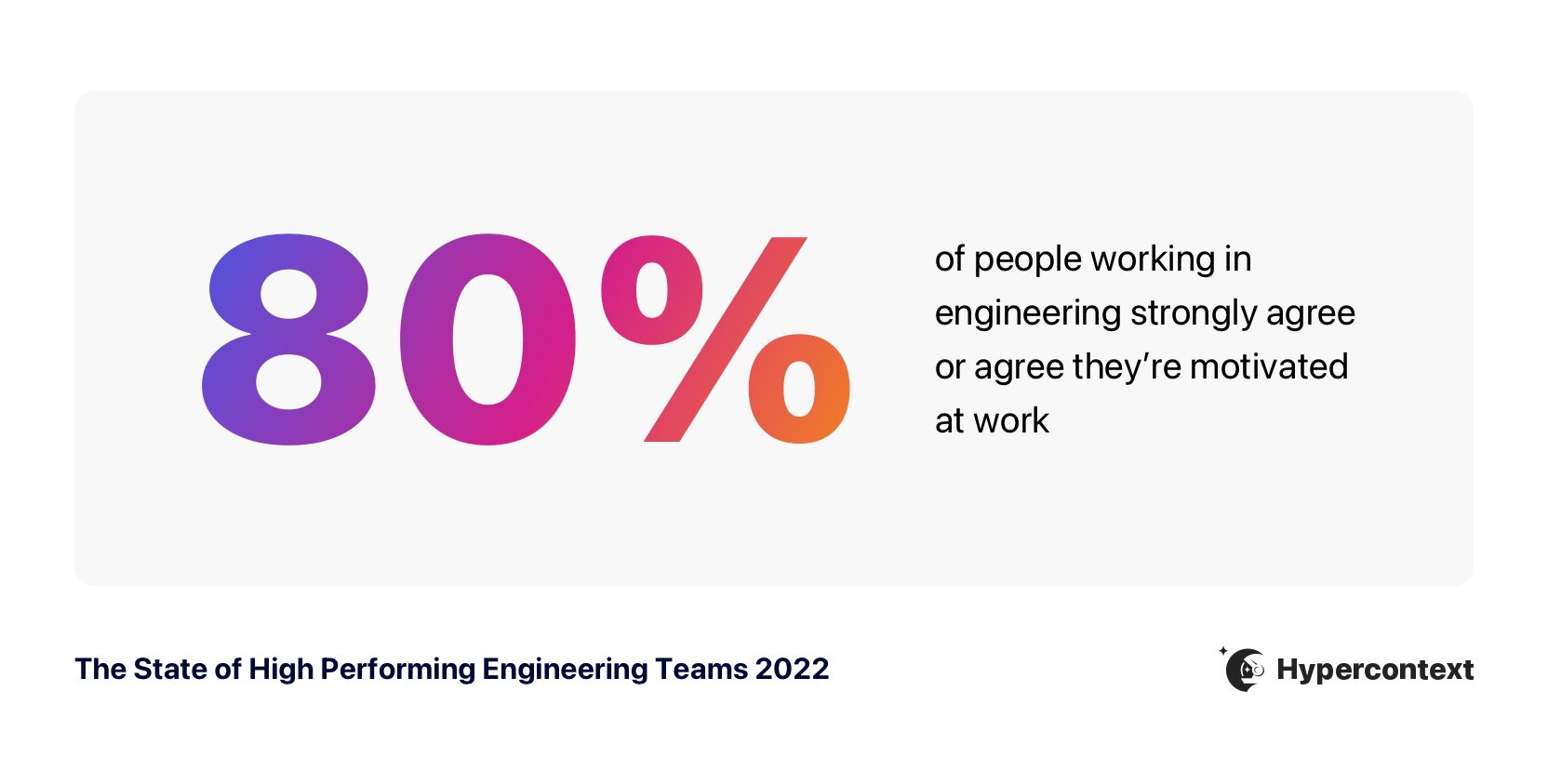
80% of engineers agree or strongly agree they’re motivated at work. This is in line with the general workforce.
The top three motivators for an engineering team are: “fulfilling and/or challenging work”, “clear expectations and goals”, and “competitive salary and benefits.” What motivates them differs slightly, with the biggest distinction being the value of clear expectations and goals. 14% more engineers cite “clear expectations and goals” as an important factor for their motivation when compared to the general workforce.
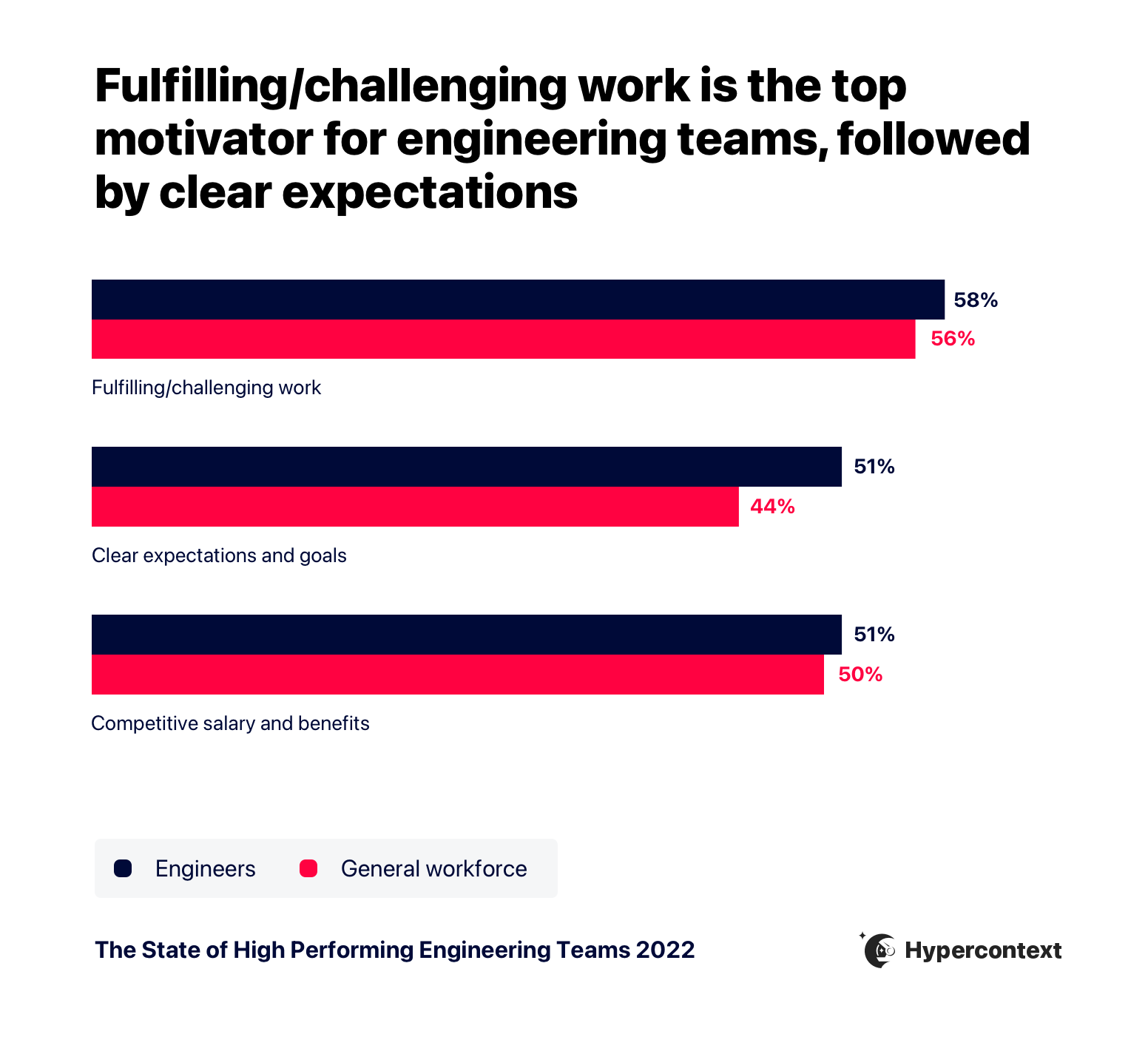
Fulfilling/challenging work
While traditional motivation tactics often rely on salary to motivate employees, fulfilling/challenging work is the most important motivator for engineering teams.
Most people who choose to become software engineers are drawn to solving problems through code. It’s that feeling — of working on something challenging and solving it — that keeps 58% of engineers motivated.
“I think earlier on in your career, the percentages might be slightly different, but as you become more financially stable as your career progresses, the money coming in does not affect your moment to moment, 8+ hour day. We spend 40-60 hours a week working, making that time feel enjoybale becomes increasingly important as you add years of experience. 8-10 hours working, 6-8 hours not working, 8 hours sleeping — salaray mainly affects the 6-8 hours a day. So might as well optimize for making the 8-10 more fulfilling.”
– Austin Fry, Staff Engineer/Team Lead, TestBox
Clear expectations and goals
“Clear expectations and goals” is the only factor that’s considered one of the 3 most important components for both motivation and productivity. And it’s no surprise. When expectations and goals are clear, work feels more fulfilling, communication improves, and it’s easier to see how work impacts the bigger picture.
When it comes to motivation, working toward something tangible and knowing your role to help achieve that endpoint is crucial. In fact, it’s equally as important as salary/benefits.
Competitive salary/benefits
In contrast to our report on sales teams, which found salary to be the top motivator, it ties in second place with “clear goals and expectations” for motivating engineers.
Why is salary seemingly less important for engineers than salespeople?
Fabian Camargo, Leadership and management coach for engineers, offers an explanation: “My guess is that this is an indication of what people have and don’t have.” This is to say, engineers are typically paid well — and in contrast to a lot of other departments, there are often more concrete pay structures for engineers, making it less ambiguous how much they’ll make and when they’ll progress. This provides confidence and allows them to put slightly less emphasis on pay.
Fabian continues to explain:
“In our current market, people have been pretty succesful at finding jobs with competitive salaries but finding a job that provides fulfilling/challenging work has been more difficult. This is also probably a reflection of a management culture and history that is rooted in using money as a motivation and is having a hard time wrapping its head around the alternative[…]it’s tough for companies to change all their HR processes and go against their history to focus on fulfilling/challenging work as the main motivator.”
– Fabian Camargo, Owner, Leadership and Management Coach, Camargo Consulting LLC
Productivity: Engineers who know their goals are 2X more likely to strongly agree they’re productive
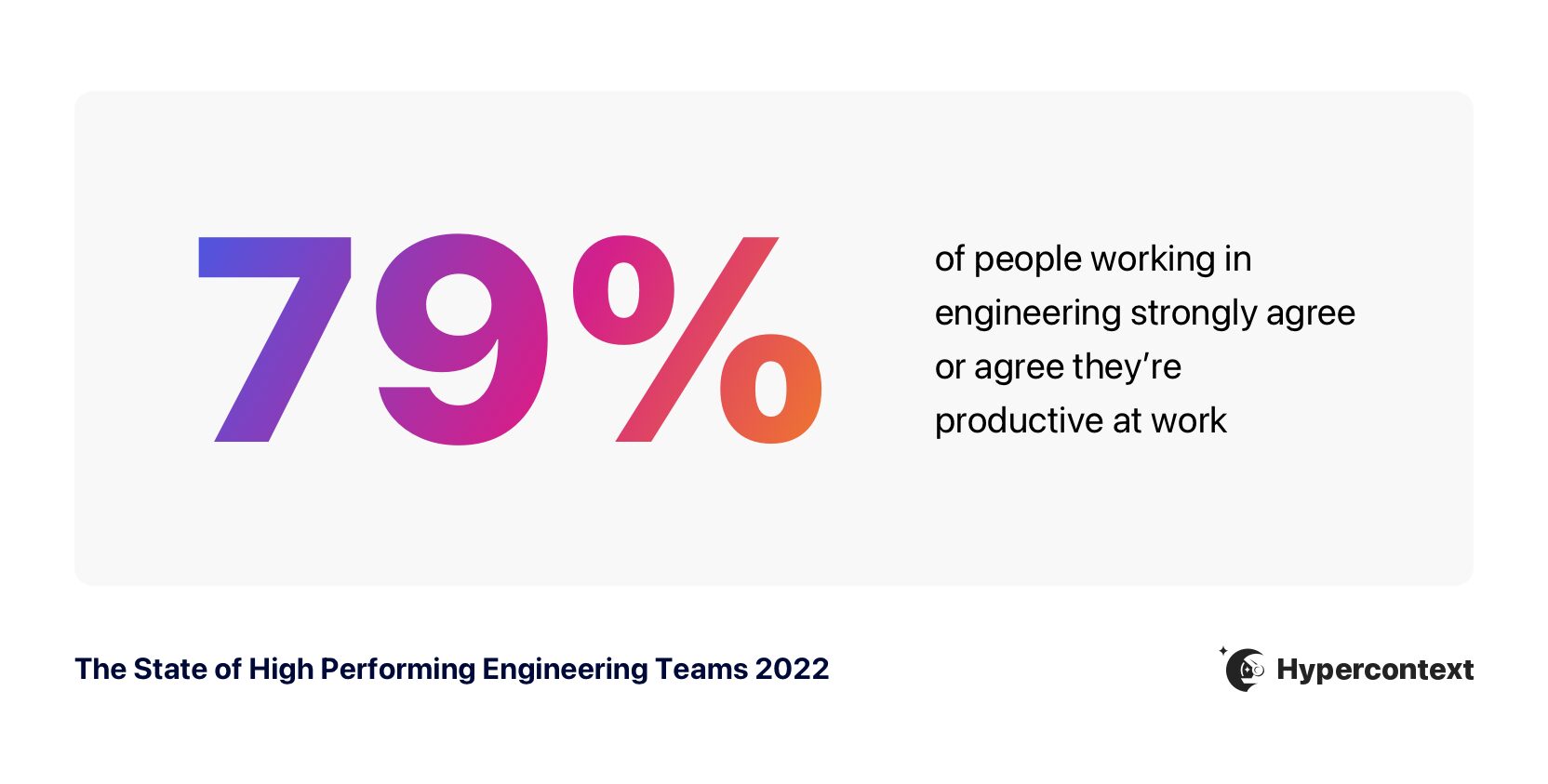
79% of engineers agree or strongly agree they’re productive at work. This is slightly lower than the general workforce and sales teams specifically, where 83% and 84% (respectively) of people agree or strongly agree they’re productive.
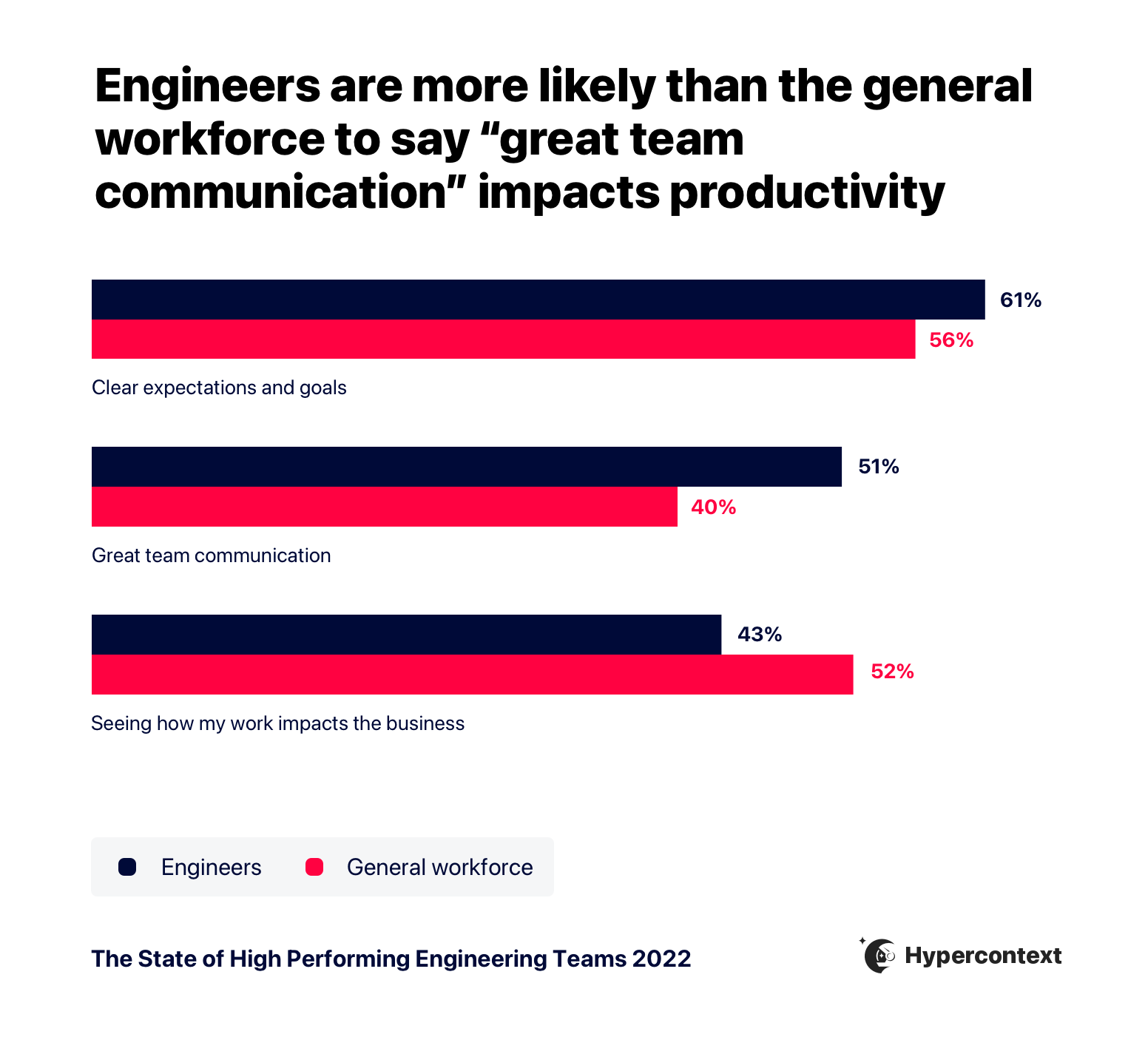
The top three factors leading to productive engineering teams include, “clear expectations and goals”, “great team communication” and “seeing how my work impacts the business.”
Clear expectations and goals
No matter the team, “clear expectations and goals” is always a top factor impacting productivity. When employees understand their goals and what’s expected of them, they can spend the bulk of their energy actually getting the work done, rather than trying to figure out what they should be doing.
Furthermore, engineers who know their team goals are 2X more likely to strongly agree they’re productive at work.
In addition to impacting productivity, this also plays a role in motivation (as seen in the previous section) and retention. Those who don’t have a clear understanding of expectations are nearly 2X more likely to look for another job.
The value of clear expectations and goals can’t be overstated. But, this isn’t to say that they can’t go wrong. Robert Fernandes, Director of Engineering at Netflix, explains:
“What you measure is important. There was a time when number of lines of code written was a measure of success. That wasn’t necessarily the best thing to measure. Or, for example, if you’re measuring how many bug fixes are closed, you need to think, why do you have that many bugs in the first place? Really the goal should be for the number of bugs open to go down[…] These things can be good indicators of success, but when it comes to goals, you need to measure the right things to help focus the work of your team.”
– Robert Fernandes, Director of Engineering, Netflix
Great team communication
Great team communication goes hand in hand with clear goals and expectations. After all, clear expectations are the first step to effectively communicating. And 51% of engineers agree it’s a primary ingredient when it comes to productivity.
It’s interesting to note that great team communication is actually 1.9X more important to engineers than salespeople.
“Salespeoples’ jobs involve talking to clients. However, engineers are usually collaborating with their teams or spending hours by themselves, which to me looks like an amazing incentive to talk to their team. I think a challenge is that we tend to underestimate the difficulty of forming new relationships. We think it’s enough to just introduce people to each other and tell them ‘Hey, now you are a team! Enjoy!'[…] Managers have an incredible opportunity to get developers to communicate more, and to discover more about each other, so they find how they’re connected and progressivly create those real relationships that will positively impact future work.”
– Liere Polo Martin, Engineering Manager, Zenhub
If your team isn’t communicating well, misalignment occurs, and your team is bound to experience an increase in drag.
💡Pro tips for better team communication:
- “Document code and decisions in a permanently searchable place.”- Austin Fry, Staff Engineer/Team Lead, TestBox
- “Make a deliberate effort to share as much relevant information as possible in as many ways as possible. This probably looks like using an internal Wiki, Slack/Teams, email video announcements, sharing notes/recordings of meetings, and having meetings designed specifically for sharing information (all-hands or town halls)”- Fabian Camargo, Leadership and Management Coach
- “Find a balance between asynchronous work and real-time meetings for more complicated problems and decisions”- Chris Fraser, Senior Engineering Manager, Spinach AI
- “Remote teams need to learn how to communicate effectively and inclusively especially in a remote world. For example, to have inclusive brainstorming, give everyone time to come up with their own thoughts individually before going around and having everyone share. No one should judge the ideas during the idea generation phase of the brainstorming. Once all the ideas have been shared, start evaluating the ideas leveraging the “yes and” technique where you take the part of the idea you like and then add something new or novel to the idea.”- Jossie Haines, Executive Coach for Engineering Leaders, Jossie Haines Consulting
- “Eliminate a ‘just read the code’ culture. When you have a large code base, it can be difficult to navigate. A little bit of documentation can go a long way”- Calvin French-Owen, Former Co-founder and CTO, Segment
👉 Skip ahead for more strategies on how to improve communication
Seeing how my work impacts the bigger picture
43% of engineers agree that “seeing how my work impacts the bigger picture” is one of the top three factors impacting productivity, in contrast to 58% of salespeople. So while it’s an important piece of the puzzle, it’s actually less important to engineers than to other teams.
This is also evident in which meetings engineers find valuable, with town halls coming in last place.
This isn’t to say that engineers don’t care about the bigger vision, but rather it’s not where they find the most meaning. Maybe engineers feel more fulfilled by the challenges they’re solving through code, than the challenges the company is trying to solve at large.
“Engineers are stereotypically committed to the minutia. It’s not that they don’t care about the overall vision, but they place more value on the details.”
– Shailesh Kumar, SVP of Engineering, ClickUp
The value of meetings: All meetings are rated below seven, except 1:1s
Team meetings are the most common meetings in engineers’ calendars, followed by one-on-ones and standups.
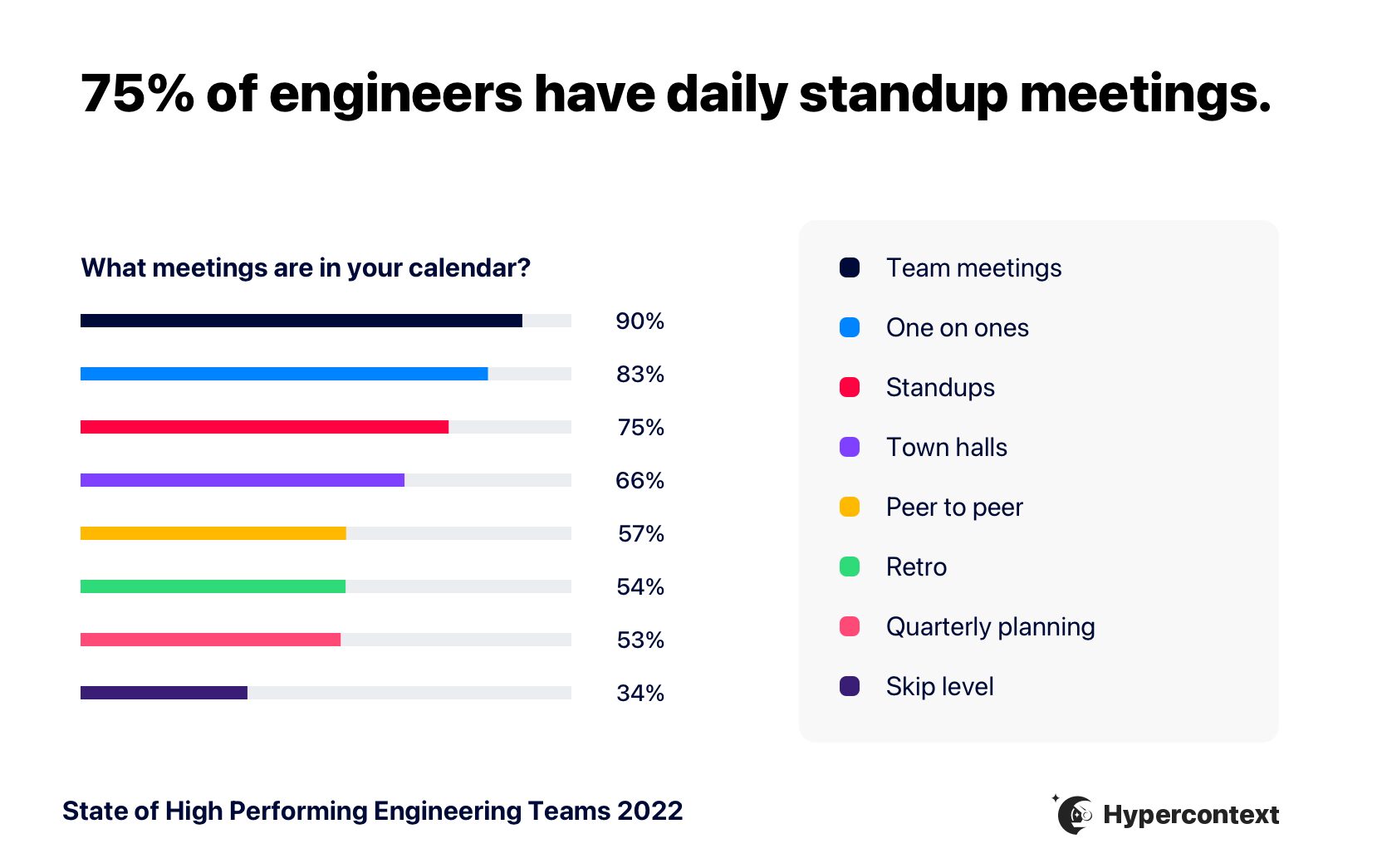
It’s no surprise that 59% more engineers have standups than the workforce at large. But, this doesn’t necessarily mean they’re more useful. In fact, despite standup meetings being a regular occurrence on agile engineering teams, they’re rated as the second least useful meeting, followed by town halls.
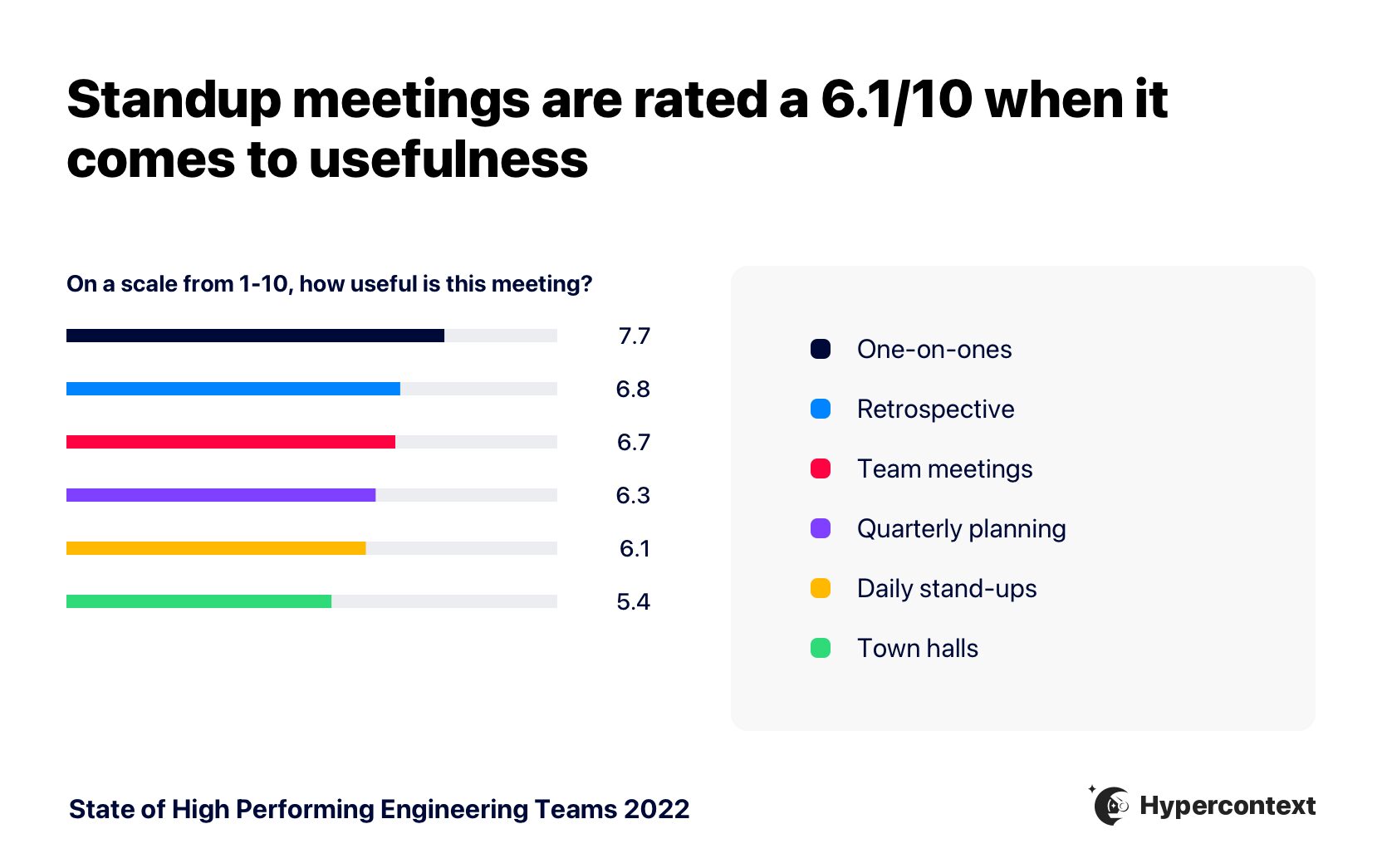
One-on-ones, on the other hand, are the most useful meeting. In fact, when compared to the general workforce, engineers find them slightly more useful on average.
“My approach is to ensure that meetings have the lowest required attendees to be succesful. Often times, engineers are present in meetings where they add little value and rarely, if ever, speak. This leads to unengaged sessions where they are working on other tasks rather than participating in the meeting. Being strategic and ‘auditing’ meeting attendees can very succesfully reduce meeting bloat and free engineers to spend time on actual work.”
– Brian Iversen, Head of Engineering, TestBox
But not all generations of engineers view meetings the same.
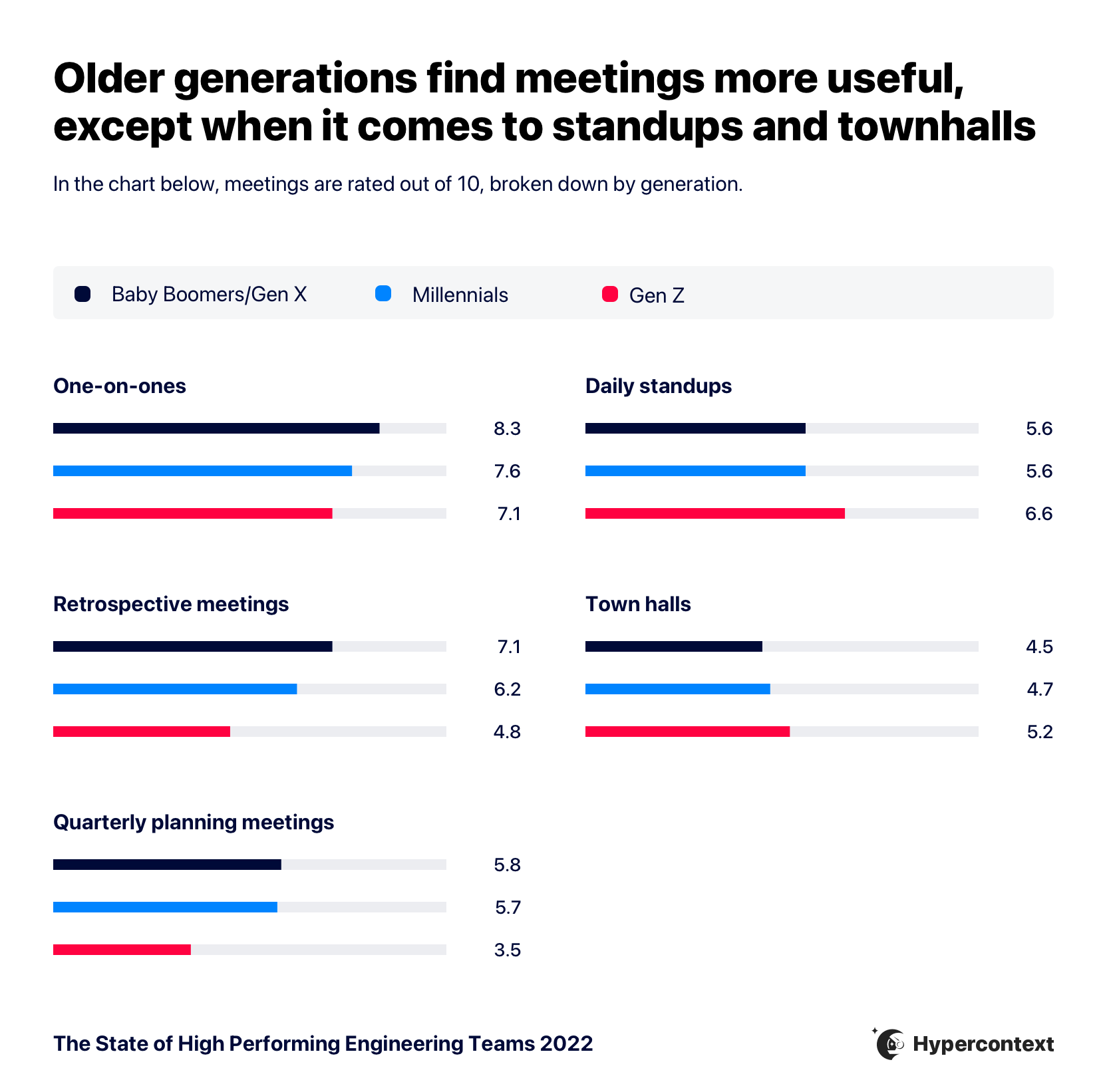
Older engineers find meetings more useful, except when it comes to standups and town halls.
Engineers of Gen Z find standups and town halls to be the most useful, compared to Baby Boomers, Gen X and Millennials.
Could this be due to the shift to remote work?
Most Gen Z tech workers have never worked full-time in an office. With fewer opportunities to communicate naturally in person, standups provide them with the opportunity to connect once a day, when they otherwise wouldn’t. Similarly, when working in an isolated environment, town halls provide more context and the opportunity to come together with the whole company — something that no longer happens in the office.
“We do an all-hands meeting weekly. We’re constantly iterating on the format and always asking for feedback because it’s tough to dial in on exactly what content should be shared. I think that’s one opportunity to bring everyone together on a regular basis.”
– Troy Goode, CEO and Co-Founder, Courier
💡Pro tip: Access agenda templates for town halls, stand-ups and one-on-ones. Or, skip ahead for how to make meetings more effective.
Remote work: Communicating effectively is a top challenge
85% of engineering managers feel confident leading a remote team.
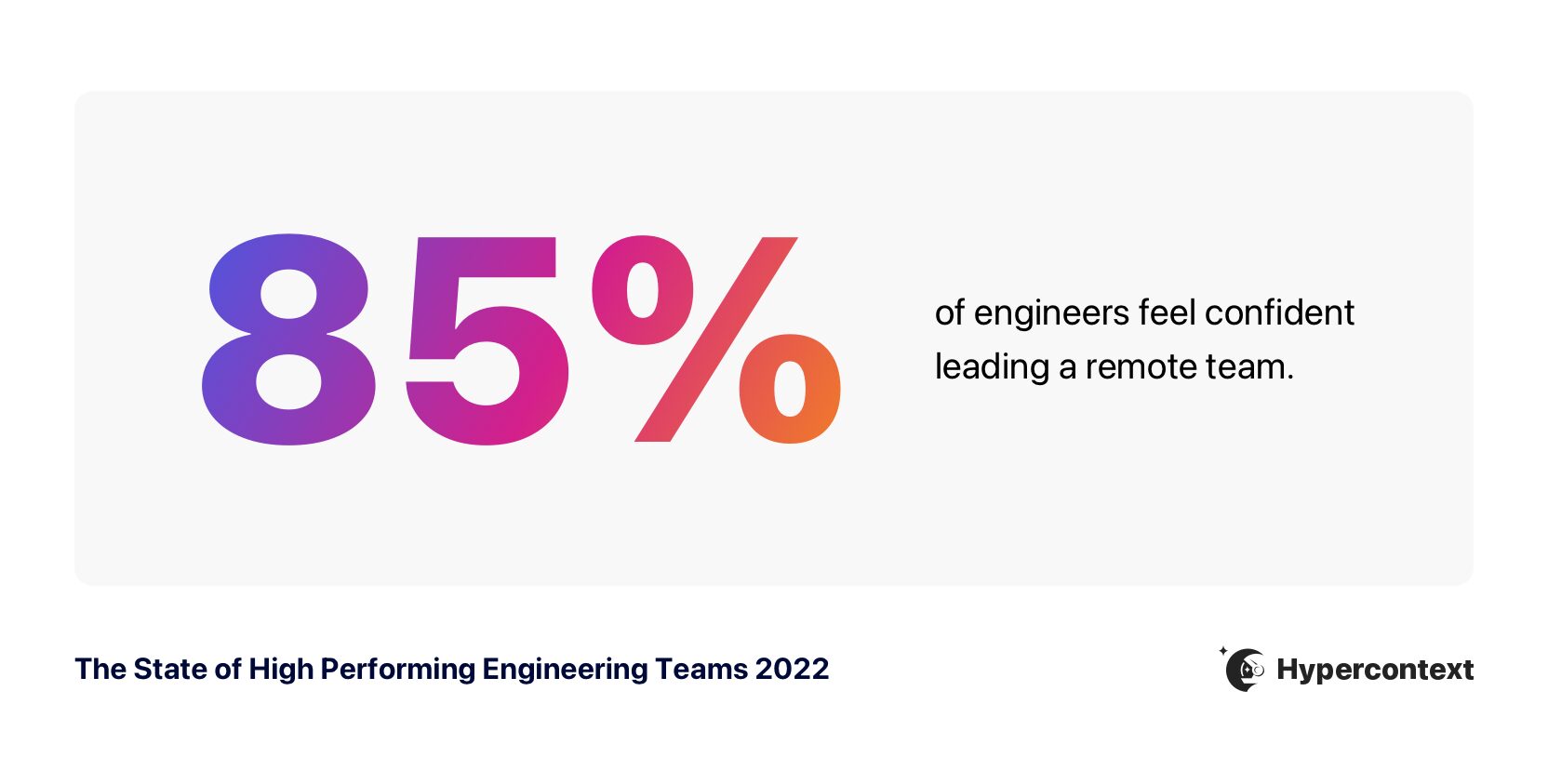
While the majority of engineering managers feel confident leading a remote team, it comes with its own challenges. The top three include: “establishing rapport/connection”, “communicating effectively with the team”, and “building trust.”
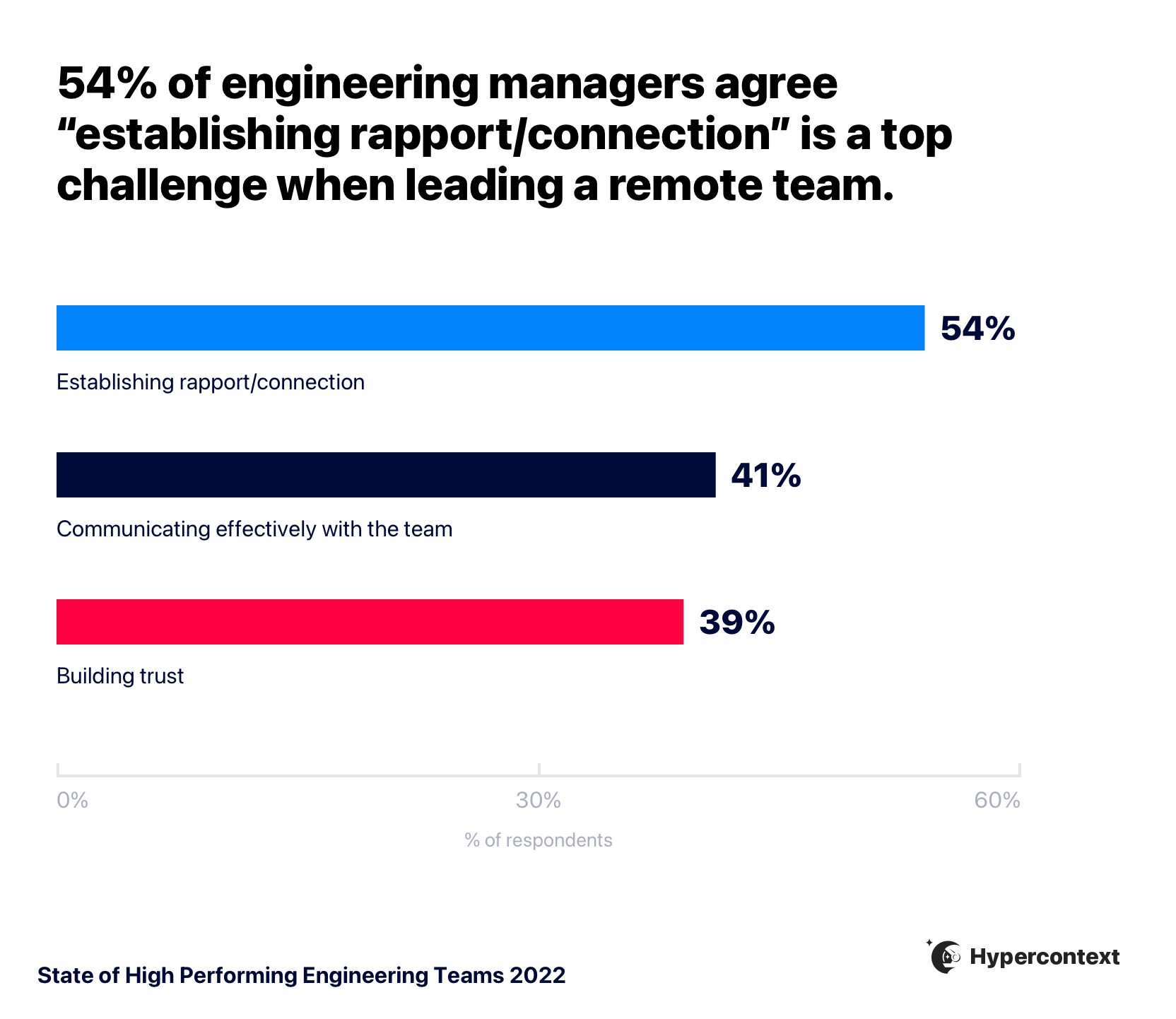
Connection and communication are the top two challenges for remote engineering managers, and are closely followed by building trust.
While they sound similar, connection and communication aren’t synonymous.
Communicating effectively with the team entails the right communication channels (i.e. meetings vs. asynchronous communication), cadence, and clarity. While nearly everyone’s having team meetings, and 75% of engineers are having standups, great communication is still a challenge. Something is missing in how engineering teams are communicating — the effects of which will impact productivity levels.
Rapport, on the other hand, requires dedicated time in team meetings, one-on-ones or otherwise, to get to know one another on a more personal level — something that used to be done more naturally in person.
With a deliberate effort to improve communication and connection, trust should naturally improve also.
“Remote work requires that you shift your management style in a big way[…]When you go remote, most people don’t know what they’re doing. There are fewer overlap points to help people understand how their work fits as part of the whole. What we tried to focus on at Segment was the manager value of creating clarity. We found that managers who performed well were able to articulate what was important and what wasn’t. One way we put this value into action was through a weekly email, sharing everything going on on the team — similar to an investor update, but distributed internally. That was really beneficial for keeping everyone abreast of what was going on.“
– Calvin French-Owen, Former Co-founder and CTO, Segment
💡 Pro tip: Try carving out 5 minutes at the beginning of your meetings for an icebreaker. While it doesn’t sound like a lot, over time these small pockets of more personal conversation will help your team get to know one another. Skip ahead for more strategies to improve connection.
Retention: “I was ready for something new” is the top reason engineers cite for leaving
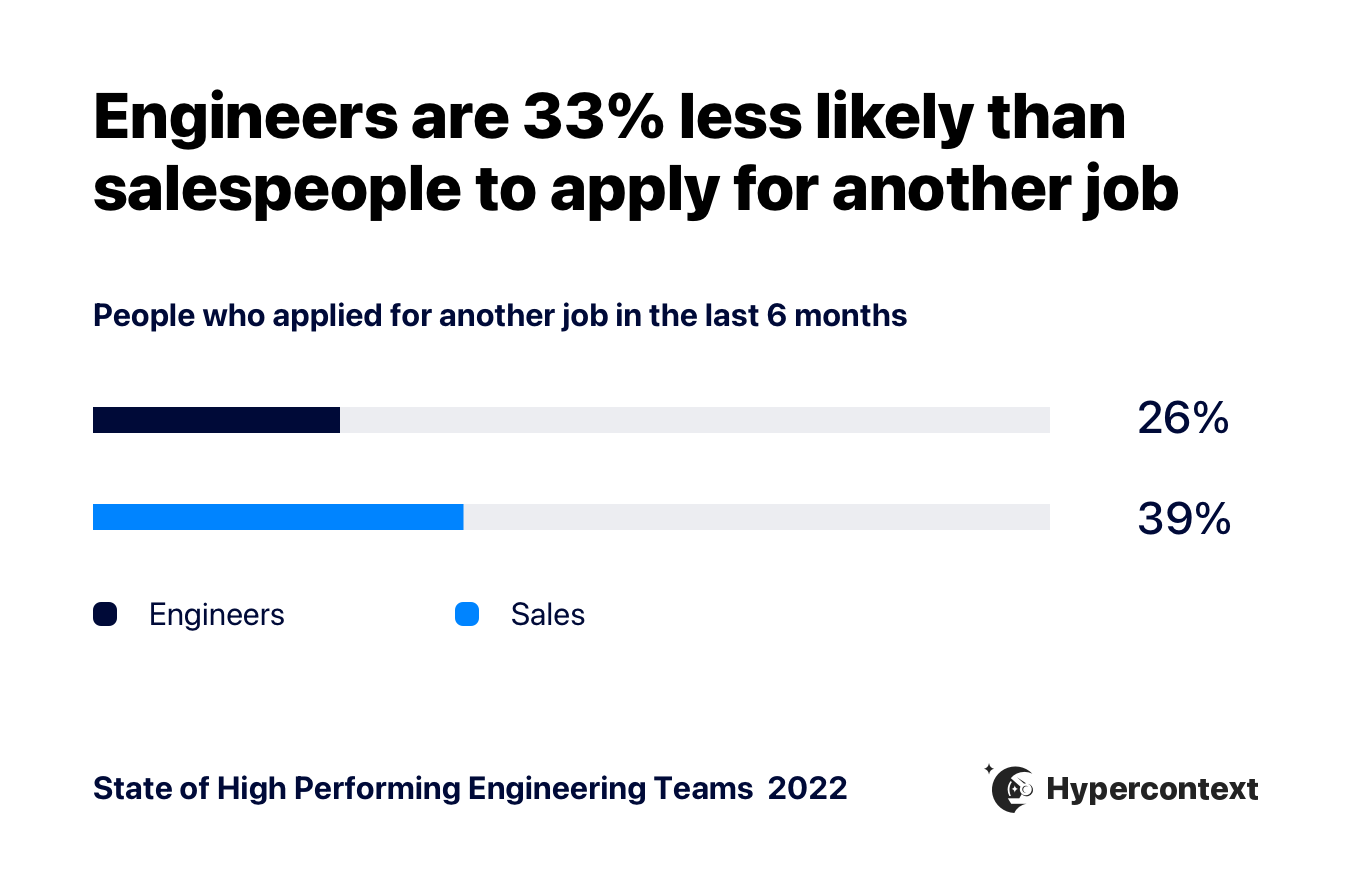
26% of engineers have applied for another job in the last 6 months — that’s 33% less than salespeople.
The top three reasons engineers applied elsewhere include: “I was ready for something new”, “non-competitive salary/benefits”, and “A recruiter reached out to me with a good opportunity.”
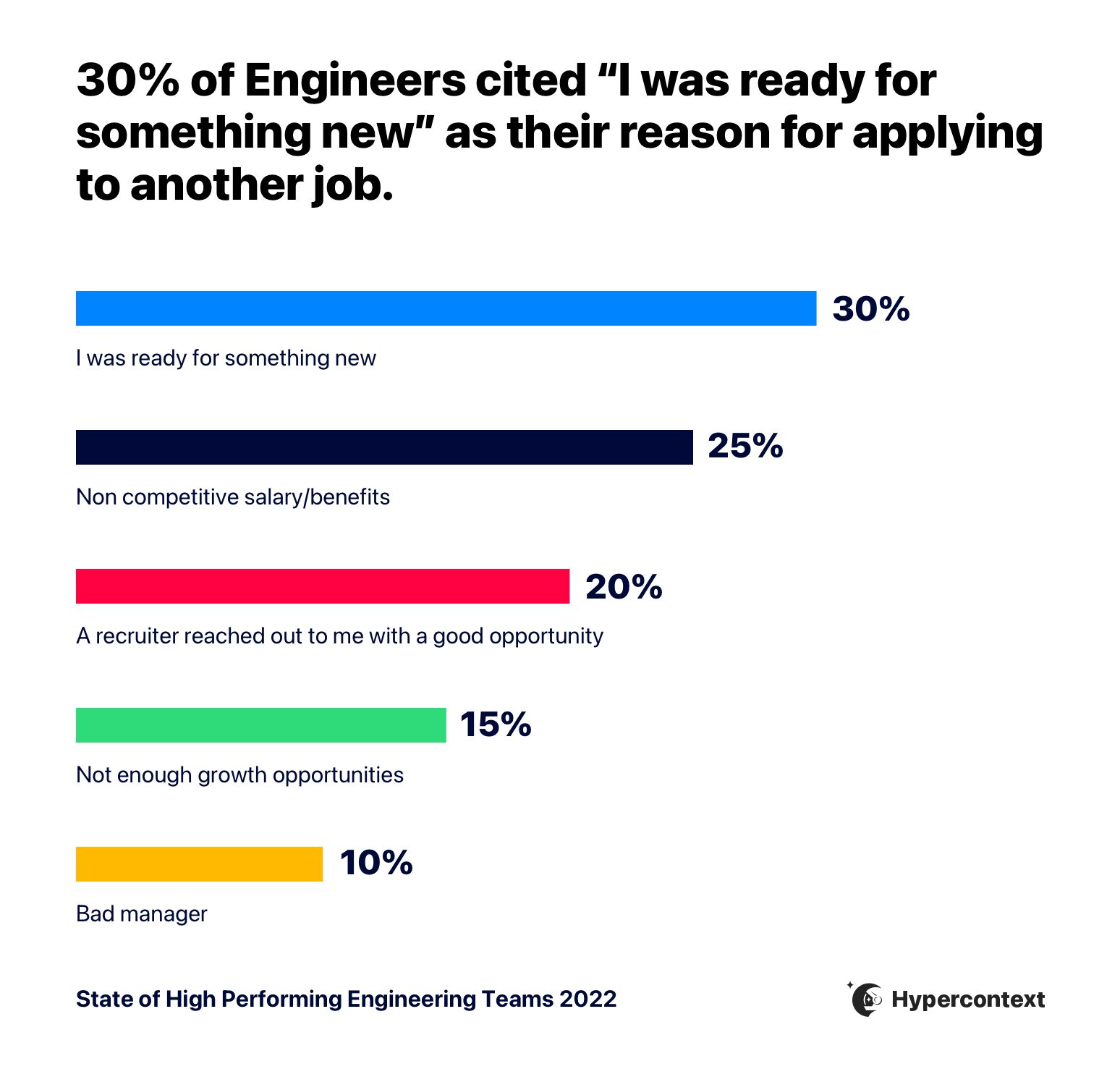
30% of engineers who applied for other jobs cited “I was ready for something new” as the primary reason. They were twice as likely to cite this as not enough growth opportunities, and 3X as likely to cite this as a “bad manager.”
Strategies to motivate and retain your engineering team
Based on this data, here are a number of strategies you can implement to help foster and retain a high-performing engineering team.
Improve communication
While it’s clear communication is important and that engineering teams are communicating with each other, the data calls into question whether teams are communicating effectively. Part of effective communication is communicating consistently and clearly and ensuring expectations are transparent.
To improve communication on your engineering team:
- Make meetings more intentional: Use an agenda to keep meetings short and on track, include only those who need to be there and do a meeting audit each quarter as part of your retro.
- Consider the timing of your meetings: The maker vs. manager schedule is incredibly important for engineering teams in particular. Context switching is damaging to productivity and workflow. If you throw a meeting in the middle of an engineer’s workflow, not only will it slow down their work, but it’ll also cause frustration— likely leading to more resentment for meetings. When booking a meeting, try to leverage natural breaks in the day — like right at the start of the day, or after lunch. If you’re not sure what the best time is for your team, ask.
- Create clear requirements: Creating clear requirements boils down to a few things:
1. Tickets: Create tickets to help communicate what needs to get done each sprint
2. Detailed acceptance criteria: There needs to be a clear pass/fail in acceptance criteria, that’s focused on end results.
3. Write everything down: People forget things if they’re not written down, plain and simple. Even if it feels like a small detail, write it down. It’ll ensure it gets remembered — and remembered the same way by everyone.
Recommended resources for improving communication:
Build connection/rapport
Communication is one thing, connection is another. While many engineering teams in tech follow the agile method, therefore resulting in consistent team touchpoints — this doesn’t mean connection is being built. For remote teams in particular, building connection is a challenge. But connection leads to trust — without which it’s difficult to operate effectively as a team.
To help foster rapport:
- Have weekly one-on-ones: 1:1s are hands down the easiest path to building trust and the most useful meeting in engineers’ calendars — no matter their seniority or age. Given that building trust and connection are two of the main challenges remote engineering leaders face, it’s especially important to be consistent with your 1:1s.
- Create a culture of transparency: Whether through regular town halls, in-person team-building sessions, consistent email updates, or a combination of the above, keeping your engineering team in the loop and being as transparent as possible will help create trust.
“Admit when you don’t know something or need help. Especially when you’re talking to a room of engineers— they’ll call you out and you can break trust really quickly. If you don’t know something, be transparent and admit it. That type of communication goes over way better than trying to blow a bunch of smoke or pretending you have knowledge you don’t have.”
– Robert Fernandes, Director of Engineering, Netflix
- Pair up team members each sprint: This is something we do at Spinach AI, to help build trust and learning. Chris Fraser, Senior Engineering Manager, explains:
“There are a lot of developers who like to work independently. But, a team’s only as good as its slowest person. So to be fast-moving, it’s essential for your team to lean on one another. We pair up team members each sprint to work together on tickets even if they’re not totally the same. That way team members can learn from each other as they solve tickets with similar features.”
– Chris Fraser, Senior Engineering Manager, Spinach AI
Recommended resources for improving connection:
Provide opportunities for challenging work
Everyone is motivated by challenging and fulfilling work. It’s not unique to engineers. But, the strategies implemented based on that information will look different for each team.
To mitigate boredom on your engineering team:
- Rotate teams on different projects: The number one reason engineers start looking for new jobs is because they’re looking for something new. Provide your team with the opportunity to try new projects at your company. This will expose them to new challenges and opportunities to learn.
- Tie everyday work to goals: Set up goals in a spot that’s accessible to all stakeholders and come back to them every week. This will help the team maintain momentum towards challenging aspirations, even when the work itself is starting to feel dull.
“I think it’s easy for work to end up not being fulfilling or challenging. On the fulfillment front, it helps to be able to tie what engineers are building directly to the value that’s being produced for the business. Sometimes that’s really clear. For example, if I’m working on a feature for a big customer. However, if I’m working more on the backend or the infrastructure, it’s not always as obvious. Spend some effort tying that work back to the growth and success of your business and ensuring engineers understand why the specific work they’re doing is valuable.”
– Troy Goode, CEO and Co-founder, Courier
- Ask for feedback in your 1:1: A big part of ensuring your team members are feeling fulfilled and challenged is by asking them directly in your one-on-ones. Try asking questions, like:
- What projects would you like to work on or be more involved in?
- What’s something you’re itching to try that you haven’t had the time or resources to do?
- What has been the work highlight/lowlight from the past week?
Recommended resources for creating challenging work:
Demographics and methodology
The State of High Performing Engineering teams in tech report was created using answers from a sample of 83 people who identified themselves as working as an engineer in the tech industry. Answers were collected between November 9 2021 and November 25, 2021.
Here’s the breakdown of demographics:
Headcount
- 1-10 employees: 6%
- 11-50 employees: 27%
- 51-500 employees: 38%
- 501-1,000 employees: 13%
- 1,001+ employees: 16%
Revenue growth in the last year
- Shrinking: 5%
- Plateaued (about the same): 11%
- Growing 0-1.5X: 35%
- Growing 2X: 23%
- Growing 3X or more: 12%
- I don’t know: 14%
Seniority
- Individual contributors: 51%
- Manager: 26%
- Director: 8%
- VP: 6%
- Executive: 4%
- CEO/Founder: 5%
Gender
- 77% of people identified as a man
- 18% of people identified as a woman
- 4% of people identified as non-binary
- 4% of people said they prefer not to say
Race/ethnicity
- 37% of people identified as a Person of Color
- 57% of people didn’t identify as a {erson of Color
- 6% of people said they’d prefer not to say
Age
- Baby Boomers (1946-1964): 2%
- Gen X (1965-1980): 22%
- Millennials (1981-1996): 66%
- Gen Z (1997-2012): 10%
Want to learn more about leading a high performing engineering team? Let’s stay in touch.
For questions about this report or data please reach out to [email protected]. For more insights on how to run a high-performing team, sign up for our weekly emails 👇
